 SAMPLED
Reference · updated 2026-08-16
THE MUSIC GLOSSARY
177 terms across theory, production, mixing, synthesis, MIDI and formats, rights and royalties, live sound, and gear and instruments. Every entry links out to free primary sources — standards bodies, manufacturers' own documentation, government offices and university course material — so you never have to take our word for it.
177 terms · jump to a section below
Photo: Music Sheet, Mozart's Alla Turca (opens in a new tab) by Schiller12 (opens in a new tab), via Wikimedia Commons — CC BY-SA 4.0 (opens in a new tab)
MUSIC THEORY BASICS
The vocabulary you need before anyone can explain a chart, a chord chart, or a session to you.
- Pitch
- How high or low a note sounds, set by the frequency of the vibration behind it. Concert A above middle C is standardised at 440 Hz.ISO 16:1975 (A440 standard) (opens in a new tab)Open Music Theory — pitch (opens in a new tab)Term page
- Interval
- The distance between two pitches, counted in scale steps (a third, a fifth) or in semitones (4, 7).musictheory.net — intervals (opens in a new tab)Open Music Theory — intervals (opens in a new tab)Term page
- Scale
- An ordered set of pitches inside an octave. Major, natural minor and the modes are the sets most pop, rap and dance music is built from.musictheory.net — scales (opens in a new tab)Open Music Theory — scales and modes (opens in a new tab)Term page
- Key and key signature
- The home pitch a piece gravitates to, plus the sharps or flats written at the start of the staff that spell out its scale.musictheory.net — key signatures (opens in a new tab)Library of Congress — reading music (opens in a new tab)Term page
- Chord and triad
- Three or more pitches sounding together. A triad stacks a root, a third and a fifth; add a seventh and you get the jazz and neo-soul colours.musictheory.net — chords (opens in a new tab)Open Music Theory — triads (opens in a new tab)Term page
- Chord progression
- A sequence of chords over time. Roman numerals (I–V–vi–IV) describe it in a key-neutral way so you can move it to any key.Open Music Theory — roman numerals (opens in a new tab)musictheory.net — lessons (opens in a new tab)Term page
- Tempo and BPM
- The speed of the pulse, counted in beats per minute. 90 BPM is a common rap pocket; 128 BPM is house's home address.musictheory.net — rhythm and tempo (opens in a new tab)Ableton — Learning Music (beats) (opens in a new tab)Term page
- Time signature
- Two stacked numbers telling you how many beats fill a bar and which note value gets the beat. 4/4 dominates popular music; 6/8 and 3/4 swing differently.musictheory.net — time signatures (opens in a new tab)Open Music Theory — meter (opens in a new tab)Term page
- Syncopation
- Accenting the weak parts of the beat instead of the downbeat. Most of what makes a groove feel alive is syncopation.Open Music Theory — rhythm (opens in a new tab)Ableton — Learning Synths & Music (opens in a new tab)Term page
- Harmony vs melody
- Melody is the line you sing; harmony is everything sounding underneath or alongside it that gives that line a context.Open Music Theory (opens in a new tab)Yale Open Courses — Listening to Music (opens in a new tab)Term page
- Transposition
- Moving a whole part up or down by a fixed interval, keeping the relationships between notes intact.musictheory.net — transposition (opens in a new tab)Open Music Theory (opens in a new tab)Term page
- Cents
- A hundredth of a semitone. Tuning software and pitch correction both measure error in cents.NIST — units and measurement (opens in a new tab)AES — technical library (opens in a new tab)Term page
- Octave
- The interval between one pitch and another at double or half its frequency. The two notes share a name because the ear hears them as the same pitch class.Open Music Theory (opens in a new tab)Stanford CCRMA — Music 320 notes (opens in a new tab)Term page
- Semitone and whole tone
- The semitone is the smallest step in Western equal temperament; two semitones make a whole tone. Everything from scales to chord spelling is counted in them.musictheory.net lessons (opens in a new tab)Open Music Theory (opens in a new tab)Term page
- Equal temperament
- The tuning system that splits the octave into twelve equal semitones so every key sounds usable, at the cost of pure intervals.Stanford CCRMA — tuning and intervals (opens in a new tab)Open Music Theory (opens in a new tab)Term page
- Just intonation
- Tuning built from small whole-number frequency ratios. Intervals beat less, but the tuning only works cleanly in a limited set of keys.Stanford CCRMA — tuning systems (opens in a new tab)UC Berkeley CNMAT research (opens in a new tab)Term page
- Overtone series
- Almost every pitched sound contains a fundamental plus quieter harmonics above it. Their relative levels are most of what we call timbre.Stanford CCRMA — spectral audio (opens in a new tab)Xiph.org — digital show and tell (opens in a new tab)Term page
- Timbre
- The character that lets you tell a trumpet from a saw wave at the same pitch and loudness. It comes from harmonic content and how it changes over time.Stanford CCRMA — spectral audio (opens in a new tab)UC Berkeley CNMAT (opens in a new tab)Term page
- Cadence
- A harmonic full stop. Authentic, plagal, half and deceptive cadences are the standard ways a phrase resolves or refuses to.Open Music Theory — cadences (opens in a new tab)musictheory.net lessons (opens in a new tab)Term page
- Voice leading
- How individual lines move between chords. Smooth voice leading keeps common tones and moves the rest by the smallest step available.Open Music Theory (opens in a new tab)musictheory.net lessons (opens in a new tab)Term page
- Inversion
- A chord voiced with something other than the root in the bass. First inversion puts the third at the bottom, second inversion the fifth.musictheory.net lessons (opens in a new tab)Open Music Theory (opens in a new tab)Term page
- Diatonic vs chromatic
- Diatonic material stays inside the seven notes of the key. Chromatic material borrows the other five for colour, tension or modulation.Open Music Theory (opens in a new tab)musictheory.net lessons (opens in a new tab)Term page
- Polyrhythm
- Two conflicting pulse groupings running at once — three against four being the classic. Common in West African, jazz and modern rap production.Open Music Theory — rhythm (opens in a new tab)MIT OpenCourseWare — music (opens in a new tab)Term page
- Swing and shuffle
- Shifting off-beat subdivisions later in the bar so the groove leans rather than sits square. Most DAWs express it as a percentage.Ableton — Learning Music (opens in a new tab)Open Music Theory (opens in a new tab)Term page
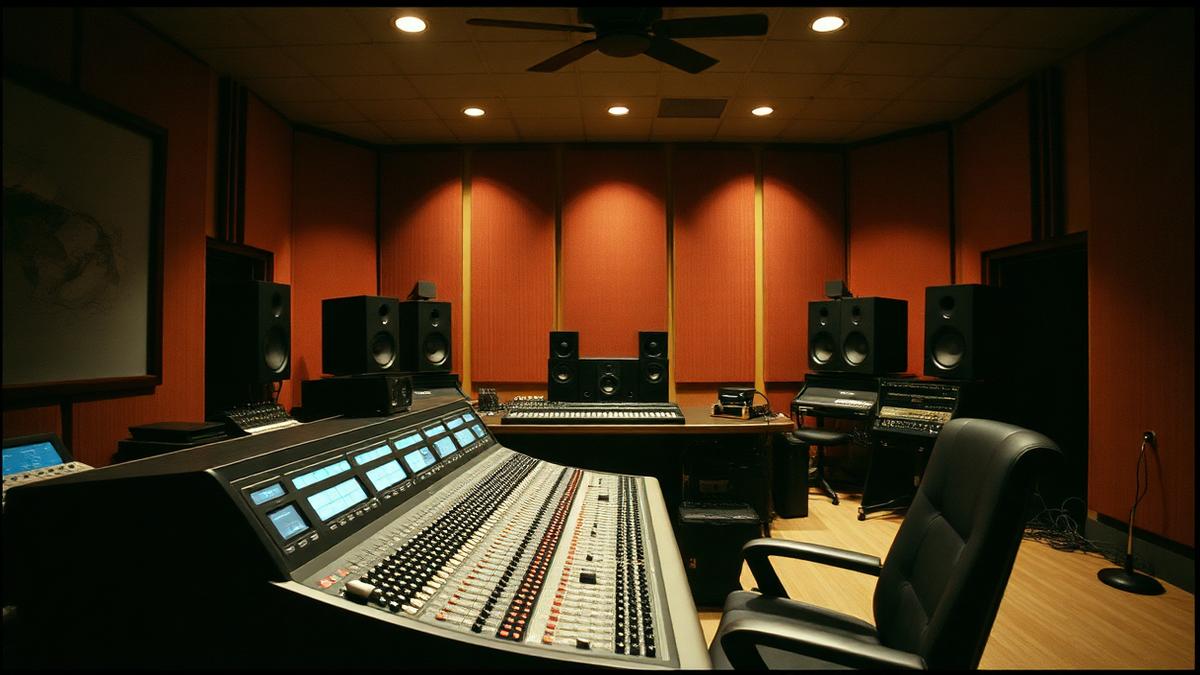
Photo: Gooi & Vecht Studio, Audio 1 control room with Nuendo 6.5 (opens in a new tab) by Marco Raaphorst (opens in a new tab), via Wikimedia Commons — CC BY 2.0 (opens in a new tab)
PRODUCTION AND RECORDING
Studio words: what the gear does, what the engineer is asking for, what the session sheet means.
- DAW
- Digital audio workstation — the software you record, arrange, edit and mix in. Ableton Live, Logic, Pro Tools, FL Studio, Reaper, plus free options.Reaper (free trial, full featured) (opens in a new tab)Audacity (free, open source) (opens in a new tab)Term page
- Sample rate
- How many times per second an analogue signal is measured on the way to digital. 44.1 kHz is CD; 48 kHz is the video and streaming default.AES5 sampling frequency standard (opens in a new tab)Xiph.org — digital audio primer (opens in a new tab)Term page
- Bit depth
- How finely each sample is measured. 24-bit gives you the headroom to record quietly and stay clean; 16-bit is the delivery format for CD.Xiph.org — 24/192 explained (opens in a new tab)AES standards search (opens in a new tab)Term page
- Latency
- The delay between playing something and hearing it back through the computer. Set by buffer size and interface drivers.Focusrite — buffer size and latency (opens in a new tab)Reaper user guide (PDF) (opens in a new tab)Term page
- Gain staging
- Keeping levels sensible at every step so nothing clips and nothing is buried in noise. Roughly -18 dBFS average on the way in is a safe home base.EBU R128 loudness recommendation (opens in a new tab)AES technical library (opens in a new tab)Term page
- Headroom
- The space left between your loudest peak and the point of digital clipping. Leave some for the mastering engineer.EBU Tech 3343 loudness guidance (opens in a new tab)ITU-R BS.1770 measurement (opens in a new tab)Term page
- Polar pattern
- The directions a microphone hears from — cardioid, omni, figure-8. Choosing it is half of getting a clean vocal in an untreated room.Shure — microphone basics (opens in a new tab)Neumann — knowledge base (opens in a new tab)Term page
- Phantom power (48V)
- DC voltage sent down a mic cable to power condenser microphones. Dynamic mics do not need it.Shure — what is phantom power (opens in a new tab)Neumann knowledge hub (opens in a new tab)Term page
- Comping
- Building one keeper take out of the best pieces of several takes.Reaper user guide (PDF) (opens in a new tab)Apple — Logic Pro User Guide (opens in a new tab)Term page
- Bounce / render / export
- Writing your session out to an audio file. Bounce stems for collaborators, a 24-bit WAV master for distribution.Apple — Logic Pro User Guide (opens in a new tab)Ableton Live manual (opens in a new tab)Term page
- Stem
- A submix of one element or group — drums, vocals, keys — printed as its own file for mixing, remixing or live playback.Ableton Live manual — exporting (opens in a new tab)Reaper user guide (PDF) (opens in a new tab)Term page
- Click track
- The metronome everyone plays to so parts recorded separately line up.Ableton — Learning Music (opens in a new tab)Apple — Logic Pro User Guide (opens in a new tab)Term page
- Nyquist frequency
- Half the sample rate — the highest frequency a digital system can represent. Above it, content folds back as aliasing, so converters filter it out.Xiph.org — digital show and tell (opens in a new tab)Stanford CCRMA — mathematics of the DFT (opens in a new tab)Term page
- Buffer size
- How many samples your interface collects before handing them to the CPU. Small buffers mean low latency and more dropouts; big buffers the reverse.Apple — Logic Pro User Guide (opens in a new tab)Steinberg ASIO information (opens in a new tab)Term page
- Punch-in recording
- Dropping into record over a defined range so you replace only the bad bar instead of re-tracking the whole pass.Apple — Logic Pro User Guide (opens in a new tab)Audacity manual (opens in a new tab)Term page
- Quantisation
- Snapping recorded or programmed notes to a rhythmic grid. Partial or 'strength' quantise keeps some of the human timing.Ableton — Learning Music (opens in a new tab)MIDI Association specifications (opens in a new tab)Term page
- Proximity effect
- Directional mics boost low frequencies as the source gets closer. Vocalists use it deliberately; it also makes plosives worse.Shure — microphone basics (opens in a new tab)AES standards (opens in a new tab)Term page
- Pop filter and plosives
- Bursts of air from p and b sounds overload a capsule. A mesh or foam screen a few inches out diffuses the blast without dulling the take.Shure performance library (opens in a new tab)AES technical library (opens in a new tab)Term page
- Room treatment vs soundproofing
- Treatment controls reflections inside a room. Soundproofing stops sound leaving it. Foam does the first, mass and isolation do the second.AES technical library (opens in a new tab)NIOSH — noise control (opens in a new tab)Term page
- Phase and polarity
- Polarity is a flipped waveform; phase is a time offset. Two mics on one source can cancel each other if you ignore either.Stanford CCRMA — physical audio signal processing (opens in a new tab)AES standards (opens in a new tab)Term page
- Sample library vs sampler
- A library is the recorded content; a sampler is the instrument that maps, loops and plays it back across a keyboard.MIDI Association specifications (opens in a new tab)UC Berkeley CNMAT (opens in a new tab)Term page
- Take folder / playlist
- A container holding every pass at a part so you can audition and combine them without cluttering the arrangement.Apple — Logic Pro User Guide (opens in a new tab)Ableton — Learning Music (opens in a new tab)Term page

Photo: Solid State Logic (SSL) Matrix Mixing Console at Audio Mix House, Studio C (opens in a new tab) by Audio Mix House (opens in a new tab), via Wikimedia Commons — CC BY 2.0 (opens in a new tab)
MIXING AND MASTERING
The processing vocabulary, plus the loudness standards streaming services actually measure you against.
- EQ (equalisation)
- Turning specific frequency ranges up or down. Subtractive cuts clear space; boosts add character.Xiph.org — digital show and tell (opens in a new tab)AES technical library (opens in a new tab)Term page
- Compression
- Automatic level control: above a threshold, gain is reduced by a ratio, shaped by attack and release times.Universal Audio — compression basics (opens in a new tab)AES technical library (opens in a new tab)Term page
- Sidechain
- Using one signal to control processing on another — most famously ducking a bass or pad every time the kick hits.Ableton Live manual — compressor (opens in a new tab)Apple — Logic Pro User Guide (opens in a new tab)Term page
- Reverb
- Simulated space. Pre-delay places the source in the room, decay time sets how big the room is.AES technical library (opens in a new tab)Valhalla DSP — reverb writing (opens in a new tab)Term page
- Delay
- Repeats of the signal, usually timed to the tempo. Slapback, ping-pong and dub delays are the common flavours.Ableton Live manual (opens in a new tab)Valhalla DSP blog (opens in a new tab)Term page
- Saturation and distortion
- Adding harmonics by pushing a circuit or algorithm past clean. Small amounts read as loudness and warmth.Universal Audio — analogue tone (opens in a new tab)AES technical library (opens in a new tab)Term page
- LUFS
- Loudness Units relative to Full Scale — the perceptual loudness measure streaming platforms normalise with, defined in ITU-R BS.1770.ITU-R BS.1770 (opens in a new tab)Spotify — loudness normalisation (opens in a new tab)Term page
- True peak
- The real analogue peak an inter-sample reconstruction can hit — often higher than your meter's sample peak. Leave around -1 dBTP for lossy encoding.ITU-R BS.1770 (true-peak metering) (opens in a new tab)Apple Digital Masters (opens in a new tab)Term page
- Dynamic range
- The distance between the quietest and loudest moments. Crushing it flat is why some masters feel exhausting.EBU R128 (opens in a new tab)AES technical library (opens in a new tab)Term page
- Limiter
- A compressor with an extreme ratio and a brick-wall ceiling, used at the end of a master to control peaks.Apple Digital Masters guidelines (opens in a new tab)Ableton Live manual (opens in a new tab)Term page
- Mid/side
- Splitting a stereo signal into what's shared (mid) and what differs (side) so you can process centre and width separately.AES technical library (opens in a new tab)Neumann knowledge hub (opens in a new tab)Term page
- Dither
- Low-level noise added when reducing bit depth so quantisation error becomes hiss instead of distortion.Xiph.org — digital audio primer (opens in a new tab)AES standards (opens in a new tab)Term page
- Panning and stereo image
- Where a source sits between the speakers, and how wide the whole mix reads. Mono compatibility is still the test that catches mistakes.EBU — audio publications (opens in a new tab)AES standards (opens in a new tab)Term page
- Bus and aux send
- A bus collects several tracks for shared processing. An aux send feeds a copy of a signal to an effect so the dry track stays intact.Apple — Logic Pro User Guide (opens in a new tab)Ableton — Learning Music (opens in a new tab)Term page
- Parallel compression
- Blending a heavily compressed copy under the untouched signal. You get density without flattening the transients.AES technical library (opens in a new tab)Stanford CCRMA — audio effects (opens in a new tab)Term page
- Transient
- The short, loud attack at the front of a sound. Compressor attack times and transient designers exist to shape exactly this part.Stanford CCRMA — spectral audio (opens in a new tab)AES standards (opens in a new tab)Term page
- Q and filter slope
- Q sets how narrow an EQ band is; slope (dB per octave) sets how hard a high- or low-pass cuts past its corner frequency.Stanford CCRMA — introduction to digital filters (opens in a new tab)AES standards (opens in a new tab)Term page
- High-pass filter
- Removes low frequencies below a set point. The fastest way to clear rumble, handling noise and mud out of a crowded mix.Stanford CCRMA — digital filters (opens in a new tab)EBU technical publications (opens in a new tab)Term page
- Automation
- Recorded changes to any parameter over time. Volume rides do more for a vocal than most plugins.Apple — Logic Pro User Guide (opens in a new tab)Ableton — Learning Music (opens in a new tab)Term page
- Reference track
- A commercially released song you A/B against, level-matched, to check tonal balance and loudness decisions against something known.EBU R 128 loudness (opens in a new tab)ITU-R BS.1770 (opens in a new tab)Term page
- Intersample peak
- A peak that appears between samples after conversion back to analogue. It is why true-peak metering exists and why -1 dBTP ceilings are common.ITU-R BS.1770 (opens in a new tab)EBU — loudness (opens in a new tab)Term page
- Mastering
- The final stage: tonal balance, loudness, sequencing, spacing and delivery formats for a whole release rather than one track.EBU R 128 (opens in a new tab)AES standards (opens in a new tab)Term page
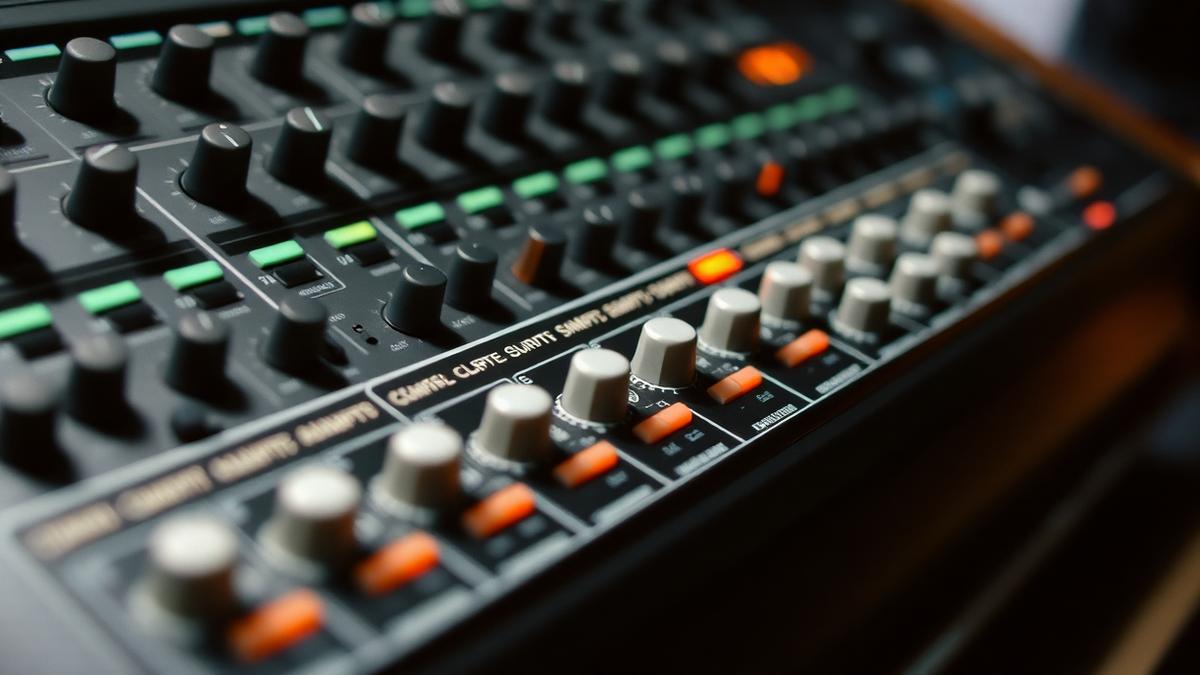
Photo: Eurorack Modular Synthesizer Closeup (opens in a new tab) by Nir Yaniv (opens in a new tab), via Wikimedia Commons — CC BY-SA 4.0 (opens in a new tab)
SYNTHESIS AND SOUND DESIGN
How synths make sound, in the order the signal actually travels.
- Oscillator (VCO/DCO)
- The sound source. It generates a repeating waveform — saw, square, triangle, sine — at a chosen pitch.Ableton — Learning Synths (opens in a new tab)Moog — synth basics (opens in a new tab)Term page
- Filter (VCF)
- Removes or emphasises frequencies. Low-pass filters are the classic; resonance boosts the band right at the cutoff.Ableton — Learning Synths (opens in a new tab)Korg — product manuals (opens in a new tab)Term page
- Envelope (ADSR)
- Attack, decay, sustain, release — how a parameter moves over the life of a note. Applied to volume, filter, pitch, anything.Ableton — Learning Synths (envelopes) (opens in a new tab)Sequential — product manuals (opens in a new tab)Term page
- LFO
- Low-frequency oscillator: a slow wave used as modulation rather than sound. Vibrato, tremolo and wobble bass all start here.Ableton — Learning Synths (opens in a new tab)Korg manuals (opens in a new tab)Term page
- Subtractive synthesis
- Start with a harmonically rich waveform and filter material away. The architecture behind most classic analogue synths.Ableton — Learning Synths (opens in a new tab)Moog Music (opens in a new tab)Term page
- FM synthesis
- One oscillator modulates another's frequency, generating sidebands. Bells, electric pianos and aggressive digital basses.Yamaha — synth history and FM (opens in a new tab)Stanford CCRMA — FM synthesis (opens in a new tab)Term page
- Wavetable synthesis
- Scanning through a table of single-cycle waveforms so the timbre morphs over time.Stanford CCRMA research (opens in a new tab)Ableton Live manual — Wavetable (opens in a new tab)Term page
- Granular synthesis
- Chopping audio into tiny grains and replaying them at varying rate, pitch and density to make clouds and textures.Stanford CCRMA — granular (opens in a new tab)Ableton Live manual (opens in a new tab)Term page
- Polyphony / paraphony / monophony
- How many notes a synth can play at once, and whether each note gets its own full voice path or shares a filter.Sequential support and manuals (opens in a new tab)Korg manuals (opens in a new tab)Term page
- Modulation matrix
- A routing grid that connects sources (LFOs, envelopes, velocity) to destinations (cutoff, pitch, pan) with an amount for each.Sequential manuals (opens in a new tab)Arturia — manuals and resources (opens in a new tab)Term page
- CV/Gate
- Control voltage sets pitch or parameter value; gate says note-on/note-off. The pre-MIDI way modular gear still talks.MIDI Association — MIDI and CV (opens in a new tab)Moog Music (opens in a new tab)Term page
- Aliasing
- Digital artefacts created when harmonics go above half the sample rate and fold back down as inharmonic junk.Xiph.org — digital audio primer (opens in a new tab)Stanford CCRMA — DSP texts (opens in a new tab)Term page
- Additive synthesis
- Building a sound by stacking sine waves at chosen frequencies and levels — the inverse of subtractive, and the basis of spectral resynthesis.Stanford CCRMA — spectral audio signal processing (opens in a new tab)UC Berkeley CNMAT (opens in a new tab)Term page
- Physical modelling
- Synthesis by simulating the physics of a string, tube or membrane instead of replaying a recording of one.Stanford CCRMA — physical audio signal processing (opens in a new tab)UC Berkeley CNMAT research (opens in a new tab)Term page
- Ring modulation
- Multiplying two signals so you hear only their sum and difference frequencies. Instantly metallic, clangorous and inharmonic.Stanford CCRMA — audio DSP texts (opens in a new tab)UC Berkeley CNMAT (opens in a new tab)Term page
- Pulse width modulation
- Sweeping the duty cycle of a square wave. The harmonic content shifts as it moves, which is why one oscillator can sound like two.Stanford CCRMA — DSP texts (opens in a new tab)Open Music Theory (opens in a new tab)Term page
- Portamento / glide
- A continuous slide in pitch between two notes rather than a jump. Time-based on most synths, and the core of a 303 line.MIDI Association specifications (opens in a new tab)Stanford CCRMA (opens in a new tab)Term page
- Unison and detune
- Stacking several voices on one note and detuning them slightly. Beating between the copies produces the wide supersaw sound.Stanford CCRMA — spectral audio (opens in a new tab)UC Berkeley CNMAT (opens in a new tab)Term page
- Velocity sensitivity
- How hard a key is struck, sent as a MIDI value and usually mapped to level and filter brightness so playing dynamics survive.MIDI Association specifications (opens in a new tab)MIDI 2.0 overview (opens in a new tab)Term page
- Arpeggiator
- A sequencer that plays a held chord one note at a time in a pattern, locked to tempo. Rate, order and octave range are the usual controls.Ableton — Learning Music (opens in a new tab)MIDI Association (opens in a new tab)Term page
- Sequencer
- A pattern recorder that fires notes or CV at set steps. Step sequencers stay central to techno, acid and modular practice.MIDI Association specifications (opens in a new tab)UC Berkeley CNMAT (opens in a new tab)Term page
- Oversampling
- Running a process at a multiple of the project sample rate so distortion products land above the audible band before being filtered out.Xiph.org — digital audio primer (opens in a new tab)Stanford CCRMA — DSP (opens in a new tab)Term page
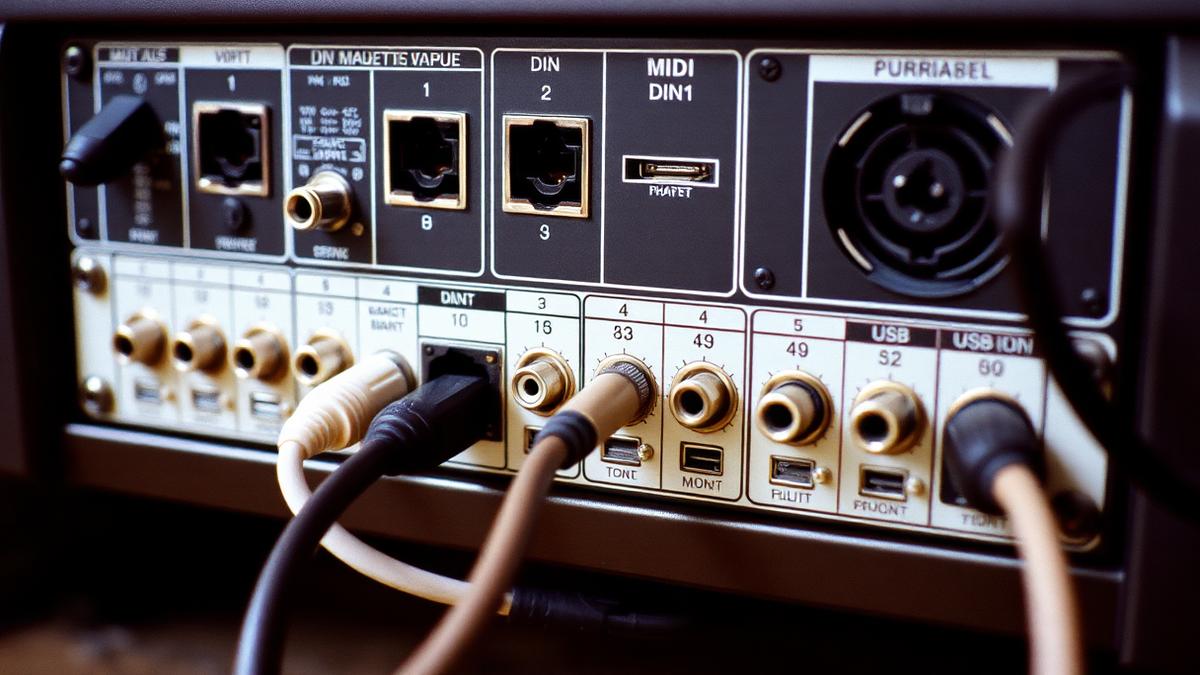
Photo: RME Hammerfall DSP 9652 MIDI connectors (opens in a new tab) by Dan Lynch (opens in a new tab), via Wikimedia Commons — CC BY-SA 2.0 (opens in a new tab)
MIDI, FORMATS AND STANDARDS
The plumbing — the specs your gear, files and delivery pipeline agree on.
- MIDI
- A control protocol, not audio. It sends note, velocity, timing and controller data between instruments and software.MIDI Association — specifications (opens in a new tab)MIDI Association — MIDI 2.0 (opens in a new tab)Term page
- MIDI 2.0
- The 2020-era update: bidirectional, higher resolution, per-note controllers and profile-based auto-configuration.MIDI Association — MIDI 2.0 overview (opens in a new tab)MIDI Association specs (opens in a new tab)Term page
- MPE
- MIDI Polyphonic Expression — each note gets its own channel so pitch bend, pressure and slide are per-note.MIDI Association — MPE spec (opens in a new tab)MIDI Association specifications (opens in a new tab)Term page
- WAV vs FLAC vs MP3/AAC
- WAV is uncompressed PCM; FLAC is lossless compression; MP3 and AAC are lossy. Deliver lossless masters and let platforms encode.Xiph.org — FLAC (opens in a new tab)Library of Congress — sustainable audio formats (opens in a new tab)Term page
- Plugin formats (VST/AU/AAX/CLAP)
- The interfaces that let third-party processors run inside a DAW. Which ones you can use depends on host and platform.CLAP — open plugin standard (opens in a new tab)Steinberg — VST developer info (opens in a new tab)Term page
- ASIO / Core Audio
- Low-latency audio driver systems on Windows and macOS respectively. They decide how fast your interface can talk to the DAW.Apple — Core Audio (opens in a new tab)Steinberg developer resources (opens in a new tab)Term page
- Sync: MIDI clock, MTC, Ableton Link
- Different ways to keep devices in time — clock pulses, timecode, or peer-to-peer tempo sharing over a network.MIDI Association specifications (opens in a new tab)Ableton Link (opens in a new tab)Term page
- Metadata (ISRC, UPC, ISWC)
- The identifiers that route money and credits: recordings get ISRCs, releases get UPCs, compositions get ISWCs.IFPI — ISRC handbook (opens in a new tab)CISAC — ISWC (opens in a new tab)Term page
- DDEX
- The messaging standards distributors, labels and DSPs use to exchange release and royalty data.DDEX standards (opens in a new tab)DDEX knowledge base (opens in a new tab)Term page
- C2PA / content credentials
- An open provenance standard for signing how a piece of media was made — increasingly relevant to AI disclosure.C2PA specifications (opens in a new tab)Content Authenticity Initiative (opens in a new tab)Term page
- Sample-accurate automation
- Parameter changes calculated per audio sample rather than per processing block, so sweeps stay smooth and click-free.Steinberg developer docs (opens in a new tab)CLAP standard (opens in a new tab)Term page
- Loudness normalisation
- Platforms play everything back at a target loudness, so a louder master mostly just gets turned down.Spotify — loudness normalisation (opens in a new tab)Apple Digital Masters (opens in a new tab)Term page
- Buffer underrun / dropout
- The CPU misses its deadline and the audio device plays empty samples, heard as a click or gap. Larger buffers and fewer live plugins fix it.Apple — Logic Pro User Guide (opens in a new tab)Steinberg developer resources (opens in a new tab)Term page
- Sample rate conversion
- Resampling audio between rates. Quality varies a lot between algorithms, so convert once, at the end, with a good one.Xiph.org — digital show and tell (opens in a new tab)AES standards (opens in a new tab)Term page
- Lossy vs lossless
- Lossless coding reconstructs the original samples exactly; lossy coding discards detail the model predicts you will not hear, and cannot be undone.Xiph.org — FLAC (opens in a new tab)Xiph.org — Opus codec (opens in a new tab)Term page
- Opus
- An open, royalty-free codec standardised as RFC 6716. It is what most real-time voice and streaming stacks use today.Opus codec (opens in a new tab)RFC 6716 (opens in a new tab)Term page
- Broadcast WAV (BWF)
- A WAV file with an embedded metadata chunk carrying timecode, originator and coding history. The standard delivery format for post.EBU Tech 3285 (BWF) (opens in a new tab)AES standards (opens in a new tab)Term page
- Timecode (SMPTE/LTC)
- A frame-accurate clock stamped onto audio or video so separately recorded media can be aligned later.EBU technical publications (opens in a new tab)MIDI Association specifications (opens in a new tab)Term page
- Dante and AES67
- Networked audio over standard Ethernet. AES67 is the interoperability standard that lets different vendors' systems exchange streams.AES67 standard (opens in a new tab)AES technical library (opens in a new tab)Term page
- Sample-rate clock and jitter
- Digital devices need one master clock. Timing error in that clock — jitter — smears conversion, which is why one device is set as master.AES standards (opens in a new tab)Stanford CCRMA — DSP (opens in a new tab)Term page
- Open-source audio tooling
- Audacity, Ardour, Surge XT and the Xiph codecs are all free to use and inspect, which makes them dependable teaching references.Ardour manual (opens in a new tab)Audacity manual (opens in a new tab)Term page

Photo: Katherine Jenkins signing her publishing deal at Rive Droite Music (opens in a new tab) by Danott (opens in a new tab), via Wikimedia Commons — CC BY-SA 3.0 (opens in a new tab)
RIGHTS, ROYALTIES AND THE BUSINESS
The words on your split sheet, your distribution dashboard and your royalty statement.
- Copyright
- Two separate rights in every track: the composition (song) and the sound recording (master). They can be owned by different people.U.S. Copyright Office — Circular 56A (opens in a new tab)WIPO — copyright basics (opens in a new tab)Term page
- Master vs publishing
- Master income comes from the recording (streams, syncs, sales). Publishing income comes from the underlying song.U.S. Copyright Office — music modernization (opens in a new tab)WIPO — creative industries (opens in a new tab)Term page
- PRO
- Performing rights organisation. In the US: ASCAP, BMI, SESAC, GMR. They license public performance and pay songwriters.ASCAP (opens in a new tab)BMI (opens in a new tab)Term page
- Mechanical royalty
- Paid to songwriters and publishers for reproductions, including interactive streams. In the US, the MLC administers the blanket licence.The MLC (opens in a new tab)U.S. Copyright Royalty Board (opens in a new tab)Term page
- Neighbouring rights
- Performer and label rights in the recording itself. In the US, SoundExchange collects for non-interactive digital radio.SoundExchange (opens in a new tab)WIPO — Rome Convention (opens in a new tab)Term page
- Sync licence
- Permission to pair music with visuals. You typically need clearance from both the master owner and the publisher.U.S. Copyright Office — licensing (opens in a new tab)ASCAP — licensing (opens in a new tab)Term page
- Sample clearance
- Getting written permission to use part of an existing recording and composition. Two clearances, two negotiations.U.S. Copyright Office — Circular 1 (opens in a new tab)Copyright.gov — fair use index (opens in a new tab)Term page
- Split sheet
- A signed document recording who wrote what percentage of a song, made in the room before anyone leaves.The MLC — songwriter resources (opens in a new tab)U.S. Copyright Office — registration (opens in a new tab)Term page
- Work for hire
- An arrangement where the commissioning party is treated as the author. Narrowly defined in US law — read before signing.U.S. Copyright Office — Circular 30 (opens in a new tab)Copyright.gov — law text (opens in a new tab)Term page
- Distributor vs label
- A distributor puts your files on DSPs and collects. A label typically invests, markets and takes a share of rights or income.IFPI — global industry data (opens in a new tab)RIAA — resources (opens in a new tab)Term page
- Advance and recoupment
- Money paid up front against future royalties. You don't see further income until the advance is earned back.IFPI resources (opens in a new tab)U.S. Copyright Office (opens in a new tab)Term page
- Termination rights
- Under US law, authors can reclaim certain transferred rights after a set period by filing notice in a specific window.U.S. Copyright Office — Circular 12 (opens in a new tab)Title 17 §203 (opens in a new tab)Term page
- Public domain
- Work whose copyright term has expired or never applied. In the U.S. this is a moving line, so check the term rules before you sample.U.S. Copyright Office — Circular 15a (opens in a new tab)WIPO — copyright (opens in a new tab)Term page
- Fair use
- A U.S. defence weighed on four factors, decided case by case. It is not a checkbox, and it is not a substitute for clearance.U.S. Copyright Office — fair use index (opens in a new tab)Title 17 §107 (opens in a new tab)Term page
- Registration vs copyright
- Copyright exists the moment a work is fixed. Registration is what gives you statutory damages and the right to sue in the U.S.U.S. Copyright Office — Circular 1 (opens in a new tab)Registering music (opens in a new tab)Term page
- Performance royalty vs mechanical
- Performance royalties pay for a work being played publicly; mechanicals pay for it being reproduced or streamed. Different collectors, different money.The MLC (opens in a new tab)SoundExchange (opens in a new tab)Term page
- Digital performance royalty
- Non-interactive digital plays of a sound recording in the U.S. are collected by SoundExchange and split with the featured artist directly.SoundExchange (opens in a new tab)U.S. Copyright Office — §114 (opens in a new tab)Term page
- Blanket licence
- One licence covering a whole repertoire rather than a song at a time. It is how radio, venues and streaming services clear performances at scale.U.S. Copyright Office — music licensing (opens in a new tab)WIPO — collective management (opens in a new tab)Term page
- Music Modernization Act
- The 2018 U.S. law that created the blanket mechanical licence and the MLC to administer streaming mechanicals and unmatched royalties.U.S. Copyright Office — MMA (opens in a new tab)The MLC (opens in a new tab)Term page
- Controlled composition clause
- A record deal term capping the mechanicals payable when the artist also wrote the song. It quietly reduces songwriter income.U.S. Copyright Office — Circular 73 (opens in a new tab)The MLC (opens in a new tab)Term page
- Moral rights
- Rights of attribution and integrity, strong in many countries and narrow in the U.S. They can survive a transfer of the economic rights.WIPO — copyright (opens in a new tab)Berne Convention text (opens in a new tab)Term page
- Neighbouring rights vs master royalties
- Neighbouring rights pay performers and labels for broadcast and public performance of a recording; master royalties come from sales and streams.WIPO — related rights (opens in a new tab)SoundExchange (opens in a new tab)Term page
- Disclosure of paid endorsement
- If a post about gear is paid, gifted or affiliate-linked, U.S. rules require the connection to be disclosed clearly and near the claim.FTC endorsement guides (opens in a new tab)FTC — disclosures (opens in a new tab)Term page

Photo: McFly Power to Play Tour, Bridlington Spa front-of-house pre-show (opens in a new tab) by Hullian111 (opens in a new tab), via Wikimedia Commons — CC BY-SA 4.0 (opens in a new tab)
LIVE SOUND AND PERFORMANCE
The stage vocabulary: what the engineer means when they wave at you.
- FOH
- Front of house — the main mix the audience hears, and the desk it's mixed from.Shure — live sound resources (opens in a new tab)Yamaha — live sound guides (opens in a new tab)Term page
- Monitor mix / IEMs
- What the performer hears — wedges on stage or in-ear monitors, mixed separately from FOH.Shure — in-ear monitors 101 (opens in a new tab)Yamaha Pro Audio (opens in a new tab)Term page
- Feedback
- The howl when a mic hears its own amplified output. Fixed with placement, pattern choice and narrow EQ cuts.Shure — feedback control (opens in a new tab)AES technical library (opens in a new tab)Term page
- DI box
- Converts an unbalanced instrument-level signal to a balanced mic-level one so it can run long cable to the desk.Shure — DI basics (opens in a new tab)AES standards (opens in a new tab)Term page
- Line check vs soundcheck
- A line check confirms every input is arriving. A soundcheck actually balances the show.Shure live sound library (opens in a new tab)Yamaha Pro Audio (opens in a new tab)Term page
- Stage plot and input list
- A diagram of where everyone stands and a numbered list of what plugs in where. Send both ahead of the show.Shure live sound resources (opens in a new tab)Yamaha Pro Audio (opens in a new tab)Term page
- Backline
- The amps, drums and keyboards provided at the venue rather than carried by the artist.Yamaha Pro Audio (opens in a new tab)Shure performance library (opens in a new tab)Term page
- Hearing protection and exposure limits
- Sound exposure is cumulative. Occupational limits exist for a reason — musicians' filtered plugs preserve tone while cutting level.NIOSH — noise and hearing loss (opens in a new tab)WHO — safe listening (opens in a new tab)Term page
- Gain before feedback
- How much level a mic can take before the room starts ringing. Mic choice, placement and monitor position matter more than any EQ trick.Shure live sound resources (opens in a new tab)Yamaha Pro Audio (opens in a new tab)Term page
- Line array
- Vertically stacked speaker elements that behave as one tall source, giving even coverage front to back in larger rooms.AES technical library (opens in a new tab)Yamaha Pro Audio (opens in a new tab)Term page
- Splitter and multicore
- A split feeds one mic signal to both FOH and monitors; a multicore carries all the channels back to the desk in one run.Shure performance library (opens in a new tab)Yamaha Pro Audio (opens in a new tab)Term page
- Wireless frequency coordination
- Radio mics and IEMs must be assigned clear, non-intermodulating frequencies within the legally usable spectrum for that country and venue.Shure — wireless resources (opens in a new tab)FCC — wireless microphones (opens in a new tab)Term page
- Ringing out a room
- Pushing monitors to the edge of feedback and notching the frequencies that ring first, so you get usable stage level.Shure live sound resources (opens in a new tab)AES technical library (opens in a new tab)Term page
- Advance (touring)
- The pre-show paperwork and calls that confirm load-in, power, backline, tech spec and curfew before the truck ever moves.Yamaha Pro Audio (opens in a new tab)Shure performance library (opens in a new tab)Term page
- Occupational noise exposure limits
- In the U.S., OSHA sets a 90 dBA eight-hour limit and NIOSH recommends 85 dBA. Every 3 dB above halves the safe exposure time.OSHA — occupational noise exposure (opens in a new tab)NIOSH — noise and hearing loss (opens in a new tab)Term page
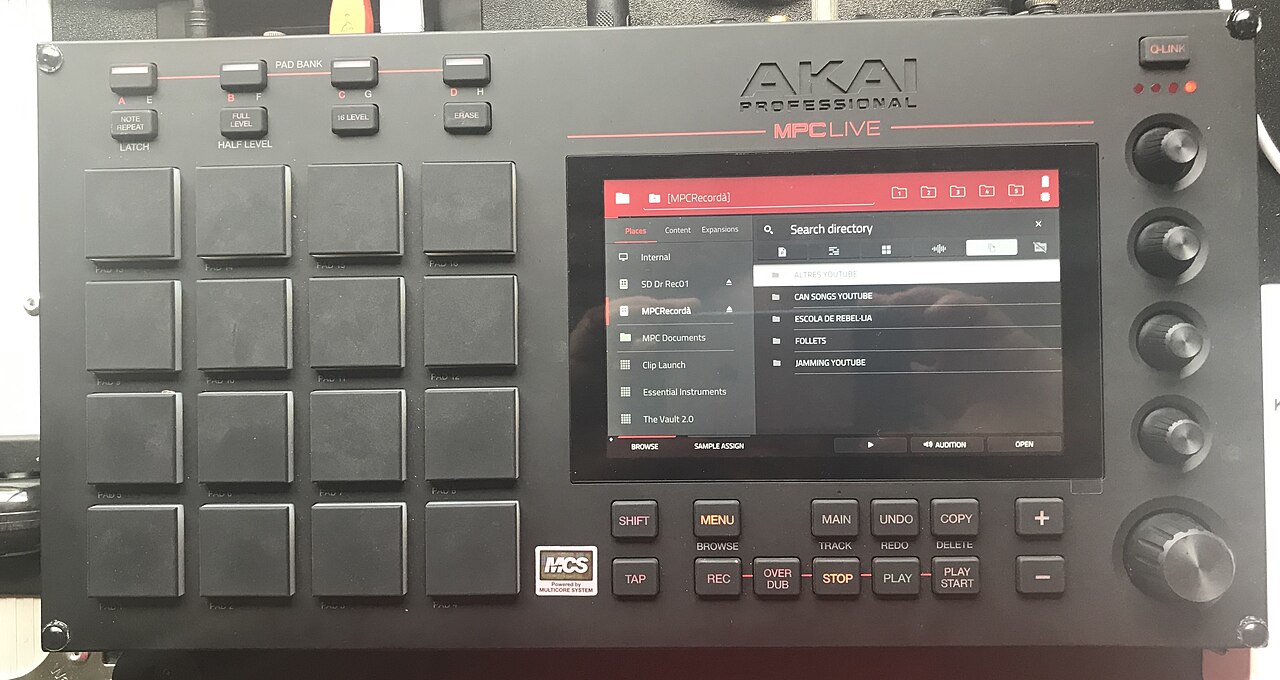
Photo: Akai MPC Live (2017) (opens in a new tab) by Joan Recordà (opens in a new tab), via Wikimedia Commons — CC BY-SA 4.0 (opens in a new tab)
GEAR, INSTRUMENTS AND TOOLS
The boxes, controllers and sample formats a producer is expected to know by name — from the MPC to a one-shot.
- MPC
- Akai's Music Production Center: a sampler, sequencer and drum machine in one box, played from 16 velocity-sensitive pads. The MPC60 (1988) set the layout every pad controller still copies.Akai Professional — MPC family (opens in a new tab)Sampled — the history of the MPCTerm page
- One-shot
- A single, non-looping sample fired once per trigger — one kick, one snare, one stab. The opposite of a loop: you play the groove yourself instead of inheriting it.Freesound — one-shot samples (CC) (opens in a new tab)Akai Professional — MPC user guides (opens in a new tab)Term page
- Loop (sample)
- A bar or phrase of audio designed to repeat seamlessly at a stated tempo and key. Loops carry someone else's groove; one-shots let you build your own.Freesound — loops (opens in a new tab)Ableton — Learning Music (opens in a new tab)Term page
- Sampler
- Any instrument that plays recorded audio back at different pitches and start points. Hardware (MPC, SP-404), software (Kontakt, Simpler) or built into your DAW.Roland — SP-404MKII (opens in a new tab)Akai Professional — MPC series (opens in a new tab)Term page
- Drum machine
- A dedicated box for programming drums, either from synthesised voices (TR-808, TR-909) or samples. Sequencing is on the unit, usually on a 16-step grid.Roland — TR-8S (opens in a new tab)Elektron — Digitakt (opens in a new tab)Term page
- Groovebox
- A self-contained beat machine: sampler or synth voices, a sequencer, effects and often a battery, so a full track can be made without a computer.Teenage Engineering — EP-133 K.O. II (opens in a new tab)Roland — SP-404MKII (opens in a new tab)Term page
- Sample pack
- A licensed folder of one-shots, loops and multisamples sold or given away for use in your own records. The licence, not the audio, is what you are paying for.Freesound — Creative Commons audio (opens in a new tab)Creative Commons — licence chooser (opens in a new tab)Term page
- Chopping
- Slicing a longer sample into pieces and reassigning them to pads or keys so you can replay the source in a new order. The core MPC technique.Akai Professional — MPC support and guides (opens in a new tab)Sampled — the history of the MPCTerm page
- Pad controller
- A grid of velocity-sensitive rubber pads — usually 8 or 16 — for finger drumming and triggering clips. No keys, no sound of its own; it drives software or a sampler.Akai Professional — MPD series (opens in a new tab)Sampled — best MIDI keyboard controllersTerm page
- MIDI keyboard controller
- A keyboard that sends note, velocity and controller data rather than making sound. Key count, key feel, pads and knob count are the only real differences.MIDI Association — MIDI basics (opens in a new tab)Sampled — best MIDI keyboard controllersTerm page
- Keybed
- The physical key mechanism under a keyboard: synth-action (light, springy), semi-weighted, or hammer-action (piano-like). It decides how the instrument plays more than the sounds do.MIDI Association — MIDI articles (opens in a new tab)Sampled — best MIDI keyboard controllersTerm page
- Aftertouch
- Pressure applied after a key is already down, sent as extra modulation. Channel aftertouch applies to the whole keyboard; polyphonic aftertouch is per note.MIDI Association — MIDI messages (opens in a new tab)MIDI Association — MPE specification (opens in a new tab)Term page
- Audio interface
- The box that converts microphones and instruments into digital audio and sends playback back out. It supplies preamps, phantom power, monitoring and low-latency drivers.Focusrite — support and setup guides (opens in a new tab)Sampled — best affordable audio interfacesTerm page
- Preamp
- The gain stage that lifts a microphone's tiny signal up to line level before conversion. Every interface has them; outboard preamps buy headroom and character, not necessity.AES — standards and publications (opens in a new tab)Focusrite — gain and levels (opens in a new tab)Term page
- Studio monitors
- Speakers designed to be revealing rather than flattering, so mix problems are audible. Nearfields sit about a metre away, forming an equilateral triangle with your head.Sampled — best studio monitors in 2026AES — standards and publications (opens in a new tab)Term page
- Open-back vs closed-back headphones
- Closed-back seals in sound and blocks bleed, which is why they live on the mic stand for tracking. Open-back leaks both ways but images wider and fatigues less when mixing.Sampled — best studio headphonesNIOSH — noise and hearing loss (opens in a new tab)Term page
- Condenser vs dynamic microphone
- Condensers need phantom power, hear detail and hear your room. Dynamics need no power, take loud sources without complaint and reject more of the space around them.Sampled — best condenser microphones for vocalsAES — standards and publications (opens in a new tab)Term page
- Shock mount
- An elastic cradle that suspends a microphone so desk knocks, foot taps and floor rumble do not travel up the stand into the capsule.Sampled — best condenser microphones for vocalsAES — standards and publications (opens in a new tab)Term page
- Guitar pedal (stompbox)
- A floor-mounted effect between instrument and amp — overdrive, delay, reverb, modulation. Order matters: dirt early, time-based effects late.Sampled — best budget guitar pedalsFender — support and manuals (opens in a new tab)Term page
- Combo amp
- An amplifier and speaker in one cabinet. Electric-guitar combos colour the sound on purpose; acoustic combos aim for flat, clean reproduction and often add a mic channel.Sampled — small Fender amps comparedFender — support and manuals (opens in a new tab)Term page
- Amp modelling
- Digital recreation of amplifiers, cabinets and mics, either in a plugin or inside the amp itself. It is what lets one small combo hold thirty voicings and send them over USB.Fender — support and manuals (opens in a new tab)Sampled — small Fender amps comparedTerm page
- Pickup (magnetic vs piezo)
- Magnetic pickups sense steel strings moving in a field — the electric guitar sound. Piezo pickups sense body vibration under an acoustic saddle, which is why they need an acoustic-voiced amp.Fender — support and manuals (opens in a new tab)Sampled — small Fender amps comparedTerm page
- Patchbay
- A panel of jacks that brings every input and output in a studio to one place so you re-route with a short cable instead of crawling behind racks.AES — standards and publications (opens in a new tab)Focusrite — connection guides (opens in a new tab)Term page
- TS, TRS and XLR
- TS is unbalanced instrument cable, TRS is balanced (or stereo), XLR is balanced with a locking connector and carries phantom power. Balanced runs reject hum over distance.AES — standards and publications (opens in a new tab)Focusrite — connection guides (opens in a new tab)Term page
- Field recorder
- A portable recorder with built-in mics, preamps and its own storage — used for foley, room tone, interviews and sampling sources that will never fit in a studio.Freesound — field recordings (opens in a new tab)AES — standards and publications (opens in a new tab)Term page
- DAW control surface
- Physical faders, knobs and transport buttons that drive your DAW over MIDI or Mackie/HUI protocol. It changes how fast you work, not how anything sounds.MIDI Association — MIDI articles (opens in a new tab)Reaper — user guide (PDF) (opens in a new tab)Term page
- Sustain pedal
- A footswitch sending MIDI CC 64. Polarity varies by manufacturer, which is why a pedal sometimes behaves backwards until you flip the setting on the keyboard.MIDI Association — MIDI messages (opens in a new tab)Sampled — best MIDI keyboard controllersTerm page
- Eurorack
- The dominant modular synth format: 3U-high modules sharing a case, power bus and 3.5 mm patch cables. You buy functions — oscillator, filter, sequencer — not finished instruments.Doepfer — A-100 technical details (opens in a new tab)VCV Rack (free modular software) (opens in a new tab)Term page
WHY THE LINKS GO ELSEWHERE
Definitions here are written in plain language, but the authority sits with the people who set the standards: the AES, the ITU, the EBU, the MIDI Association, DDEX, the U.S. Copyright Office, WIPO, the MLC, SoundExchange, manufacturers' own manuals, and free university material from Yale, Stanford CCRMA and Open Music Theory. All of those are free to read.
Spot something out of date or wrong? Email us and we'll fix it.