 SAMPLED
MIDI, formats and standards · updated 2026-08-16
WAV VS FLAC VS MP3/AAC
WAV is uncompressed PCM; FLAC is lossless compression; MP3 and AAC are lossy. Deliver lossless masters and let platforms encode.
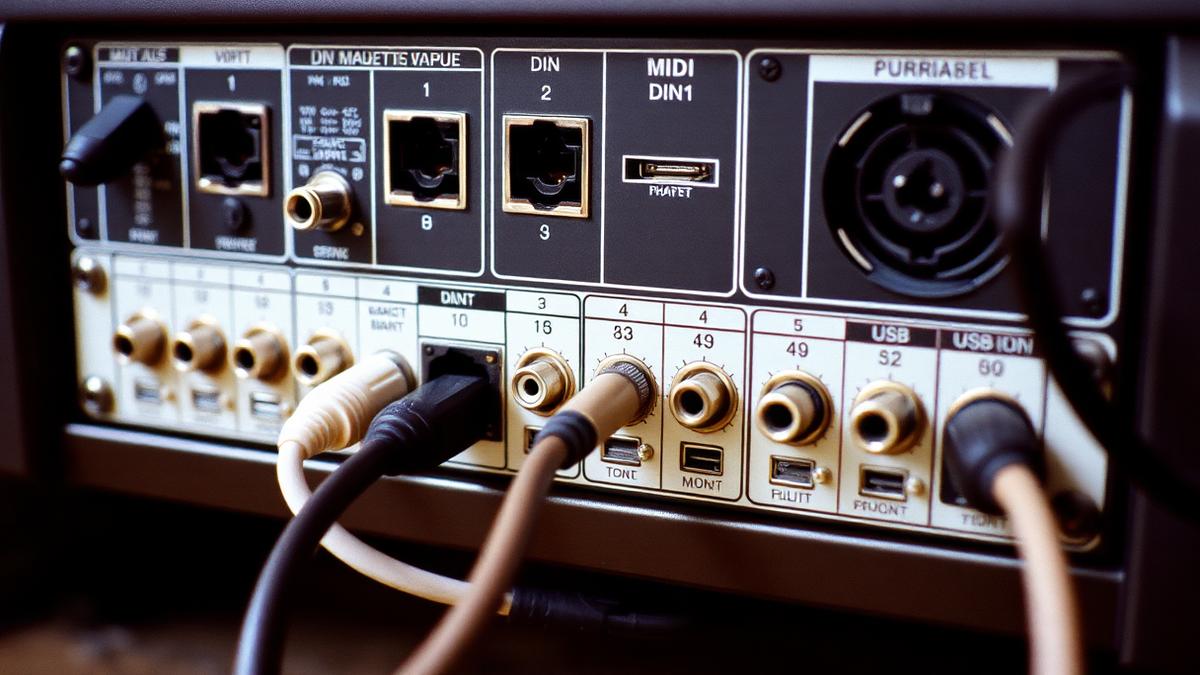
Photo: RME Hammerfall DSP 9652 MIDI connectors (opens in a new tab) by Dan Lynch (opens in a new tab), via Wikimedia Commons — CC BY-SA 2.0 (opens in a new tab)
Key takeaways
- WAV is uncompressed PCM; FLAC is lossless compression; MP3 and AAC are lossy.
- Deliver lossless masters and let platforms encode.
- Master and archive in WAV or FLAC; use lossy only for delivery.
- Deliver 24-bit WAV to distributors and mastering engineers; use AAC or MP3 for email previews only.
- Watch out: re-encoding a lossy file.
Quick checklist
- Can you define wav vs flac vs mp3/aac in one sentence without looking?
- Can you point at wav vs flac vs mp3/aac in a real session, mix or contract?
- Have you tried the practical move above at least once?
- Would you catch the common mistake before it costs you a take?
- Have you opened one of the primary sources below rather than a forum thread?
WAV VS FLAC VS MP3/AAC IN DEPTH
WAV is uncompressed PCM, FLAC is lossless compression that halves file size with bit-perfect decoding, and MP3 and AAC are lossy formats that discard data the encoder judges inaudible. Master and archive in WAV or FLAC; use lossy only for delivery.
How it works in practice
Deliver 24-bit WAV to distributors and mastering engineers; use AAC or MP3 for email previews only.
The mistake people make
Re-encoding a lossy file. Each generation compounds artefacts, and no amount of processing recovers what was discarded.
WHERE WAV VS FLAC VS MP3/AAC SITS
WAV vs FLAC vs MP3/AAC belongs to midi, formats and standards in the Sampled music glossary. The plumbing — the specs your gear, files and delivery pipeline agree on.
TERMS THAT DEPEND ON WAV VS FLAC VS MP3/AAC
- Timbre
The character that lets you tell a trumpet from a saw wave at the same pitch and loudness. It comes from harmonic content and how it changes over time.
- Bounce / render / export
Writing your session out to an audio file. Bounce stems for collaborators, a 24-bit WAV master for distribution.
- Phase and polarity
Polarity is a flipped waveform; phase is a time offset. Two mics on one source can cancel each other if you ignore either.
- Oscillator (VCO/DCO)
The sound source. It generates a repeating waveform — saw, square, triangle, sine — at a chosen pitch.
- LFO
Low-frequency oscillator: a slow wave used as modulation rather than sound. Vibrato, tremolo and wobble bass all start here.
- Subtractive synthesis
Start with a harmonically rich waveform and filter material away. The architecture behind most classic analogue synths.
TEST YOURSELF
0/3 answered · 0 correct
3 quick questions on wav vs flac vs mp3/aac. Answers are marked instantly — nothing is sent anywhere.
1. Which statement best describes wav vs flac vs mp3/aac?
2. What is the mistake people most often make with wav vs flac vs mp3/aac?
3. In practice, which of these applies to wav vs flac vs mp3/aac?
Ready for the full thing? Take the 25-question terminology test and get a certificate with your name and score.
SOURCES AND CITATIONS
Free, primary references for wav vs flac vs mp3/aac — standards bodies, manufacturers, government offices and university course material. Each one lists the line of this entry it backs up.
- Xiph.org — FLAC (opens in a new tab)
Open-source standards group · Xiph.Org Foundation
“WAV is uncompressed PCM; FLAC is lossless compression; MP3 and AAC are lossy.”— the claim this source supports
Why it counts: Xiph's write-ups are free, technically rigorous and famously careful about the myths around digital audio.
- Library of Congress — sustainable audio formats (opens in a new tab)
National library · Library of Congress
“Deliver lossless masters and let platforms encode.”— the claim this source supports
Why it counts: Archival primary material, which is about as stable a reference as this subject gets.
RELATED TERMS IN MIDI, FORMATS AND STANDARDS
- MIDI
- MIDI 2.0
- MPE
- Plugin formats (VST/AU/AAX/CLAP)
- ASIO / Core Audio
- Sync: MIDI clock, MTC, Ableton Link
- Metadata (ISRC, UPC, ISWC)
- DDEX
Back to the full music glossary or read our latest articles.