 SAMPLED
Gear, instruments and tools · updated 2026-08-16
CHOPPING
Slicing a longer sample into pieces and reassigning them to pads or keys so you can replay the source in a new order. The core MPC technique.
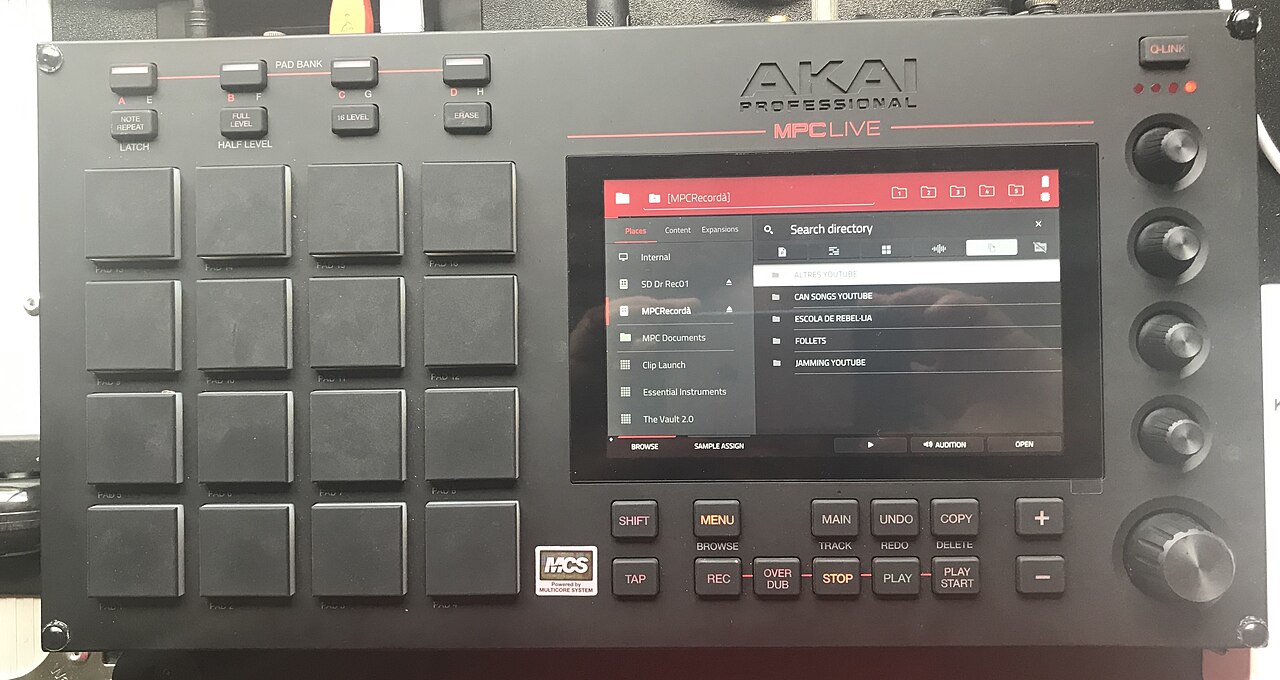
Photo: Akai MPC Live (2017) (opens in a new tab) by Joan Recordà (opens in a new tab), via Wikimedia Commons — CC BY-SA 4.0 (opens in a new tab)
Key takeaways
- Slicing a longer sample into pieces and reassigning them to pads or keys so you can replay the source in a new order.
- The core MPC technique.
- Done on transients, it turns a four-bar loop into a playable instrument; done on non-transient points, it produces the stuttered, half-swallowed phrasing that defines a lot of sample-based production.
- Slice on transients first, then delete every other slice and play the gaps yourself — you get a new groove out of the same four bars.
- Watch out: chopping without setting the sample's tempo.
Quick checklist
- Can you define chopping in one sentence without looking?
- Can you point at chopping in a real session, mix or contract?
- Have you tried the practical move above at least once?
- Would you catch the common mistake before it costs you a take?
- Have you opened one of the primary sources below rather than a forum thread?
CHOPPING IN DEPTH
Chopping means cutting a longer sample into slices and assigning them to pads or keys so the source can be replayed in a new order. Done on transients, it turns a four-bar loop into a playable instrument; done on non-transient points, it produces the stuttered, half-swallowed phrasing that defines a lot of sample-based production.
How it works in practice
Slice on transients first, then delete every other slice and play the gaps yourself — you get a new groove out of the same four bars.
The mistake people make
Chopping without setting the sample's tempo. Once the slices drift against the grid, quantising them fixes timing but destroys the original feel.
WHERE CHOPPING SITS
Chopping belongs to gear, instruments and tools in the Sampled music glossary. The boxes, controllers and sample formats a producer is expected to know by name — from the MPC to a one-shot.
TERMS THAT DEPEND ON CHOPPING
- Granular synthesis
Chopping audio into tiny grains and replaying them at varying rate, pitch and density to make clouds and textures.
TEST YOURSELF
0/3 answered · 0 correct
3 quick questions on chopping. Answers are marked instantly — nothing is sent anywhere.
1. Which statement best describes chopping?
2. What is the mistake people most often make with chopping?
3. In practice, which of these applies to chopping?
Ready for the full thing? Take the 25-question terminology test and get a certificate with your name and score.
SOURCES AND CITATIONS
Free, primary references for chopping — standards bodies, manufacturers, government offices and university course material. Each one lists the line of this entry it backs up.
- Akai Professional — MPC support and guides (opens in a new tab)
Primary reference · akaipro.com
“Slicing a longer sample into pieces and reassigning them to pads or keys so you can replay the source in a new order.”— the claim this source supports
Why it counts: Published by the organisation responsible for the thing being defined, so it is a first-hand source rather than a summary of one.
- Sampled — the history of the MPC
Primary reference · Sampled — the history of the MPC
“The core MPC technique.”— the claim this source supports
Why it counts: Published by the organisation responsible for the thing being defined, so it is a first-hand source rather than a summary of one.
RELATED TERMS IN GEAR, INSTRUMENTS AND TOOLS
Back to the full music glossary or read our latest articles.