 SAMPLED
Gear, instruments and tools · updated 2026-08-16
ONE-SHOT
A single, non-looping sample fired once per trigger — one kick, one snare, one stab. The opposite of a loop: you play the groove yourself instead of inheriting it.
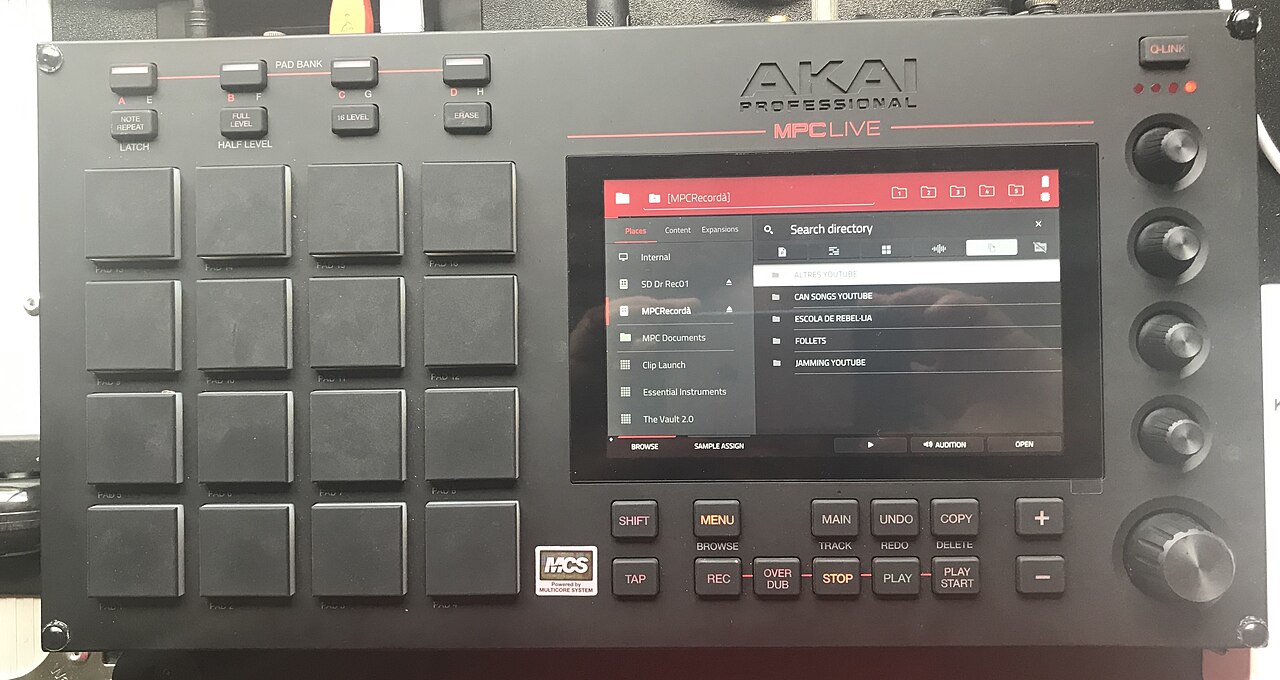
Photo: Akai MPC Live (2017) (opens in a new tab) by Joan Recordà (opens in a new tab), via Wikimedia Commons — CC BY-SA 4.0 (opens in a new tab)
Key takeaways
- A single, non-looping sample fired once per trigger — one kick, one snare, one stab.
- The opposite of a loop: you play the groove yourself instead of inheriting it.
- Because it carries no tempo and no groove of its own, it stays useful forever: you set the timing, the velocity and the swing, and it drops into any project at any BPM without stretching artefacts.
- Build a kit from one-shots on pads 1–16 and program the pattern yourself instead of dropping in a pre-made drum loop that locks the whole track to someone else's feel.
- Watch out: assuming a one-shot is clearance-free.
Quick checklist
- Can you define one-shot in one sentence without looking?
- Can you point at one-shot in a real session, mix or contract?
- Have you tried the practical move above at least once?
- Would you catch the common mistake before it costs you a take?
- Have you opened one of the primary sources below rather than a forum thread?
ONE-SHOT IN DEPTH
A one-shot is a single sample that plays through once from its start point and stops — one kick, one snare, one vocal stab, one riser. Because it carries no tempo and no groove of its own, it stays useful forever: you set the timing, the velocity and the swing, and it drops into any project at any BPM without stretching artefacts.
How it works in practice
Build a kit from one-shots on pads 1–16 and program the pattern yourself instead of dropping in a pre-made drum loop that locks the whole track to someone else's feel.
The mistake people make
Assuming a one-shot is clearance-free. A one-shot lifted from a commercial record is still a sample of that record — a licensed sample pack or your own recording is what keeps it clean.
WHERE ONE-SHOT SITS
One-shot belongs to gear, instruments and tools in the Sampled music glossary. The boxes, controllers and sample formats a producer is expected to know by name — from the MPC to a one-shot.
TERMS THAT DEPEND ON ONE-SHOT
- Loop (sample)
A bar or phrase of audio designed to repeat seamlessly at a stated tempo and key. Loops carry someone else's groove; one-shots let you build your own.
- Sample pack
A licensed folder of one-shots, loops and multisamples sold or given away for use in your own records. The licence, not the audio, is what you are paying for.
TEST YOURSELF
0/3 answered · 0 correct
3 quick questions on one-shot. Answers are marked instantly — nothing is sent anywhere.
1. Which statement best describes one-shot?
2. What is the mistake people most often make with one-shot?
3. In practice, which of these applies to one-shot?
Ready for the full thing? Take the 25-question terminology test and get a certificate with your name and score.
SOURCES AND CITATIONS
Free, primary references for one-shot — standards bodies, manufacturers, government offices and university course material. Each one lists the line of this entry it backs up.
- Freesound — one-shot samples (CC) (opens in a new tab)
Primary reference · freesound.org
“A single, non-looping sample fired once per trigger — one kick, one snare, one stab.”— the claim this source supports
Why it counts: Published by the organisation responsible for the thing being defined, so it is a first-hand source rather than a summary of one.
- Akai Professional — MPC user guides (opens in a new tab)
Primary reference · akaipro.com
“The opposite of a loop: you play the groove yourself instead of inheriting it.”— the claim this source supports
Why it counts: Published by the organisation responsible for the thing being defined, so it is a first-hand source rather than a summary of one.
RELATED TERMS IN GEAR, INSTRUMENTS AND TOOLS
Back to the full music glossary or read our latest articles.