 SAMPLED
What Are the Best Studio Monitors to Buy in 2026?
Four nearfields cover almost every real-world room and budget: the KRK ROKIT 5 G5, Yamaha HS5, JBL 305P MkII and PreSonus Eris 3.5. Here is how they differ and which one fits which desk.
Monitors are the one purchase that changes every decision made after it. A pair that flatters low end produces mixes that arrive thin everywhere else; a pair that is honest but too large for the room produces the opposite problem. For 2026 the shortlist at the working end of the market has not really moved: the KRK ROKIT 5 G5 (opens in a new tab), the Yamaha HS5 (opens in a new tab), the JBL 305P MkII (opens in a new tab) and the PreSonus Eris 3.5 (opens in a new tab).
All four are active, so no separate power amp is needed. The differences that matter are woofer size, how much low end the cabinet can honestly produce, and what room correction is built in.
Quick comparison
| KRK ROKIT 5 G5 | Yamaha HS5 | JBL 305P MkII | PreSonus Eris 3.5 | |
|---|---|---|---|---|
| Woofer | 5" Kevlar | 5" cone | 5" | 3.5" woven composite |
| Tweeter | 1" Kevlar | 1" dome | 1" with waveguide | 1" silk dome |
| Amplification | 55 W bi-amp class D | 70 W bi-amp | 82 W bi-amp class D | 50 W peak, pair |
| Low end | to about 43 Hz | to about 54 Hz | to about 49 Hz | to about 80 Hz |
| Port | Front | Rear | Rear | Rear |
| Room tuning | On-board DSP with LCD, 25 settings | HIGH TRIM and ROOM CONTROL switches | Boundary EQ and HF trim | HF and acoustic space controls |
| Inputs | XLR, TRS | XLR, TRS | XLR, TRS | TRS, RCA, front 3.5 mm |
| Best for | Bass-heavy production in a treated corner | Honest midrange, arrangement work | Detail and stereo image on a budget | Small desks and second reference |
| Buy | Amazon (opens in a new tab) | Amazon (opens in a new tab) | Amazon (opens in a new tab) | Amazon (opens in a new tab) |
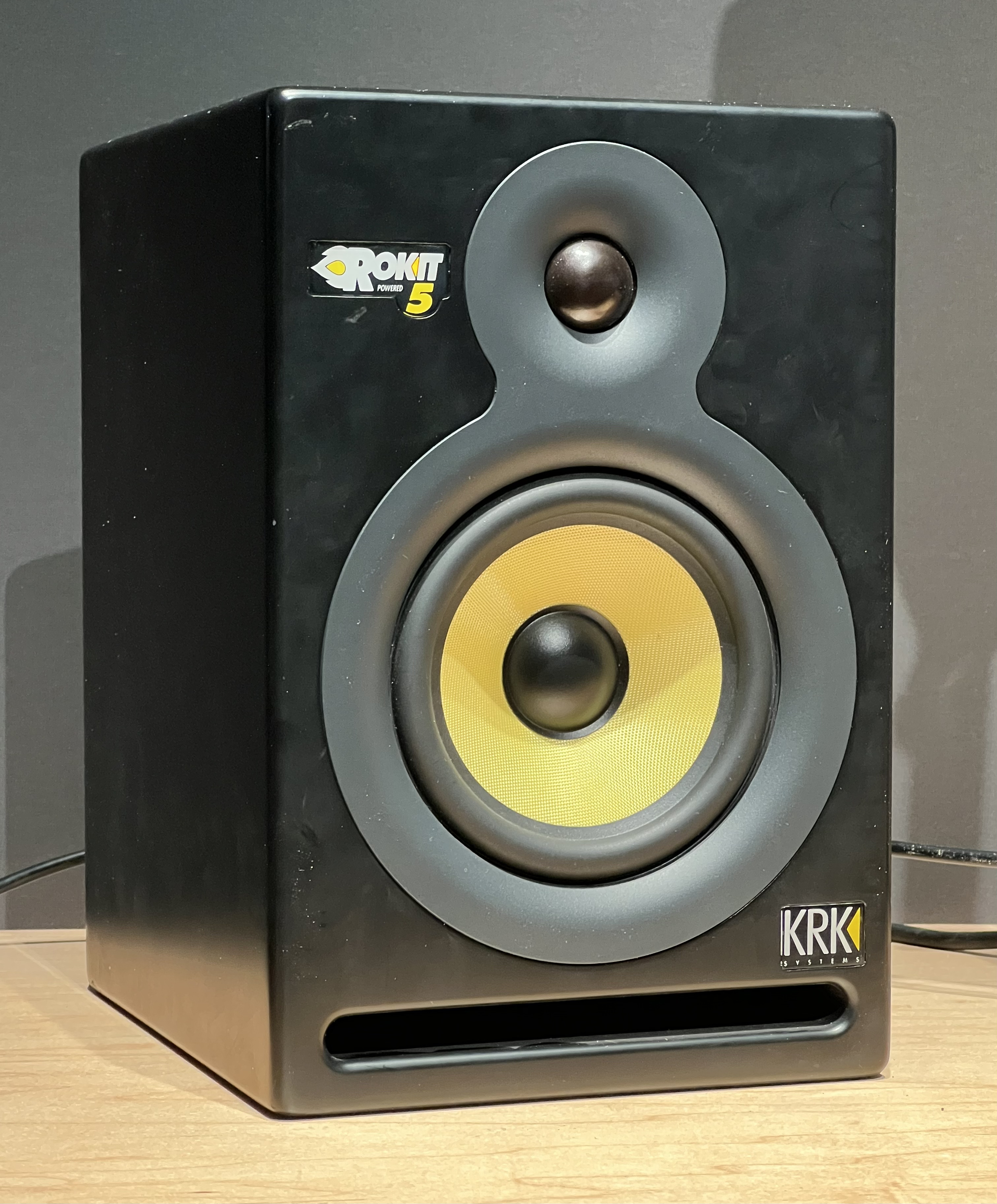
KRK ROKIT 5 G5: the DSP-corrected workhorse
The fifth generation ROKIT keeps the yellow Kevlar cones that made the line recognisable and adds the feature that actually justifies an upgrade: an on-board DSP section with a small LCD and 25 room-correction presets, plus a companion app that uses a phone microphone to suggest a setting. In an untreated bedroom, where the nearest wall does more to the low end than the speaker does, that is a meaningful tool rather than a spec-sheet line.
Bi-amped class-D power and a front-firing port let the ROKIT sit closer to a wall than most rear-ported cabinets without turning the low end to mush. The character is still a touch forward down low, which is why the correction presets matter; set flat in a corner, it will encourage under-cooking the bass.
Best for hip-hop, electronic and anything where sub information carries the arrangement, especially in a room with limited treatment. Current price on Amazon. (opens in a new tab)
Yamaha HS5: the honest midrange
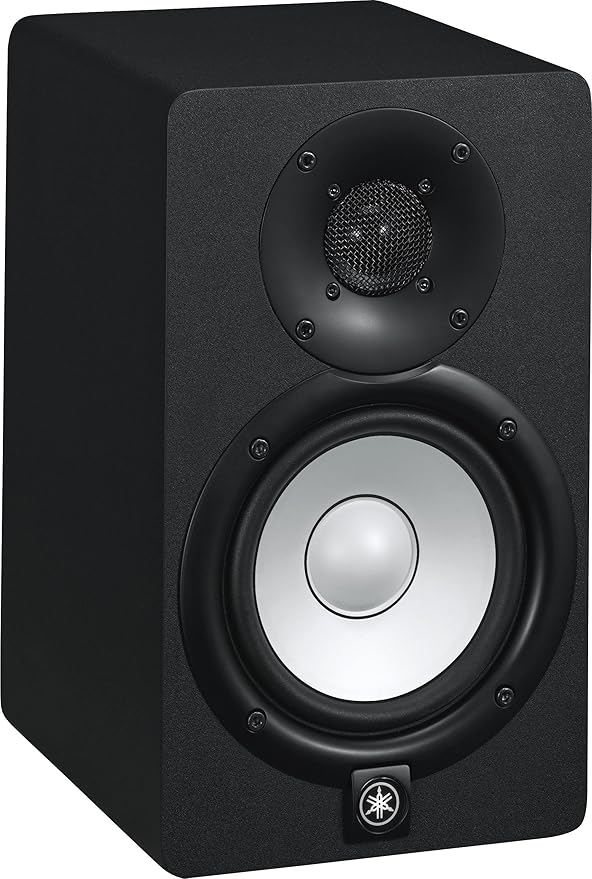
The white-cone HS line inherited its reputation from the NS-10, the passive monitor that producers used for decades precisely because it made bad mixes obvious. The HS5 is not the same speaker, but it keeps the philosophy: a flat, unforgiving midrange that exposes muddy low mids, harsh vocal presence and clashing arrangements.
Practical controls are simple and effective. ROOM CONTROL cuts low-frequency buildup when the speaker is against a wall or in a corner, and HIGH TRIM adjusts the top end for a bright or dead room. Rear-ported, 5-inch, and honest to about 54 Hz, it does not pretend to have sub extension it lacks, which is arguably safer than a monitor that hints at bass that is not really there.
Best for mixing, arrangement and vocal work where midrange truth matters more than low-end excitement. Pair it with a reference check on headphones or a subwoofer for the bottom octave. The HS5 is here. (opens in a new tab)
JBL 305P MkII: the value benchmark
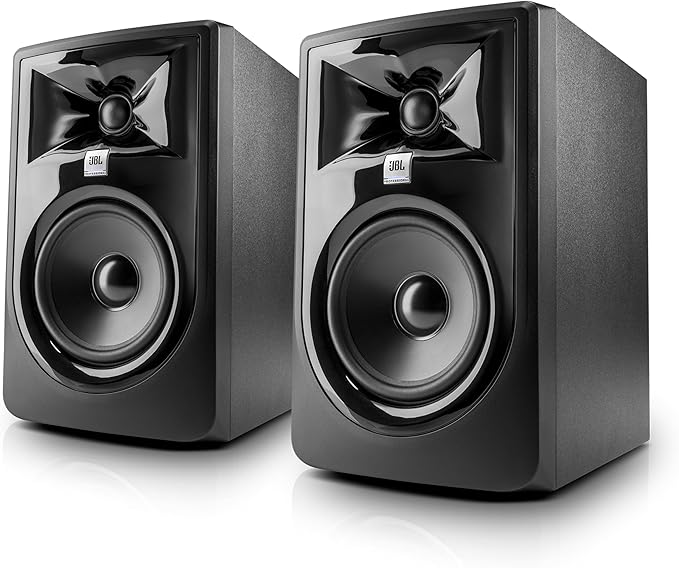
The 305P MkII borrowed its Image Control Waveguide from JBL's far more expensive master reference designs, and the effect is audible: a wide, stable stereo image and a sweet spot that does not collapse the moment the chair moves six inches. For anyone mixing at a desk rather than in a perfectly aligned triangle, that forgiveness is worth as much as raw frequency response.
Class-D amplification driving a 5-inch woofer gets the low end down near 49 Hz, deeper than the HS5, with a slightly more flattering top-end sheen. Boundary EQ and HF trim switches on the rear panel handle wall placement and room brightness. XLR and TRS inputs mean it drops straight into any interface.
Best for a first serious pair of monitors, or a small room where seating position cannot be controlled. The MkII pair is on Amazon. (opens in a new tab)
PreSonus Eris 3.5: the small-desk reference
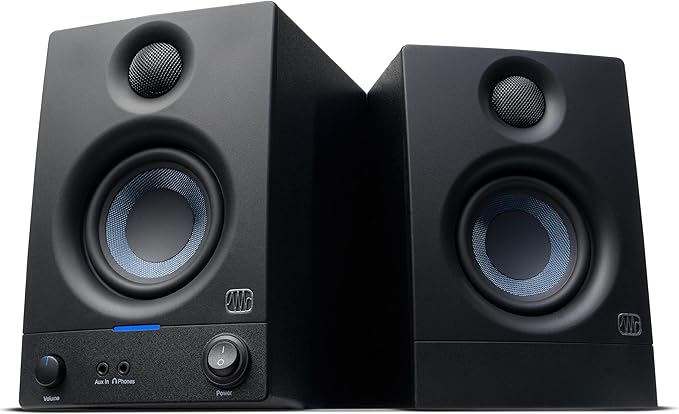
The Eris 3.5 is the outlier here, and deliberately so. A 3.5-inch woofer and roughly 50 watts across the pair are not going to reproduce a sub bass line, and the low end tapers off around 80 Hz. What it does offer is a genuinely tuned nearfield in a footprint that fits either side of a laptop, with a silk dome tweeter that stays smooth for long sessions.
The layout is built for a desk rather than a rack: a front-panel headphone jack and aux input, volume on the front, and rear-panel TRS and RCA connections plus high-frequency and acoustic-space controls. Plenty of engineers who own larger monitors keep a pair of these as a small-speaker reference, the modern equivalent of checking a mix on a car stereo.
Best for tight desks, dorm rooms, edit rigs and as a deliberately limited second reference. Check the pair on Amazon. (opens in a new tab)
Which one to buy
If the work is bass-forward and the room is untreated, the ROKIT 5 G5 (opens in a new tab) earns its keep on the DSP correction alone. If the priority is midrange honesty and clean arrangement decisions, the HS5 (opens in a new tab) remains the reference that other monitors get compared against. For the best all-round performance per dollar, the 305P MkII (opens in a new tab) is still the one to beat. And if the desk is small, or a second, deliberately modest reference is what is missing, the Eris 3.5 (opens in a new tab) does that job for less than the price of a plugin bundle.
Whichever pair arrives, spend the first week listening to finished records that are already familiar rather than mixing on them. Monitors do not make decisions; they only show what the room and the ears are doing. Treatment, symmetry and speaker height at ear level will change the result more than swapping between any two of these four.
Disclosure: links to Amazon in this article are affiliate links. Sampled may earn a commission on purchases made through them, at no additional cost to the reader.