 SAMPLED
Why Does Every Studio Still Keep Sony MDR-7506 on the Mic Stand?
Introduced in 1991 and still on every tracking-room mic stand, the MDR-7506 is the closed-back monitor that outlived three decades of wireless flagships. From the records Andrew Scheps mixed for Adele and the Red Hot Chili Peppers to the film sets that made it a location-sound standard, here is the history, the specs and why engineers never replace it.
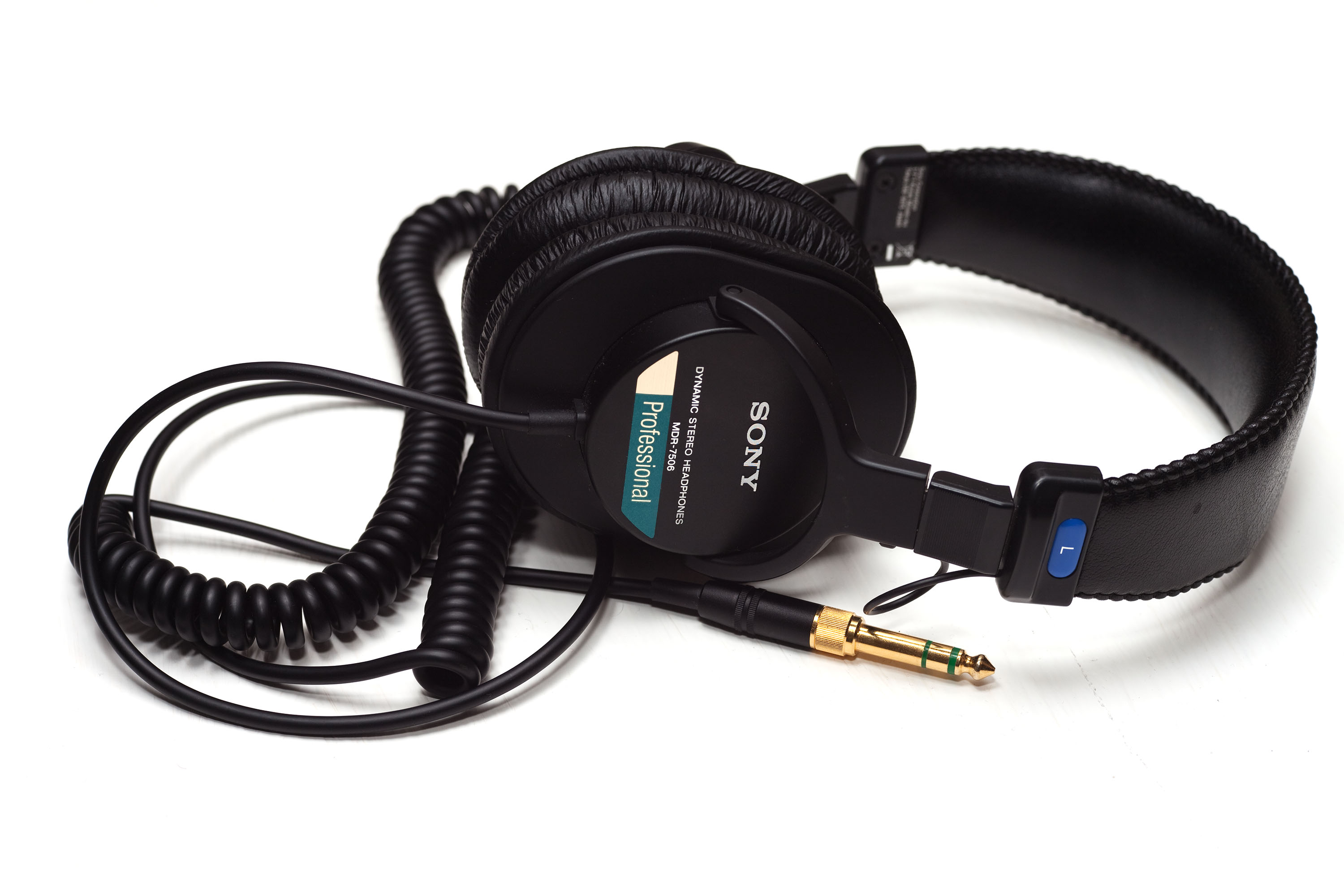
Walk into any working recording studio and look at the mic stand. The pair of headphones curled around it is almost never the $400 closed-back the gear forums are arguing about this month. It is a pair of black-and-silver Sony MDR-7506 with the foam worn flat and the logo half-rubbed off. That is not an accident, and it is not nostalgia. It is the result of a design Sony finished in 1991 and then had the good sense to leave alone. The MDR-7506 is available here. (opens in a new tab)
A thirty-year lineage
The MDR-7506 descends from the MDR-V6, which Sony introduced in 1985 as a Digital-era headphone tuned for the new clarity of the compact disc. Its foldable, sealed-ear design and unusually flat response made it an immediate favorite with field recorders, DJs and studio engineers. In 1989, Consumer Reports called the V6 the highest-accuracy headphone it had ever measured. By 1997, EQ magazine was already describing the MDR-7506 — Sony's professional variant — as a model most people reach for.
Sony launched the MDR-7506 itself in 1991 as the professional entry in its 7500 line. Outwardly it is nearly identical to the V6: the same 40 mm driver, the same folding chassis, the same coiled oxygen-free copper cord. The differences are a gold-plated plug, a blue Professional badge in place of the V6's red Digital badge, and a slightly more pronounced treble. A 2014 CNET comparison found the two models very close overall, with the 7506 accentuating the highs and carrying marginally less bass than the flatter V6.
What set the 7506 apart was not a frequency curve. It was reliability. By 1993 the model was being described as almost-industry-standard for film and television location sound, and a 2008 edition of The Sound Effects Bible listed it as essential to the standard recording package. When Sony finally discontinued the V6 in 2020 after thirty-five years, the 7506 — which shares the same driver — carried the lineage forward and remains in production today, available here. (opens in a new tab)
The engineers who never replace them
The reason the 7506 endures is that the people who depend on a headphone for a living keep reaching for it. Andrew Scheps — the mixing engineer behind Red Hot Chili Peppers' Californication, Adele's 25, Metallica's Death Magnetic and Black Sabbath's 13 — works almost entirely in the box, and when headphone monitoring is needed the choice is a Sony 7506. Scheps told AudioTechnology that the 7506 paired with a UAD Apollo Twin is the go-to for headphone work. The logic is consistency: Scheps mixes between studios and continents, and a $100 pair of wired headphones that sounds the same everywhere is what keeps a mix transferable from room to room.
Dave Rat, the live-sound engineer behind Rat Sound Systems and front-of-house for the Red Hot Chili Peppers and Soundgarden, has tested the line on the bench and called it one of the most popular live sound headphones, describing its response as a little low on the top end, a little low on the bottom, and definitely close to neutral. For a monitoring job where isolation and predictability matter more than flattery, that is the whole brief.
This is the pattern across the profession. The 7506 is not the headphone bought for the photograph. It is the headphone hanging off the console in the session where the record gets made.
Why the pros never stop reaching for it
The MDR-7506 is not a headphone anyone buys for novelty. There is no app, no active noise cancellation, no Bluetooth, no companion software. It is a wired, passive, closed-back monitor, and the absence of features is the feature. When the room is lying about a mix, a tool with no opinion of its own is exactly what is needed. The pair the pros reach for is here. (opens in a new tab)
A few qualities make it the studio default:
- An honest midrange. The 7506 has a slightly hyped top end, but the vocal region — where most mixing decisions actually live — is unflattering. A de-esser working, or not working, is audible on the first pass.
- A low end that does not flatter. Where many modern closed-backs boost the sub to make everything sound huge, the 7506 is comparatively polite down low. If a kick sounds right here, it will sound right on a phone speaker.
- Real isolation. Closed-back construction keeps the click track out of the vocal mic and lets a drummer hear the cue mix — the single reason it sits on every tracking rig and podcast booth in the country.
- It folds. The earcups flip and the whole unit collapses. It is why the 7506 travels in a backpack and survives the trip.
The specs
| Spec | Sony MDR-7506 |
|---|---|
| Type | Closed-back, dynamic |
| Driver | 40 mm |
| Impedance | 63 ohms |
| Sensitivity | 106 dB/mW |
| Frequency response | 10 Hz – 20 kHz |
| Cable | Coiled, ~3 m extended, attached |
| Connector | 3.5 mm with screw-on 1/4-inch adapter |
| Weight | ~230 g (without cable) |
The 63-ohm impedance is the unsexy spec that matters. It is high enough that a phone or a budget interface drives it cleanly without the bass turning to mud, and low enough that a dedicated headphone amplifier is not required to reach a usable level. For a tracking rig running off an entry-level interface, that is the difference between a usable monitor and a frustrating one. Full specs and current pricing are here. (opens in a new tab)
The tradeoffs
No headphone is perfect, and the 7506's weaknesses are well documented. The stock earpads are the weak point: the pleather flakes after a year or two of daily use and the foam beneath goes hard. Replacements are inexpensive, and a set of Beyerdynamic DT 250 earpads fits and is the upgrade most owners make — rounder, more comfortable, and free of the flaking.
The clamping force is firm out of the box. The first week is genuinely tight, and the break-in is real. For a bigger head the initial period is uncomfortable, and the 7506 is a tool rather than a comfort headphone for long casual listening sessions.
Why the line was never replaced
The product was finished in 1991. Every flashier closed-back that has arrived since — flatter curves, plusher pads, wireless everything — has come and gone, while the 7506 stays on the mic stand. The reason is simple. A $100 pair of wired headphones that outlasts three generations of wireless flagships and still tells the truth about a vocal is the rare piece of gear that is actually done. Sony has had the good sense not to touch it.
The Sony MDR-7506 is available here. (opens in a new tab) Purchases made through this link may earn the site a commission at no extra cost to the reader.
Disclosure: The owner of Sampled runs Sampledex, a plugin company. Links in this article may be affiliate links.