 SAMPLED
Synthesis and sound design · updated 2026-08-16
FM SYNTHESIS
One oscillator modulates another's frequency, generating sidebands. Bells, electric pianos and aggressive digital basses.
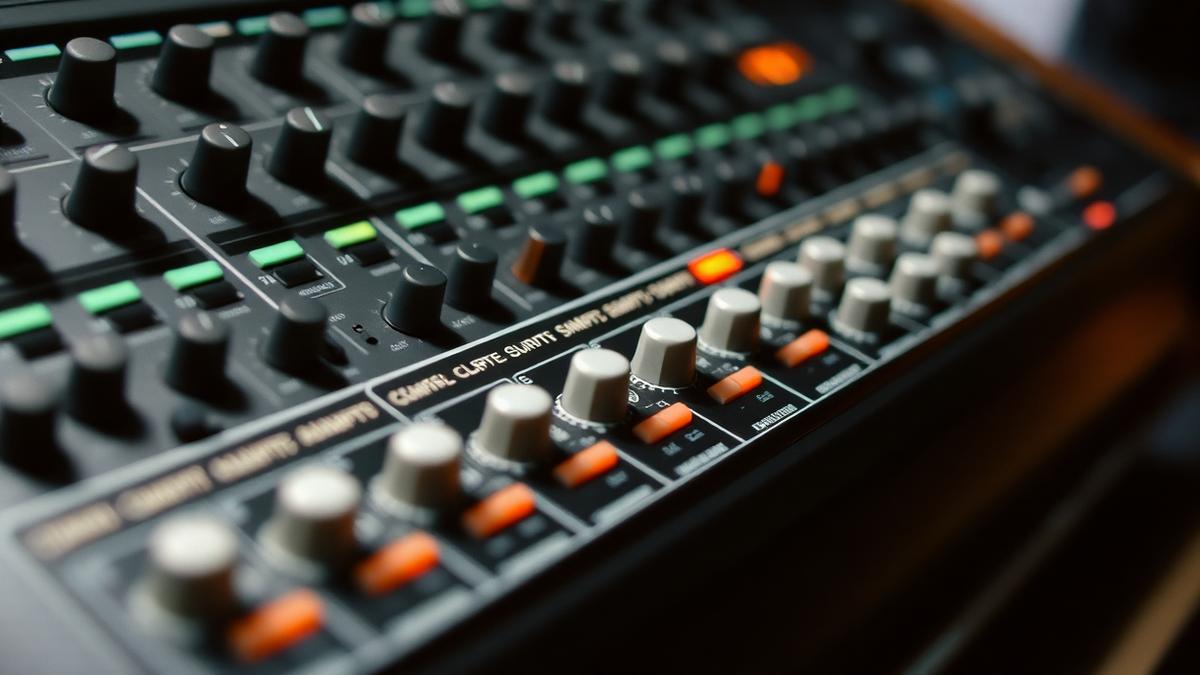
Photo: Eurorack Modular Synthesizer Closeup (opens in a new tab) by Nir Yaniv (opens in a new tab), via Wikimedia Commons — CC BY-SA 4.0 (opens in a new tab)
Key takeaways
- One oscillator modulates another's frequency, generating sidebands.
- Bells, electric pianos and aggressive digital basses.
- Operator ratios decide harmonic content and modulation index decides brightness.
- A simple 1:1 ratio with a decaying modulation envelope gives the DX-style electric piano heard on countless ballads.
- Watch out: programming FM by random knob-turning.
Quick checklist
- Can you define fm synthesis in one sentence without looking?
- Can you point at fm synthesis in a real session, mix or contract?
- Have you tried the practical move above at least once?
- Would you catch the common mistake before it costs you a take?
- Have you opened one of the primary sources below rather than a forum thread?
FM SYNTHESIS IN DEPTH
In FM synthesis one oscillator modulates the frequency of another, generating sidebands that produce bell, electric-piano and metallic tones subtractive synthesis cannot easily reach. Operator ratios decide harmonic content and modulation index decides brightness.
How it works in practice
A simple 1:1 ratio with a decaying modulation envelope gives the DX-style electric piano heard on countless ballads.
The mistake people make
Programming FM by random knob-turning. Small, deliberate ratio changes are predictable; large random ones just produce noise.
WHERE FM SYNTHESIS SITS
FM synthesis belongs to synthesis and sound design in the Sampled music glossary. How synths make sound, in the order the signal actually travels.
TEST YOURSELF
0/3 answered · 0 correct
3 quick questions on fm synthesis. Answers are marked instantly — nothing is sent anywhere.
1. Which statement best describes fm synthesis?
2. What is the mistake people most often make with fm synthesis?
3. In practice, which of these applies to fm synthesis?
Ready for the full thing? Take the 25-question terminology test and get a certificate with your name and score.
SOURCES AND CITATIONS
Free, primary references for fm synthesis — standards bodies, manufacturers, government offices and university course material. Each one lists the line of this entry it backs up.
- Yamaha — synth history and FM (opens in a new tab)
Primary reference · yamaha.com
“One oscillator modulates another's frequency, generating sidebands.”— the claim this source supports
Why it counts: Published by the organisation responsible for the thing being defined, so it is a first-hand source rather than a summary of one.
- Stanford CCRMA — FM synthesis (opens in a new tab)
University research centre · Stanford CCRMA
“Bells, electric pianos and aggressive digital basses.”— the claim this source supports
Why it counts: The CCRMA course material derives this from first principles, so you can check the maths behind the plain-English version above.
RELATED TERMS IN SYNTHESIS AND SOUND DESIGN
- Oscillator (VCO/DCO)
- Filter (VCF)
- Envelope (ADSR)
- LFO
- Subtractive synthesis
- Wavetable synthesis
- Granular synthesis
- Polyphony / paraphony / monophony
Back to the full music glossary or read our latest articles.