 SAMPLED
Synthesis and sound design · updated 2026-08-16
WAVETABLE SYNTHESIS
Scanning through a table of single-cycle waveforms so the timbre morphs over time.
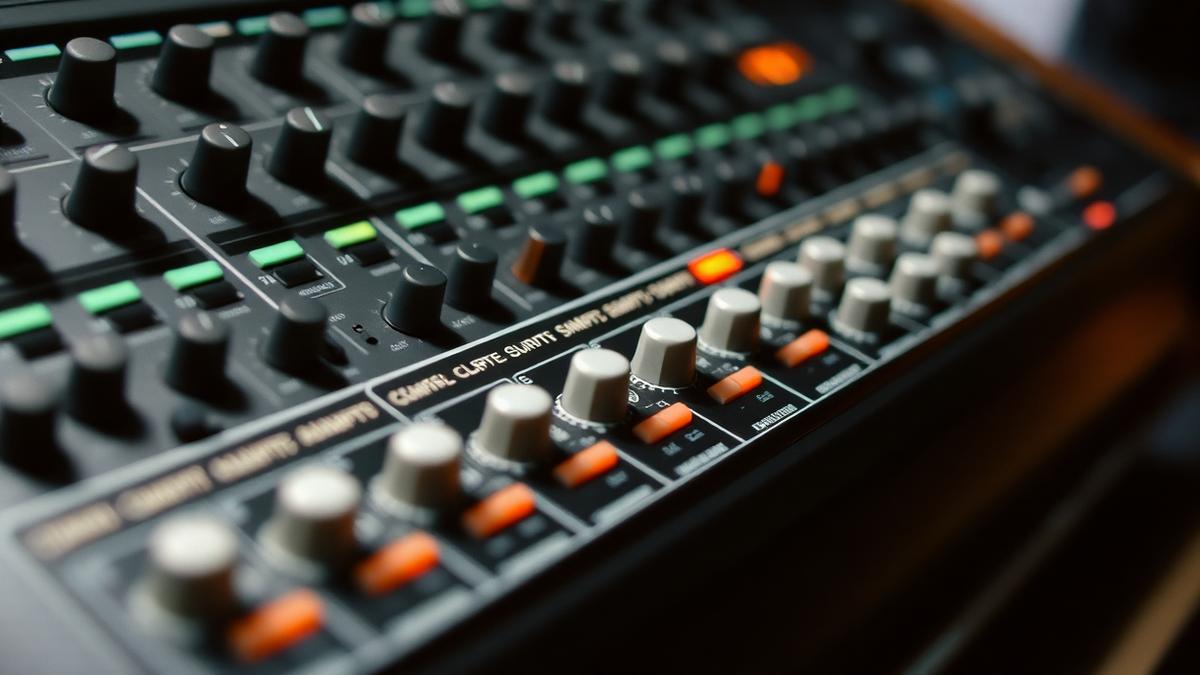
Photo: Eurorack Modular Synthesizer Closeup (opens in a new tab) by Nir Yaniv (opens in a new tab), via Wikimedia Commons — CC BY-SA 4.0 (opens in a new tab)
Key takeaways
- Scanning through a table of single-cycle waveforms so the timbre morphs over time.
- It underpins the PPG and Waldorf lineage and most modern hybrid soft synths.
- Assign an envelope to table position so a pad starts thin and blooms into a full harmonic spectrum.
- Watch out: scanning tables quickly with no interpolation or oversampling.
- Sits under synthesis and sound design in this glossary, with 2 primary sources below.
Quick checklist
- Can you define wavetable synthesis in one sentence without looking?
- Can you point at wavetable synthesis in a real session, mix or contract?
- Have you tried the practical move above at least once?
- Would you catch the common mistake before it costs you a take?
- Have you opened one of the primary sources below rather than a forum thread?
WAVETABLE SYNTHESIS IN DEPTH
A wavetable is a series of single-cycle waveforms you scan through, so timbre becomes something you modulate over time rather than a fixed setting. It underpins the PPG and Waldorf lineage and most modern hybrid soft synths.
How it works in practice
Assign an envelope to table position so a pad starts thin and blooms into a full harmonic spectrum.
The mistake people make
Scanning tables quickly with no interpolation or oversampling. It produces digital grit that reads as an artefact rather than an effect.
WHERE WAVETABLE SYNTHESIS SITS
Wavetable synthesis belongs to synthesis and sound design in the Sampled music glossary. How synths make sound, in the order the signal actually travels.
TEST YOURSELF
0/3 answered · 0 correct
3 quick questions on wavetable synthesis. Answers are marked instantly — nothing is sent anywhere.
1. Which statement best describes wavetable synthesis?
2. What is the mistake people most often make with wavetable synthesis?
3. In practice, which of these applies to wavetable synthesis?
Ready for the full thing? Take the 25-question terminology test and get a certificate with your name and score.
SOURCES AND CITATIONS
Free, primary references for wavetable synthesis — standards bodies, manufacturers, government offices and university course material. Each one lists the line of this entry it backs up.
- Stanford CCRMA research (opens in a new tab)
University research centre · Stanford CCRMA
“Scanning through a table of single-cycle waveforms so the timbre morphs over time.”— the claim this source supports
Why it counts: The CCRMA course material derives this from first principles, so you can check the maths behind the plain-English version above.
- Ableton Live manual — Wavetable (opens in a new tab)
Manufacturer learning resource · Ableton
“A wavetable is a series of single-cycle waveforms you scan through, so timbre becomes something you modulate over time rather than a fixed setting.”— the claim this source supports
Why it counts: A free, hands-on explainer from a DAW maker — useful for hearing the concept rather than only reading it.
RELATED TERMS IN SYNTHESIS AND SOUND DESIGN
- Oscillator (VCO/DCO)
- Filter (VCF)
- Envelope (ADSR)
- LFO
- Subtractive synthesis
- FM synthesis
- Granular synthesis
- Polyphony / paraphony / monophony
Back to the full music glossary or read our latest articles.