 SAMPLED
Rights, royalties and the business · updated 2026-08-16
SAMPLE CLEARANCE
Getting written permission to use part of an existing recording and composition. Two clearances, two negotiations.
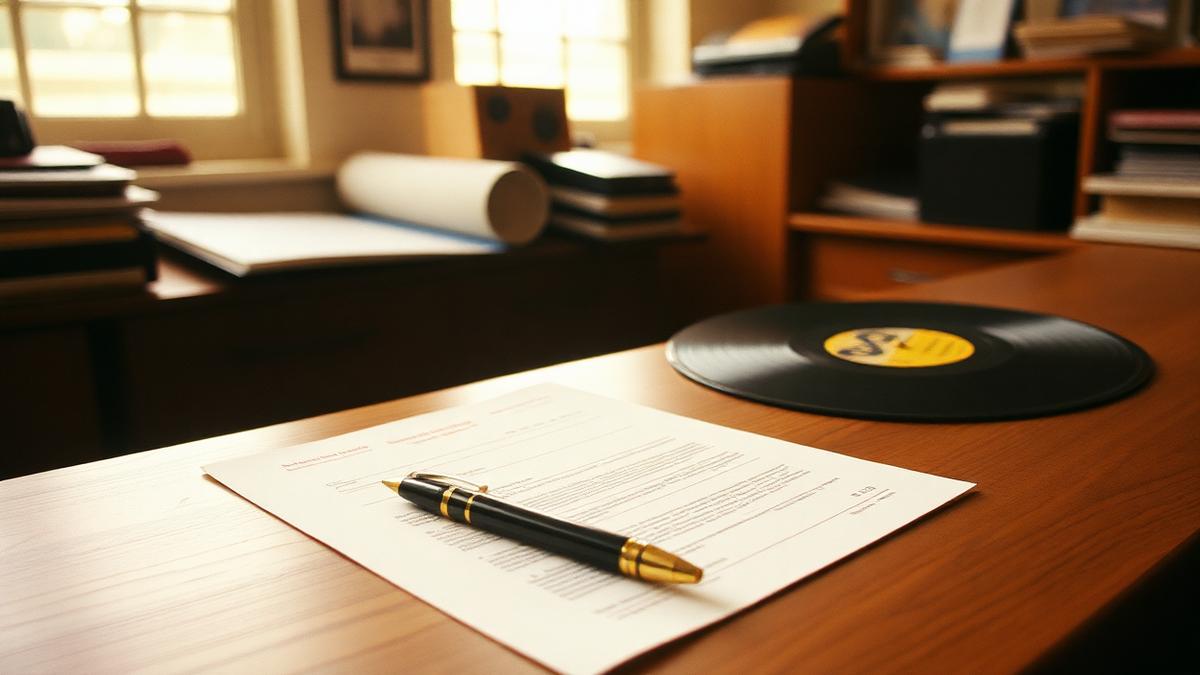
Photo: Katherine Jenkins signing her publishing deal at Rive Droite Music (opens in a new tab) by Danott (opens in a new tab), via Wikimedia Commons — CC BY-SA 3.0 (opens in a new tab)
Key takeaways
- Getting written permission to use part of an existing recording and composition.
- Two clearances, two negotiations.
- There is no legal duration below which sampling is automatically permitted, and clearance is often settled with an upfront fee plus a share of the new master and publishing.
- Clear before release, not after.
- Watch out: believing a few seconds or a heavily processed sample is safe.
Quick checklist
- Can you define sample clearance in one sentence without looking?
- Can you point at sample clearance in a real session, mix or contract?
- Have you tried the practical move above at least once?
- Would you catch the common mistake before it costs you a take?
- Have you opened one of the primary sources below rather than a forum thread?
SAMPLE CLEARANCE IN DEPTH
Sampling a recording requires permission from both the master owner and the publisher of the composition. There is no legal duration below which sampling is automatically permitted, and clearance is often settled with an upfront fee plus a share of the new master and publishing.
How it works in practice
Clear before release, not after. Post-release negotiations start from a position where the rights holder already has leverage.
The mistake people make
Believing a few seconds or a heavily processed sample is safe. Recognisability is not the legal test for the recording.
WHERE SAMPLE CLEARANCE SITS
Sample clearance belongs to rights, royalties and the business in the Sampled music glossary. The words on your split sheet, your distribution dashboard and your royalty statement.
TEST YOURSELF
0/3 answered · 0 correct
3 quick questions on sample clearance. Answers are marked instantly — nothing is sent anywhere.
1. Which statement best describes sample clearance?
2. What is the mistake people most often make with sample clearance?
3. In practice, which of these applies to sample clearance?
Ready for the full thing? Take the 25-question terminology test and get a certificate with your name and score.
SOURCES AND CITATIONS
Free, primary references for sample clearance — standards bodies, manufacturers, government offices and university course material. Each one lists the line of this entry it backs up.
- U.S. Copyright Office — Circular 1 (opens in a new tab)
Government registry · U.S. Copyright Office
“Getting written permission to use part of an existing recording and composition.”— the claim this source supports
Why it counts: This is the office that actually administers the right being described, so its wording governs in a dispute.
- Copyright.gov — fair use index (opens in a new tab)
Government registry · U.S. Copyright Office
“Two clearances, two negotiations.”— the claim this source supports
Why it counts: This is the office that actually administers the right being described, so its wording governs in a dispute.
RELATED TERMS IN RIGHTS, ROYALTIES AND THE BUSINESS
- Sync licence
- Split sheet
- Work for hire
- Distributor vs label
- Advance and recoupment
- Termination rights
- Public domain
- Fair use
Back to the full music glossary or read our latest articles.