 SAMPLED
Synthesis and sound design · updated 2026-08-16
OVERSAMPLING
Running a process at a multiple of the project sample rate so distortion products land above the audible band before being filtered out.
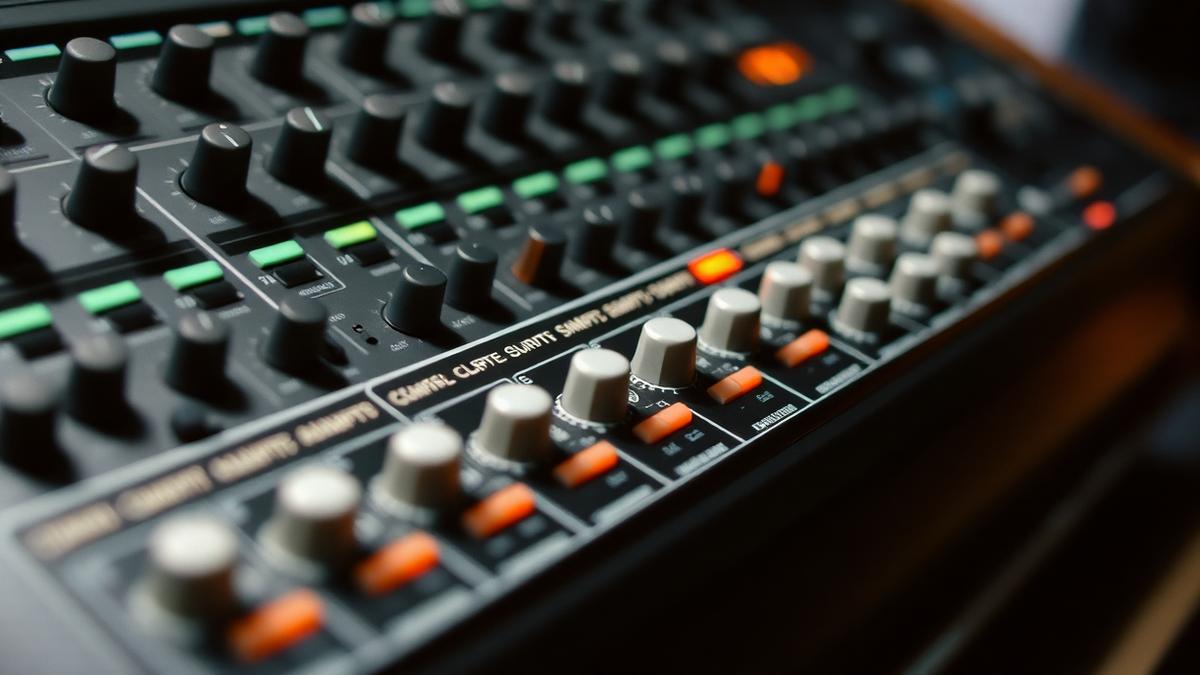
Photo: Eurorack Modular Synthesizer Closeup (opens in a new tab) by Nir Yaniv (opens in a new tab), via Wikimedia Commons — CC BY-SA 4.0 (opens in a new tab)
Key takeaways
- Running a process at a multiple of the project sample rate so distortion products land above the audible band before being filtered out.
- It costs CPU and adds latency but removes the aliasing that makes saturation and clipping sound brittle.
- Enable 4x oversampling on a master clipper for the final bounce, and turn it off while arranging to save CPU.
- Watch out: leaving high oversampling on every instance during composition, then wondering why the project cannot play back.
- Sits under synthesis and sound design in this glossary, with 2 primary sources below.
Quick checklist
- Can you define oversampling in one sentence without looking?
- Can you point at oversampling in a real session, mix or contract?
- Have you tried the practical move above at least once?
- Would you catch the common mistake before it costs you a take?
- Have you opened one of the primary sources below rather than a forum thread?
OVERSAMPLING IN DEPTH
Oversampling runs a process at a higher internal sample rate so distortion products land above the audible band before being filtered and downsampled. It costs CPU and adds latency but removes the aliasing that makes saturation and clipping sound brittle.
How it works in practice
Enable 4x oversampling on a master clipper for the final bounce, and turn it off while arranging to save CPU.
The mistake people make
Leaving high oversampling on every instance during composition, then wondering why the project cannot play back.
WHERE OVERSAMPLING SITS
Oversampling belongs to synthesis and sound design in the Sampled music glossary. How synths make sound, in the order the signal actually travels.
TEST YOURSELF
0/3 answered · 0 correct
3 quick questions on oversampling. Answers are marked instantly — nothing is sent anywhere.
1. Which statement best describes oversampling?
2. What is the mistake people most often make with oversampling?
3. In practice, which of these applies to oversampling?
Ready for the full thing? Take the 25-question terminology test and get a certificate with your name and score.
SOURCES AND CITATIONS
Free, primary references for oversampling — standards bodies, manufacturers, government offices and university course material. Each one lists the line of this entry it backs up.
- Xiph.org — digital audio primer (opens in a new tab)
Open-source standards group · Xiph.Org Foundation
“Running a process at a multiple of the project sample rate so distortion products land above the audible band before being filtered out.”— the claim this source supports
Why it counts: Xiph's write-ups are free, technically rigorous and famously careful about the myths around digital audio.
- Stanford CCRMA — DSP (opens in a new tab)
University research centre · Stanford CCRMA
“Oversampling runs a process at a higher internal sample rate so distortion products land above the audible band before being filtered and downsampled.”— the claim this source supports
Why it counts: The CCRMA course material derives this from first principles, so you can check the maths behind the plain-English version above.
RELATED TERMS IN SYNTHESIS AND SOUND DESIGN
- Subtractive synthesis
- FM synthesis
- Wavetable synthesis
- Granular synthesis
- Polyphony / paraphony / monophony
- Modulation matrix
- CV/Gate
- Aliasing
Back to the full music glossary or read our latest articles.