 SAMPLED
Music theory basics · updated 2026-08-16
KEY AND KEY SIGNATURE
The home pitch a piece gravitates to, plus the sharps or flats written at the start of the staff that spell out its scale.
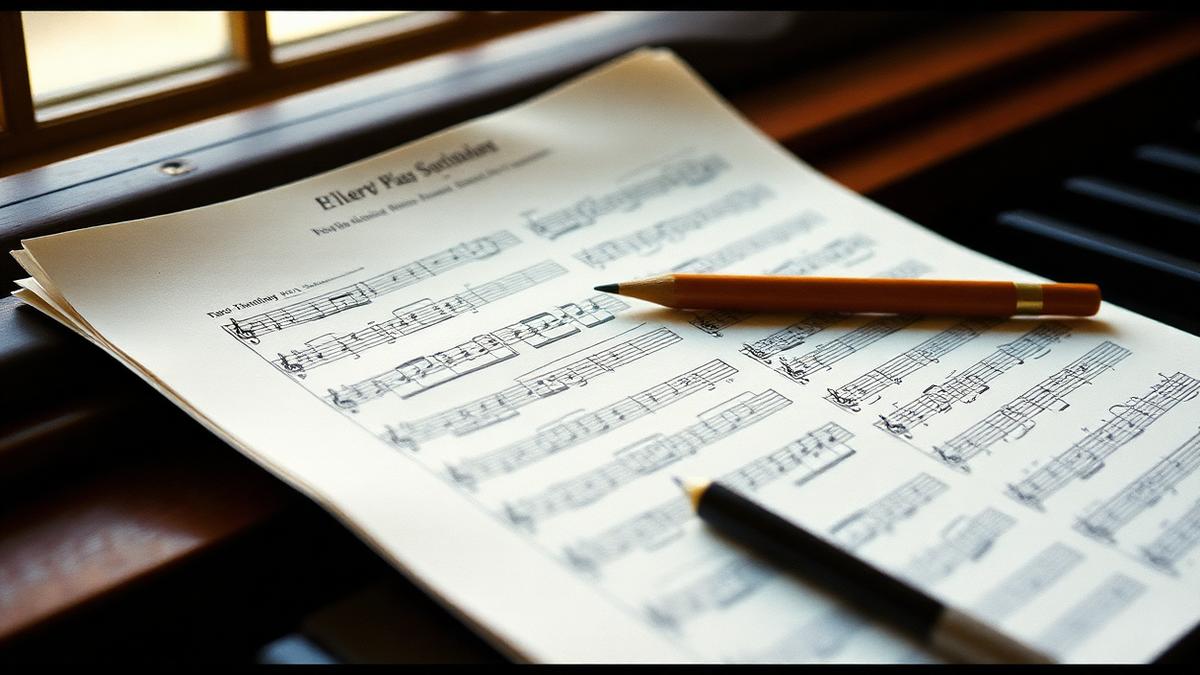
Photo: Music Sheet, Mozart's Alla Turca (opens in a new tab) by Schiller12 (opens in a new tab), via Wikimedia Commons — CC BY-SA 4.0 (opens in a new tab)
Key takeaways
- The home pitch a piece gravitates to, plus the sharps or flats written at the start of the staff that spell out its scale.
- Knowing the key lets you transpose, pick a sample that will not clash, and communicate with session players in one word.
- A track labelled 'F minor, 140' can immediately be paired with a loop in F minor or A♭ major — its relative major — without pitch-shifting.
- Watch out: trusting the key detection in your DAW or sample marketplace.
- Sits under music theory basics in this glossary, with 2 primary sources below.
Quick checklist
- Can you define key and key signature in one sentence without looking?
- Can you point at key and key signature in a real session, mix or contract?
- Have you tried the practical move above at least once?
- Would you catch the common mistake before it costs you a take?
- Have you opened one of the primary sources below rather than a forum thread?
KEY AND KEY SIGNATURE IN DEPTH
The key is the pitch centre a piece keeps returning to; the key signature is the notation shorthand that spells that key's sharps or flats once at the start rather than in front of every note. Knowing the key lets you transpose, pick a sample that will not clash, and communicate with session players in one word.
How it works in practice
A track labelled 'F minor, 140' can immediately be paired with a loop in F minor or A♭ major — its relative major — without pitch-shifting.
The mistake people make
Trusting the key detection in your DAW or sample marketplace. Detection routinely reports the relative major instead of the minor, and it misfires badly on drum-heavy or heavily processed material.
WHERE KEY AND KEY SIGNATURE SITS
Key and key signature belongs to music theory basics in the Sampled music glossary. The vocabulary you need before anyone can explain a chart, a chord chart, or a session to you.
TERMS THAT DEPEND ON KEY AND KEY SIGNATURE
- Chord progression
A sequence of chords over time. Roman numerals (I–V–vi–IV) describe it in a key-neutral way so you can move it to any key.
- Equal temperament
The tuning system that splits the octave into twelve equal semitones so every key sounds usable, at the cost of pure intervals.
- Just intonation
Tuning built from small whole-number frequency ratios. Intervals beat less, but the tuning only works cleanly in a limited set of keys.
- Diatonic vs chromatic
Diatonic material stays inside the seven notes of the key. Chromatic material borrows the other five for colour, tension or modulation.
- Stem
A submix of one element or group — drums, vocals, keys — printed as its own file for mixing, remixing or live playback.
- Sample library vs sampler
A library is the recorded content; a sampler is the instrument that maps, loops and plays it back across a keyboard.
TEST YOURSELF
0/3 answered · 0 correct
3 quick questions on key and key signature. Answers are marked instantly — nothing is sent anywhere.
1. Which statement best describes key and key signature?
2. What is the mistake people most often make with key and key signature?
3. In practice, which of these applies to key and key signature?
Ready for the full thing? Take the 25-question terminology test and get a certificate with your name and score.
SOURCES AND CITATIONS
Free, primary references for key and key signature — standards bodies, manufacturers, government offices and university course material. Each one lists the line of this entry it backs up.
- musictheory.net — key signatures (opens in a new tab)
Free interactive lessons · musictheory.net
“The home pitch a piece gravitates to, plus the sharps or flats written at the start of the staff that spell out its scale.”— the claim this source supports
Why it counts: Short interactive drills that let you test the concept immediately rather than only read about it.
- Library of Congress — reading music (opens in a new tab)
National library · Library of Congress
“The key is the pitch centre a piece keeps returning to; the key signature is the notation shorthand that spells that key's sharps or flats once at the start rather than in front of every note.”— the claim this source supports
Why it counts: Archival primary material, which is about as stable a reference as this subject gets.
RELATED TERMS IN MUSIC THEORY BASICS
Back to the full music glossary or read our latest articles.