 SAMPLED
Analog vs digital oscillators: an honest comparison
What analog genuinely does better, what digital does better, and where the difference stops mattering.
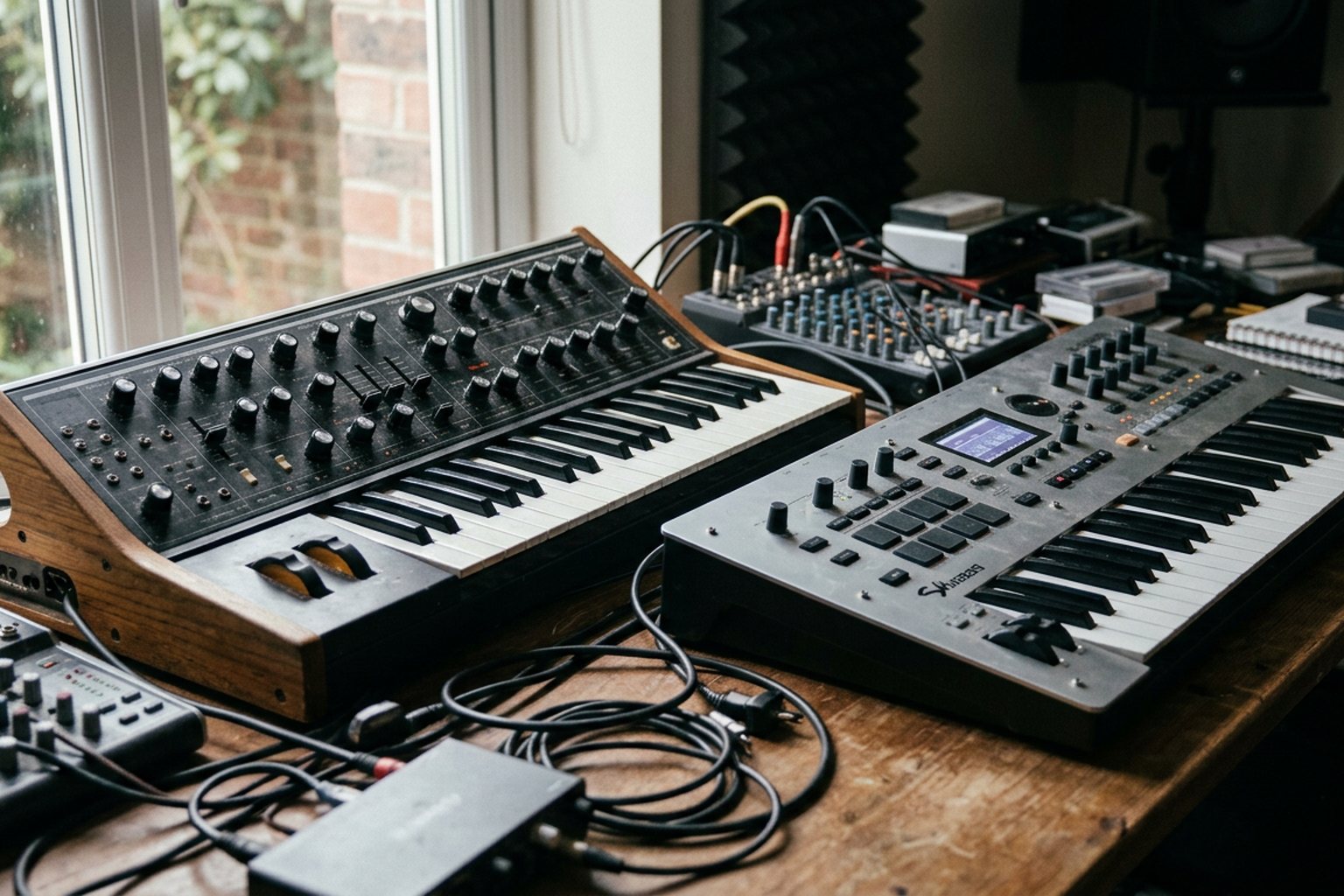
The debate between analog and digital synthesizers has dragged on for four decades, usually bogged down by nostalgic romance or spec-sheet elitism. Stripping away the marketing noise reveals that the distinction at the oscillator level comes down to fundamental physics versus mathematical calculation. Neither approach is objectively superior, but they behave in ways that directly shape how you program patches, manage pitch, and mix tracks.
How Analog Oscillators Actually Generate Sound
Analog oscillators rely on continuous electrical currents charging and discharging physical capacitors. In a Voltage Controlled Oscillator (VCO), an incoming control voltage alters the rate of this charge cycle, changing the fundamental pitch. The raw output of a basic core is typically a sawtooth or triangle wave. Circuit designers then run this core signal through analog wave-shaping circuits to derive pulse waves, variable square waves, or sine approximations.
Because physical electronic components react to temperature changes, power supply fluctuations, and manufacturing tolerances, analog oscillators never produce a perfectly static, frozen wave cycle. Even highly stable designs—such as the Curtis CEM3340 microchips found in late-seventies and eighties instruments like the Sequential Prophet-5 or Oberheim OB-Xa—exhibit microscopic pitch wander and subtle harmonic distortion. Early discrete-transistor circuits, like those in early Minimoog Model D units, were notorious for scaling drift across octaves until the components warmed up to operating temperature.
Digitally Controlled Oscillators (DCOs) were developed to solve this tuning instability. Found in classics like the Roland Juno-106 and Roland JX-3P, a DCO is not a digital sound engine. It uses an analog capacitor-charging circuit to generate the actual audio waveform, but uses a digital microprocessor clock to reset the cycle at precise intervals. The signal remains entirely analog, but the pitch stability matches a digital clock. This removes thermal drift while preserving the raw analog wave shape, though some synthesists argue it sacrifices the organic beating phase relationships produced by free-running VCOs detuned against one another.
How Digital Oscillators Work (and Where They Excel)
Digital oscillators generate sound by calculating numerical values and feeding those numbers into a digital-to-analog converter (DAC) at a fixed sample rate. Instead of relying on physical component physics, a digital oscillator steps through stored lookup tables (wavetable synthesis) or computes geometric equations in real time (virtual analog modeling and frequency modulation).
The primary engineering hurdle for digital oscillators is aliasing. When a digital system generates harmonic content that exceeds half the sample rate—the Nyquist limit—those high frequencies do not simply disappear. They bounce back down into the audible spectrum as harsh, inharmonic frequencies that sound detached from the fundamental pitch. Modern digital synthesis uses band-limited step functions (BLEP), anti-aliasing algorithms, and high-ratio internal oversampling to eliminate these artifacts.
Once aliasing is controlled, digital oscillators offer unmatched capabilities:
- Waveform variety: A single digital core can seamlessly morph through hundreds of complex wavetables, complex additive spectra, or single-cycle samples that physical analog circuits cannot generate.
- Absolute pitch precision: Digital phase modulation (FM) requires exact, static frequency ratios between operators to maintain musical harmonic structures. Analog VCOs drift too much to keep complex multi-operator FM patches stable across the keyboard.
- Polyphonic efficiency: Generating dozens of digital oscillator voices requires DSP processing power rather than physical circuit boards filled with matched transistors, keeping physical footprint and power draw minimal.
Instruments like the classic Waldorf PPG Wave, the Sequential Prophet VS, and modern Eurorack digital cores like Mutable Instruments Plaits demonstrate how digital oscillators expand sound design beyond basic geometric shapes.
The Core Comparison
Comparing how these oscillator architectures perform in daily studio and live applications helps clarify which tool fits a specific production task.
| Feature | Analog VCO | Analog DCO | Virtual Analog (DSP) | Wavetable / Advanced Digital |
|---|---|---|---|---|
| Pitch Stability | Moderate (Temperature dependent) | High (Microprocessor locked) | Absolute (Unless drift is modeled) | Absolute |
| Harmonic Variety | Saw, Pulse, Tri, Sine approximations | Saw, Pulse, Sub-oscillators | Standard shapes + modeled quirks | Complex tables, additive, FM, morphing |
| Phase / Pitch Drift | Continuous organic instability | Microprocessor locked, phase static | Optional algorithmic drift | Static phase unless programmed |
| Aliasing Risk | None | None | Negligible in modern engines | Negligible in modern engines |
| Voice Density Cost | High footprint and circuit cost | Moderate footprint and circuit cost | Low per-voice processor cost | Low per-voice processor cost |
Where the Difference Stops Mattering
Focusing strictly on the oscillator misses how synthesizers actually generate pleasing timbres. An oscillator in isolation is rarely what makes an instrument sound compelling. A raw sawtooth wave from an analog VCO looks and sounds remarkably similar to a band-limited digital sawtooth wave when auditioned dry in a room.
The perceived warmth, punch, and depth of classic hardware often happen downstream from the generator:
- Filter Nonlinearities: Analog filters introduce phase shifts, resonance saturation, and asymmetric clipping as signals hit the ladder or state-variable circuits. Pushing a clean digital oscillator into a real analog filter yields a thick, cohesive sound.
- Gain Staging: Analog mixers and VCAs soft-clip signal peaks when driven hard, compressing transients in a way that feels musically responsive.
- Hybrid Signal Paths: Instruments like the Novation Peak or Sequential Prophet-600 demonstrate that pairing digital or digitally controlled oscillators with true analog filters delivers the tuning reliability and complex wave shapes of digital alongside the warm saturation of analog processing.
Once a synthesizer track is recorded into a DAW, equalized, compressed, and arranged alongside acoustic drums, vocal tracks, and room reverb, the micro-level pitch instability of a VCO rarely dictates whether the track works in a mix.
Quick Answers
Do digital oscillators still sound cold or thin?
No. Early digital synthesizers from the late seventies and eighties suffered from low bit depth, low sample rates, and primitive DACs, which created harsh aliasing and a sterile top end. Modern DSP runs at high sample rates with advanced oversampling algorithms, allowing digital oscillators to sound rich, full, and virtually indistinguishable from analog sources when running standard subtractive patches.
Are DCOs real analog oscillators?
Yes. A Digitally Controlled Oscillator generates its sound using an analog circuit charging and discharging a capacitor. The digital element is simply a master clock that tells the capacitor when to reset its charge cycle to keep the pitch perfectly in tune. The audio path itself remains entirely analog.
What causes pitch drift in analog synthesizers?
Pitch drift is caused by ambient temperature changes, component heating inside the synth chassis, and minor voltage fluctuations. As transistors and capacitors warm up, their internal resistance changes, altering the rate at which the oscillator core charges and discharges. Modern analog synths use thermal compensation circuits or automated background tuning routines to control this drift.
Which oscillator type is better for sub-bass?
Both have clear advantages. Digital oscillators and DCOs offer perfect phase alignment and static tuning, preventing the fundamental sub-frequency from dropping out due to phase cancellation when layered. However, a single raw analog VCO with a clean triangle or sine wave provides a deep, smooth low end without any digital filtering artifacts.
Making the Practical Choice
Choose your gear based on architecture and workflow rather than circuit dogmatism. If your music relies on evolving atmospheric pads, complex metallic textures, precise FM bass, or massive polyphonic voice counts, digital oscillators are the correct tool for the job. If you want instant sweet spots, organic beating between detuned voices without extra menu diving, and simple subtractive sound design that fills out a sparse mix, analog hardware remains efficient and rewarding. Focus on how the instrument operates in your signal chain, not the physical properties of its signal generator.