 SAMPLED
Effects for analog synths: what to buy first
Reverb, delay, and drive in the order that actually improves your patches.
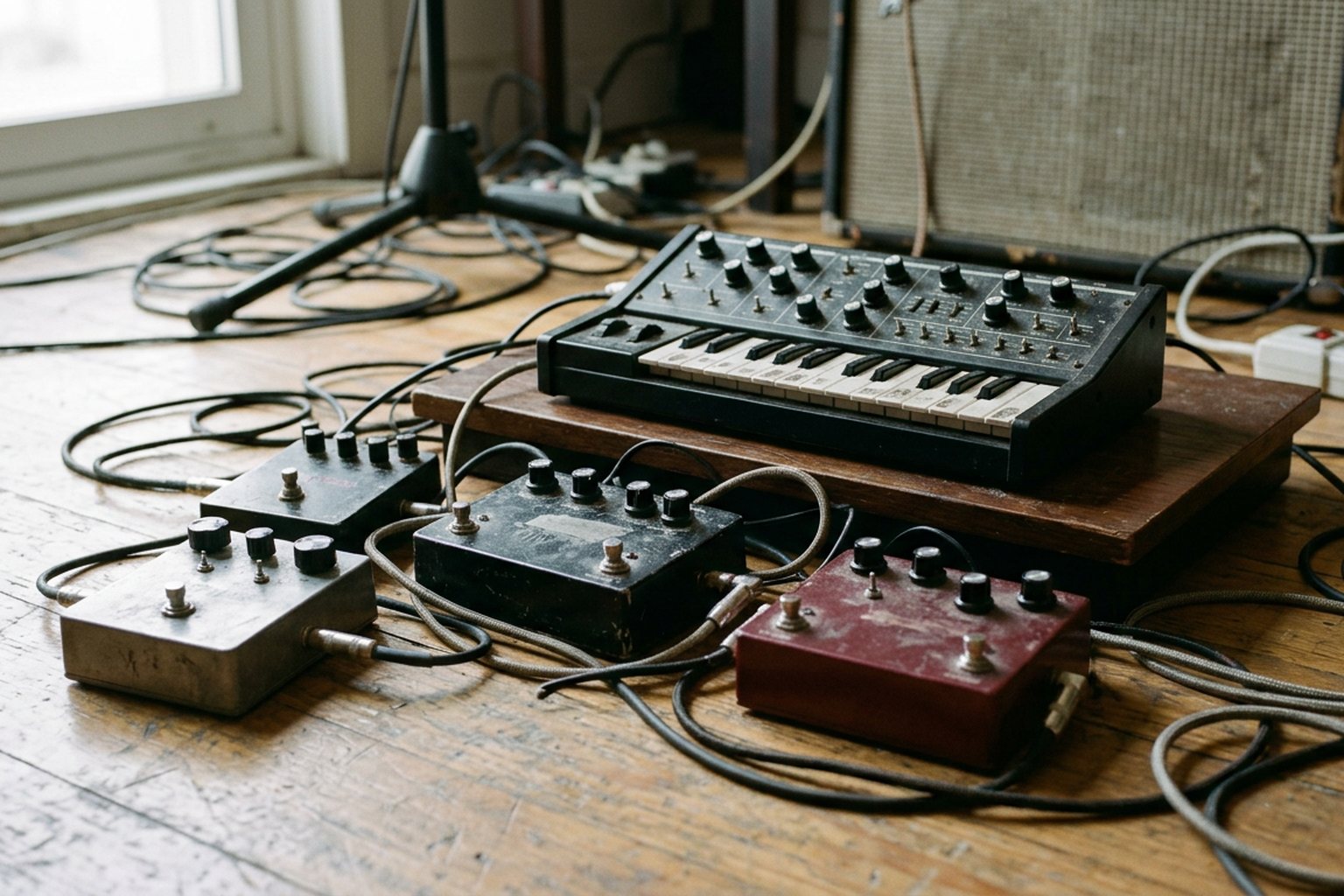
Analog synthesizers are celebrated for their raw, uncompromising sound, but dry oscillators straight out of an output jack rarely sound complete in a mix. Without spatial depth or subtle harmonic distortion, even a classic subtractive patch can sound clinical and disconnected from the rest of your track. If you are building your first hardware rig, buying the right effects processors in the correct order will do far more for your tone than buying another synthesizer.
Line Level vs. Instrument Level: The Technical Baseline
Before shopping for outboard gear, you must address signal levels and impedance. Synthesizers output line-level signals, which are significantly hotter than the low-level, high-impedance signals produced by electric guitars. Standard synth outputs run anywhere from consumer line level (-10 dBV) to professional line level (+4 dBu).
Plugging a hot synthesizer output directly into a standard guitar pedal designed for passive pickups creates two distinct problems:
- Input Stage Overload: The incoming signal clips the pedal’s input buffer before the effect circuit even processes the audio. In digital pedals, this creates harsh digital distortion. In analog pedals, it squashes dynamic response and ruins headroom.
- Impedance Mismatch: Guitars expect an input impedance of around 1 Megaohm, whereas synth outputs are driven by low-impedance line drivers (typically under 1 kilohm). Plugging low-impedance sources into high-impedance inputs without proper gain staging can alter the frequency response, often dulling top-end detail or introducing an elevated noise floor.
To avoid these issues, select processors built with generous headroom or dedicated line/instrument switches. Modern digital stompboxes from manufacturers like Strymon, Eventide, and Universal Audio handle high signal levels natively. If you want to use vintage or simple analog guitar pedals, place a passive attenuator or a re-amping box between your synth and the pedalboard, or run your hardware through a mixer with dedicated auxiliary sends and returns.
1. Stereo Delay: The True Priority
If you can only buy one processor for your synth setup, start with a stereo delay. Beginner synth owners often buy reverb first, but reverb quickly muddy dense synth patches. A good delay creates space, rhythmic movement, and stereophonic width while keeping the core transient of your patch sharp and distinct.
Delay affects your sound differently depending on the circuit topology you choose:
Bucket Brigade Device (BBD) Analog Delays
Found in classics like the Electro-Harmonix Deluxe Memory Man and modern analog desktop units, BBD chips pass audio through a series of physical capacitors. Every repeat loses high-frequency energy and gains subtle clock noise and distortion. Because the repeats darken rapidly, they sit behind your dry synth patch without competing for mid-range clarity. This makes BBD delays exceptional for arpeggiated synth lines and fast bass sequences.
Tape Emulation Delays
Processors like the Boss RE-202 or Strymon Volante emulate mechanical tape echo units like the Roland RE-201 Space Echo. They add wow, flutter, pitch instability, and tape saturation to the wet signal. On static analog patches—like a basic two-oscillator pad—the subtle modulation of a tape delay injects organic life into sounds that would otherwise feel stiff.
Stereo Width and Ping-Pong Delays
Many of the most popular analog synths—such as the Korg MS-20, Moog Subsequent 37, or Dreadbox Erebus—are strictly mono devices. Passing a mono synth signal through a stereo ping-pong delay bounces wet repeats back and forth across the left and right channels. This transforms a narrow central lead into a massive stereo image without relying on phase-canceling stereo chorus pedals.
2. Saturation and Drive: Giving Oscillators Weight
Subtractive analog synths generate rich harmonic content, but filtering down raw sawtooth and square waves can sometimes leave a patch feeling thin in a multitrack mix. Overdrive, distortion, and tape saturation sit second in priority because they shape the fundamental frequency response and dynamic feel of your patch before it hits spatial effects.
Placing drive directly after your synth allows the harmonic distortion to interact dynamically with your filter envelope. As your synth's filter opens up, the higher signal level pushes the saturation circuit harder, creating an evolving harmonic response.
+------------------+     +-------------------+     +------------------+     +------------------+
|                  |     |                   |     |                  |     |                  |
|  Analog Synth    | --> | Overdrive / Drive | --> |   Stereo Delay   | --> |  Stereo Reverb   |
|  (Mono or Stereo)|     |  (Serial Insert)  |     | (Spatial Width)  |     | (Acoustic Space) |
+------------------+     +-------------------+     +------------------+     +------------------+
Different drive topologies suit different synth roles:
- FET and Transistor Preamps: These circuits add subtle odd-order harmonics and mild soft-clipping compression. They round off sharp filter transients, adding weight and punch to basslines and synth leads.
- Hard-Clipping Distortion: Circuits like the ProCo Rat or classic Japanese distortion pedals clip the audio wave aggressively. They are the standard tool for turning simple resonant basslines (such as those from a Roland TB-303) into aggressive acid lines.
- Polyphonic Considerations: Be cautious when running polyphonic synths (like a Prophet-5 or Minilogue) through heavy distortion. Playing complex chords through high-gain circuits produces intermodulation distortion, where sum and difference frequencies create harsh, unmusical mud. For polyphonic synths, stick to subtle tape saturation or dedicated stereo bus processors.
3. Reverb: The Final Spatial Layer
Reverb sits at the end of the signal chain to place your synth inside a simulated acoustic or artificial environment. Synthesizers produce continuous sustain and ultra-wide frequency ranges that strain reverb algorithms much more than dynamic acoustic instruments do. Inexpensive reverbs convert sustained sawtooth waves into a resonant low-end smear.
When selecting a reverb processor for synthesizers, prioritize units that feature a built-in high-pass filter (low-cut) on the wet decay tail. Removing frequencies below 100 to 200 Hz from the wet signal keeps the reverb tail from obscuring your kick drum and synth bass lines.
Algorithmic Reverbs
Units like the Eventide Space, Strymon BigSky, or Empress Reverb offer massive, non-linear decay times, modulation, and shimmer pitch-shifting. Algorithmic reverbs do not try to emulate real rooms; instead, they generate lush artificial tails that act as an extension of the synthesizer itself, making them ideal for ambient pads and cinematic sound design.
Plate and Spring Reverbs
For punchy leads and vintage-style synth patches, plate and spring emulations provide quick density without cluttering the stereo field. Plate reverbs offer a smooth, bright decay tail that sits behind a lead patch, adding smooth depth without taking up low-mid frequencies.
Comparing the Core FX Categories
| Processor Category | Signal Chain Position | Headroom Needs | Primary Sonic Benefit | Recommended Patch Types |
|---|---|---|---|---|
| Overdrive / Saturation | First (Directly after synth) | High (Prone to input clipping) | Adds harmonic weight, tames harsh transients, compresses dynamics | Mono leads, aggressive acid basslines, thin raw oscillators |
| Modulation (Chorus/Phaser) | Second (Before delay) | Medium | Creates movement, widens mono patches via phase offset | Static pads, string machines, vintage polysynth emulations |
| Stereo Delay | Third (Before reverb) | Medium to High | Adds rhythm and width without obscuring low end or transients | Arpeggios, syncopated sequences, mono synth stereo widening |
| Reverb | Last (End of chain or Aux send) | Medium to High | Places patches in physical or continuous artificial space | Ambient pads, slow brass patches, sound effects, swells |
Signal Chain Layout and Routing Options
Wiring your effects in the correct order prevents unwanted noise and preserves sound clarity.
For a standard inline pedalboard rig, connect your gear in this sequence: Synth → Overdrive/Saturation → Stereo Modulation → Stereo Delay → Stereo Reverb → Interface/Mixer.
If you work with an analog hardware mixer, consider running your spatial processors (delay and reverb) via Auxiliary Sends and Returns rather than as direct inline inserts.
Parallel routing offers distinct advantages:
- Your dry synth signal remains completely pure and uncolored by digital conversion.
- A single high-end delay or reverb unit can process multiple synthesizers simultaneously.
- You can high-pass filter the auxiliary return channels on the mixer to control low-end mud across all connected instruments.
Quick answers
Can I use guitar pedals directly with my synth without clipping?
Yes, provided you monitor gain staging carefully. If the pedal lacks a line/instrument level switch, turn down the synth’s main output volume to roughly 20–30 percent, send the signal into the pedal, and make up the lost volume using your mixer or audio interface preamp.
Why does my synth sound muddy when I turn on reverb?
Synthesizers output broad frequency spectrums with continuous sustain. If low frequencies enter a reverb algorithm, they create long, dense tails that overwhelm the mix. Use a reverb pedal with an integrated low-cut (high-pass) filter to shave off frequencies below 150 Hz on the wet tail.
Is a stereo delay useful if my synth only has a mono output?
Yes. Stereo delay is one of the most effective tools for turning a mono synth signal into a wide stereo field. By using ping-pong modes or slight time offsets between the left and right channels, you create spatial separation without causing phase cancellation issues.
Should I put chorus before or after delay?
Place modulation effects like chorus, flangers, and phasers before delay and reverb. Placing modulation after delay modulates the delay repeats themselves, which often creates unstable pitch artifacts and reduces mix clarity.
Selecting effects for an analog synth is an exercise in control. Avoid the temptation to buy a long chain of cheap pedals all at once. Start by picking a flexible, high-headroom stereo delay to handle spatial positioning, add a subtle saturation tool to shape your dynamics, and finish with a clean, filterable reverb. Learning how each processor handles your synth's frequency range individually will result in cleaner mixes and better patches.