 SAMPLED
Analog synth myths that will not die
Blind-test reality checks on warmth, presets, and the idea that a filter can fix a bad idea.
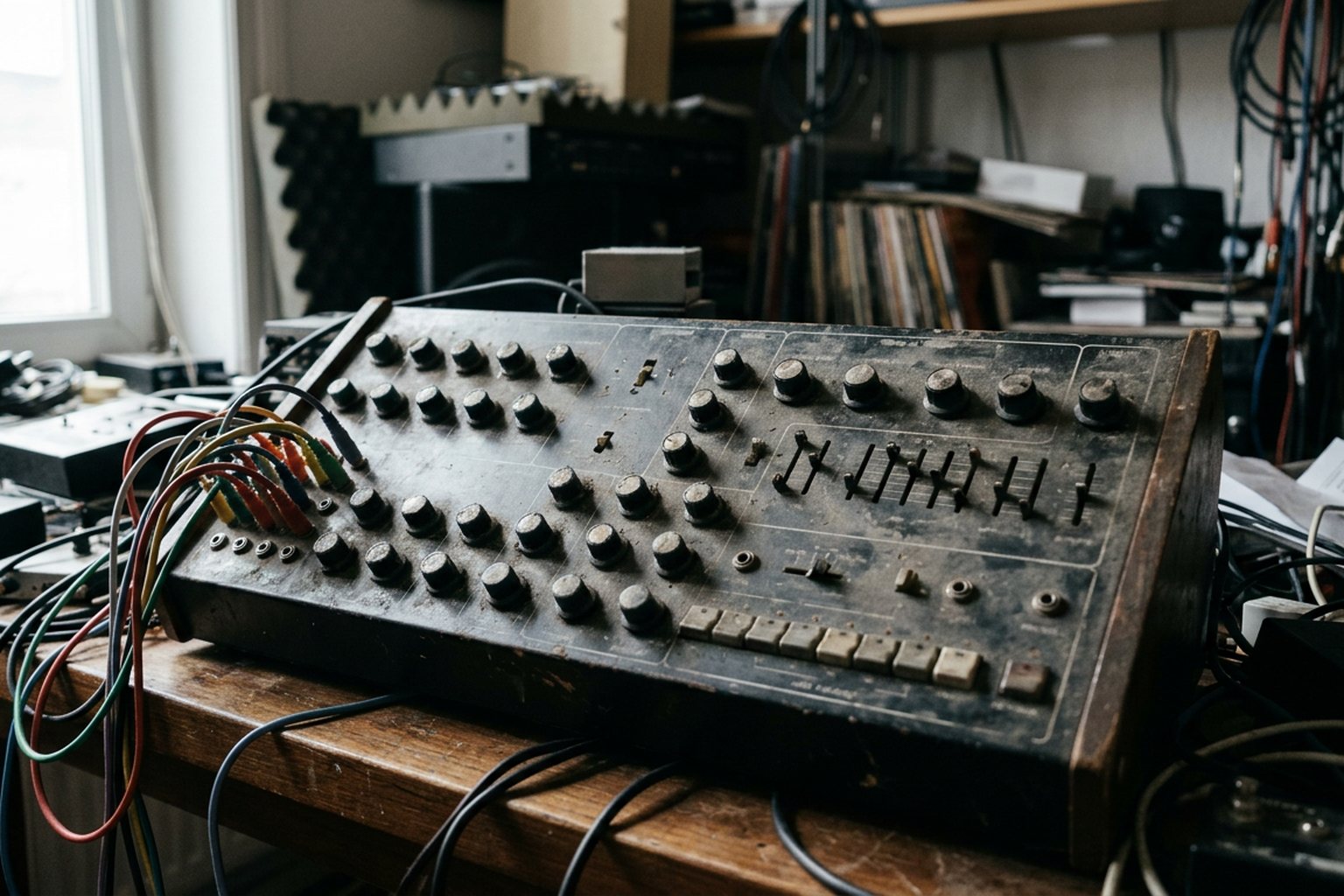
For decades, synthesizer culture has been choked by romantic revisionism. We are told that voltage-controlled circuitry possesses an organic soul that no digital system can replicate, and that owning an analog synth automatically elevates a track from amateurish to professional. In double-blind listening tests and real-world studio mixdown environments, these absolute dogmas fall apart instantly.
Myth 1: Analog automatically means warm, while digital means cold
The word "warmth" is the most abused term in music production. When engineers talk about warmth, they are usually describing a combination of subtle harmonic distortion, a rolled-off high end, and gentle low-frequency saturation. None of these characteristics are inherently tied to an analog signal path.
An analog synth can sound bracingly cold, sharp, and aggressive. The Korg MS-20, with its unyielding Korg35 high-pass and low-pass filters, is famous for producing abrasive, screaming textures that bite through a mix like broken glass. Similarly, polyphonic synths from the early eighties built around integrated Curtis CEM chips often sound punchy, bright, and mid-forward rather than soft or pillowy.
Conversely, digital synthesis is not restricted to thin or clinical tones. A modern digital synthesizer running high-resolution, oversampled digital signal processing (DSP) can generate deep low-end resonance and smooth high-frequency response without introducing unwanted digital aliasing. "Warmth" is a product of architecture, gain staging, and filtering techniques, not the physical nature of the component passing the current. If you push an analog input stage too hard without understanding signal flow, you get harsh, unwanted clipping rather than pleasing analog saturation.
Myth 2: Digitally controlled oscillators aren't true analog
The debate between Voltage Controlled Oscillators (VCOs) and Digitally Controlled Oscillators (DCOs) remains a source of endless online confusion. Many musicians mistakenly assume that a synth featuring DCOs—such as the Roland Juno-106 or the Dave Smith Instruments Prophet '08—is secretly a digital hybrid instrument playing low-resolution samples.
This is factually incorrect. A DCO is a fully analog oscillator circuit. The difference lies entirely in how the oscillator's pitch is managed.
In a traditional VCO circuit, pitch is determined by variable control voltages. Because electronic components expand and contract with temperature shifts, VCOs are notorious for pitch drift, requiring manual tuning routines and thermal compensation circuits.
In a DCO circuit, a digital microprocessor sends precise clock pulses to reset the charge on an analog capacitor, forcing the analog core to maintain exact tuning stability. The generated waveform—whether saw, triangle, or square—is an continuous analog signal. It passes through real voltage-controlled filters (VCFs) and voltage-controlled amplifiers (VCAs).
| Concept / Component | Popular Misconception | Technical Reality |
| :--- | :--- | :--- |
| **VCO vs. DCO** | DCOs use digital samples instead of analog waveforms. | DCOs use an analog wave-generating core governed by a digital timing clock. |
| **Analog Pitch Drift** | Continuous drift is required to make a synthesizer sound wide and organic. | Uncontrolled drift causes out-of-tune phase cancellation in dense polyphonic mixes. |
| **Ladder Filters** | Resonance boosts lower frequencies to add low-end power. | Classic 24dB ladder filters attenuate low frequencies as resonance increases. |
| **Presets** | Using factory patches compromises artistic authenticity. | Patch storage was developed specifically to allow musicians to focus on performance. |
While VCOs do exhibit subtle, free-running phase inconsistencies that create a pleasing chorus-like beating when detuned, DCOs provide tight, punchy transient responses that excel in basslines and complex chords. Neither is superior; they are simply different engineering solutions to the challenge of tuning stability.
Myth 3: Real synthesists build every patch from scratch
A persistent strain of gear snobbery dictates that using presets is lazy, and that true sound designers must start every session with an initialized patch. This mindset ignores both the history of the instrument and the practical realities of music production.
When Sequential Circuits released the Prophet-5 in the late seventies, its defining breakthrough was not its voice architecture, but its digital patch memory. For the first time, a musician could save complex sound settings and recall them instantly on stage. The synth became a commercial triumph precisely because players were exhausted by repatch routines between songs.
Some of the most iconic synth lines in modern music history were played straight out of factory banks:
- The sharp brass stabs on classic pop records came straight from Oberheim and Sequential factory presets.
- The iconic bass sounds of nineties house music relied heavily on unedited preset patches from the Casio CZ series and Korg M1.
- Industrial and soundtrack compositions routinely used unedited soundbanks from early digital and analog units.
Spending three hours tweaking an envelope generator does not make a song better. A great patch is merely a source texture; the song relies on performance, arrangement, cadence, and mix placement. If a preset fits the context of your track immediately, using it is efficient workflow, not a creative failure.
Myth 4: A great filter can save a bad musical idea
There is a widespread belief that passing any mundane audio signal through a famous analog filter—like a Minimoog 24dB/octave low-pass ladder filter or an Oberheim SEM state-variable filter—will magically turn a dull line into a hit track.
Filters are subtractive tools. They do not generate musical content; they carve away frequencies that already exist in the source signal. If the underlying oscillator waveform is thin, or if the chord voicing is muddy, sweeping a low-pass filter merely changes the volume of a poorly constructed signal.
Furthermore, cranking the resonance control on a classic ladder filter actually strips away the low-end fundamental frequencies due to internal phase cancellation. If you sweep a highly resonant filter over an improperly voice-led keyboard part, you end up with unpredictable volume spikes and a loss of low-end weight in the mix. An analog filter is a precision tone-shaping tool, not a magical sound repair kit.
Quick answers
Do analog synths really need time to warm up before playing?
Yes, synths with VCOs require ten to twenty minutes for their internal temperatures to stabilize. Before the components reach operating temperature, the pitch tracking across octaves will be unpredictable and out of tune. DCO and digital synths do not require a warm-up period.
Are software emulations indistinguishable from real analog hardware?
In the context of a full, busy commercial mix, high-end software emulations are virtually indistinguishable from hardware. Where hardware still holds an advantage is in immediate physical control surfaces, zero-latency feedback loops, and extreme gain-staging non-linearities when overdriving filter circuits.
Should a beginner start with an analog monophonic synth or a digital polyphonic synth?
A beginner should prioritize control layout over component topology. A synth with a clear, knob-per-function front panel—whether analog or digital—will teach synthesis fundamentals far better than a complex analog synth buried behind deep digital menu structures.
Stop evaluating instruments based on internet mythology, component fetishism, or vintage hype. Select your equipment based on panel layout, tactile feedback, and workflow speed. An instrument's value is measured strictly by how efficiently it allows you to translate an idea into a completed recording, regardless of whether the voltage moving through its circuits is continuous, stepped, or modeled in code.