 SAMPLED
Analog synths for live performance
Patch recall, tuning under stage lights, and building a rig you can carry in one trip.
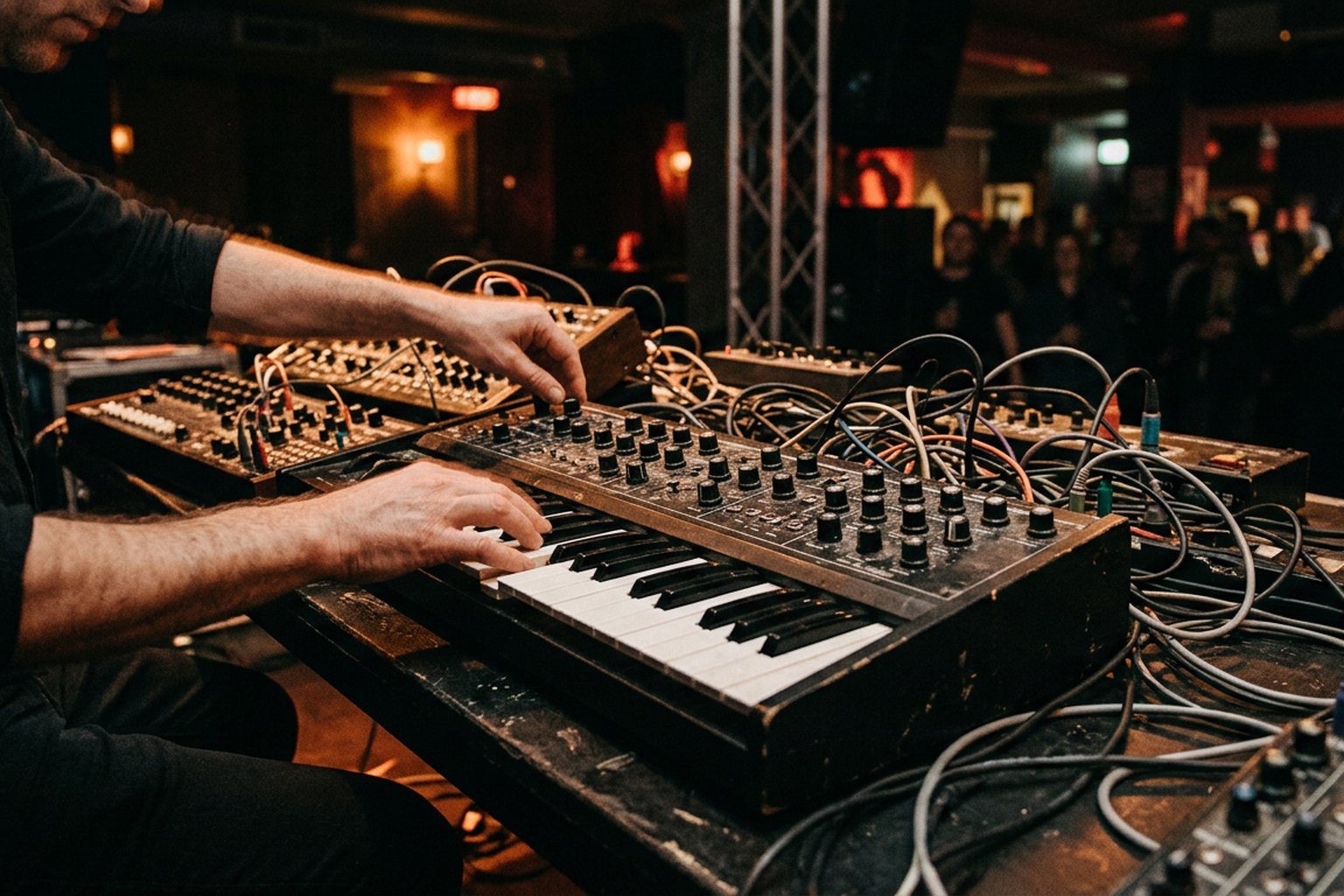
Taking an analog synthesizer out of the studio and onto a dark, beer-slicked stage is an exercise in managed chaos. What sounds warm and detailed in a climate-controlled tracking room can quickly turn into an out-of-tune, volume-spiking liability under hot stage lights and harsh floor monitors. Building a gig-worthy analog rig isn't about collecting rare vintage circuits; it's about picking instruments that stay in tune, switch patches seamlessly, and pack down into a single haul from the curb to the green room.
Pitch Drift and Thermal Reality
Analog oscillators rely on physical components—transistors, capacitors, and resistors—whose electric behavior shifts with temperature. If you take a synth from a cold band van straight onto a stage heated by tungsten lamps or packed crowds, its pitch will drift.
Studio Environment (Stable Pitch)   -->   Stage Environment (Variable Pitch)
[21°C / Constant Humidity]                [Thermal Shift / AC Drafts / Stage Lights]
    └─ Voltage-Controlled Oscillators         └─ Transistor Junction Voltages Shift
       Maintain Calibrated Tuning                └─ Uncompensated VCOs Drift Off-Pitch
Oscillator design dictates how severe this shift will be:
- Voltage-Controlled Oscillators (VCOs): Found in classic architectures like the Moog Minimoog and Sequential Prophet-5. VCOs offer organic, subtle pitch instability that delivers iconic analog thickness. On stage, however, uncompensated VCOs require a 15- to 30-minute warm-up period to stabilize. Modern VCO synths, such as the Sequential Prophet-6 or Korg Prologue, feature microprocessor-controlled auto-tuning routines. Hitting a designated "Tune" button between songs forces the digital control layer to recalibrate oscillator voltages across all voices in seconds.
- Digitally Controlled Oscillators (DCOs): Found in synths like the Roland Juno-106 or Sequential Prophet Rev2. DCOs use an analog core driven by a digital master clock. The signal path remains completely analog—filters, amplifiers, and modulation—but pitch drift is eliminated. For touring acts running complex arrangements or playing outdoor festivals with drastic temperature swings, DCO synths deliver analog timbre without tuning anxiety.
If you run VCO-based gear on stage, power your rig up as soon as load-in happens. Let the internal temperature equalize before your soundcheck, and map a quick-tune button or key shortcut to your muscle memory.
The Preset Dilemma and Potentiometer Modes
Unpatched analog synths require manual knob-turning to change sounds. That approach works for ambient sets or long improvisations, but for a 45-minute festival set with tight transitions, preset recall is essential.
When you load a preset on an analog synth, the physical positions of the knobs on the front panel no longer match the active internal values. The moment you touch a filter knob during a solo, the synth must decide how to handle that physical mismatch. Modern stage synths offer three distinct potentiometer modes to solve this:
- Jump (or Direct): The parameter instantly snaps from its saved preset value to the physical position of the knob. This causes abrupt, noticeable jumps in sound—such as a quiet filter cutoff suddenly snapping wide open. Avoid this mode for live tweaking.
- Catch-Up (or Hook): The internal value does not change until you move the physical knob past its saved position. Once the physical control "catches" the stored value, it takes smooth control. This prevents sudden audio spikes, but requires you to remember where the parameter was saved.
- Relative (or Pass-Through): Moving the knob adjusts the parameter smoothly from its current preset value, regardless of physical position, reaching maximum or minimum limits gradually. This is the cleanest option for live performance, allowed by encoders or modern digital pot control layers like those on the Moog Subsequent 37 and Sequential synths.
| Architecture Type | Pitch Stability | Patch Recall Speed | Live Operational Risk | Ideal Stage Role |
|---|---|---|---|---|
| Unpatched Vintage VCO | Low (Drifts with temp) | None (Manual adjustment) | Slow song transitions, tuning errors | Dedicated soloing / Ambient noise |
| Modern Auto-Tuned VCO | Medium-High (Requires calibration) | Instant | Parameter jumps if pot modes are misconfigured | Lead synths, character pads |
| DCO Polyphonic | High (Clock-locked) | Instant | Gain staging discrepancies across banks | Main stage poly / Brass / Stabs |
| Analog Desktop Module | High (Modern circuit design) | Instant | Small interface requiring external controller | Compact bass rigs / Sub-synth duty |
Build Quality, Form Factors, and the One-Trip Load-In
A live rig must survive luggage handlers, vibration, and quick changeovers. Plastic chassis, unanchored pots, and external power supplies ("wall warts") are weak links on the road.
Look for synths built with steel or heavy aluminum enclosures and panel-mounted potentiometers that are bolted directly to the chassis rather than soldered straight to the circuit board. Unanchored pots flex when bumped, eventually cracking internal solder joints.
Compact Modules vs. Integrated Keybeds
Carrying two full-sized 61-key synths requires heavy flight cases and a multi-tiered stand that takes ten minutes to level and wire up. A more efficient strategy is the hybrid rig:
- One primary keyboard: A durable 37- or 44-key synth (such as the Sequential Take 5 or Moog Subsequent 37) positioned as your main interactive performance instrument.
- One desktop module: A compact, keyless analog module (such as the Dreadbox Typhon or Moog Minitaur) mounted on a side tray or pedalboard, triggered via MIDI from your main board or an external sequencer.
Cabling and Infrastructure
The time spent fumbling behind dark keyboard stands connecting individual power cables, MIDI leads, and quarter-inch jacks is time wasted. Streamline your rig with three practical habits:
- Build a snake (loom): Group your audio out, MIDI, and power cables into a single flexible sleeve using expandable wire loom or spiral wrap. Label both ends clearly.
- Lock down power: External power bricks pull out easily. Mount power strips inside a pedalboard or rack case, and secure loose transformer bricks with heavy-duty zip ties or industrial hook-and-loop fasteners.
- Isolate your audio: Synth outputs are unbalanced, high-impedance, line-level signals. Running long unbalanced cables to a stage box introduces ground hum and high-frequency loss. Feed your synths directly into a dual-channel passive Direct Injection (DI) box built with isolation transformers (such as a Radial JDI). This breaks ground loops and delivers balanced, mic-level signals straight to front-of-house.
Stage Infrastructure and Gain Staging
Analog synth patches fluctuate widely in volume. A patch built around a self-oscillating ladder filter with high resonance can produce massive level spikes compared to a gentle two-oscillator pad.
Do not balance your preset volumes using studio headphones. Headphones exaggerate low end and obscure peak energy. Level your patches through a flat-response PA or studio monitors at high volume during rehearsal.
Keep your synth's main master volume knob set between 75% and 85%. This leaves headroom for the instrument's output circuitry to operate cleanly without clipping its own internal stages, while giving you room to boost your level slightly on stage if an engineer misjudges your mix.
Quick Answers
Do I need a dedicated DI box for analog synths on stage?
Yes. Analog synths output unbalanced line-level signals that suffer from signal loss and ground hum over long cable runs. A high-quality DI box balances the signal, converts it to mic-level for the stage box, and offers a ground-lift switch to eliminate hum caused by dirty venue power.
Are DCO synths less analog than VCO synths for live use?
No. The audio signal path in a DCO synth—filters, amplifiers, waveshapers—is entirely analog. Only the clock timing that triggers the oscillator pitch is digital. DCO synths give you genuine analog tone with absolute pitch stability on stage.
How do I stop parameters from jumping when I move a knob live?
Set your synth's control panel mode to "Catch-Up" (Hook) or "Relative" (Pass-Through) in its global system menu. Avoid "Jump" mode, which snaps parameters instantly to the physical pot's current position and causes volume or filter spikes during a performance.
Is a modular synth rig practical for live touring?
It is practical only if built inside a rugged, self-contained travel case with pre-patched normalled routing. Re-patching complex modular patch cables on a dark stage between songs invites patch errors, loose connections, and unpredictable signal spikes that frustrate sound engineers.
Put It into Practice
Before taking any analog synth setup on the road, run a dark rehearsal. Turn off the studio lights, wear your gig footwear, put your gear on its stands, and practice a complete set transition from power-on to load-out. If a patch change requires three hands, or if a wall wart disconnects when the stand gets bumped, fix that mechanical flaw in your studio—not ten minutes before your downbeat at a festival.