 SAMPLED
A twelve-month plan to learn synthesis properly
A structured practice route from first patch to confident sound design, one skill per month.
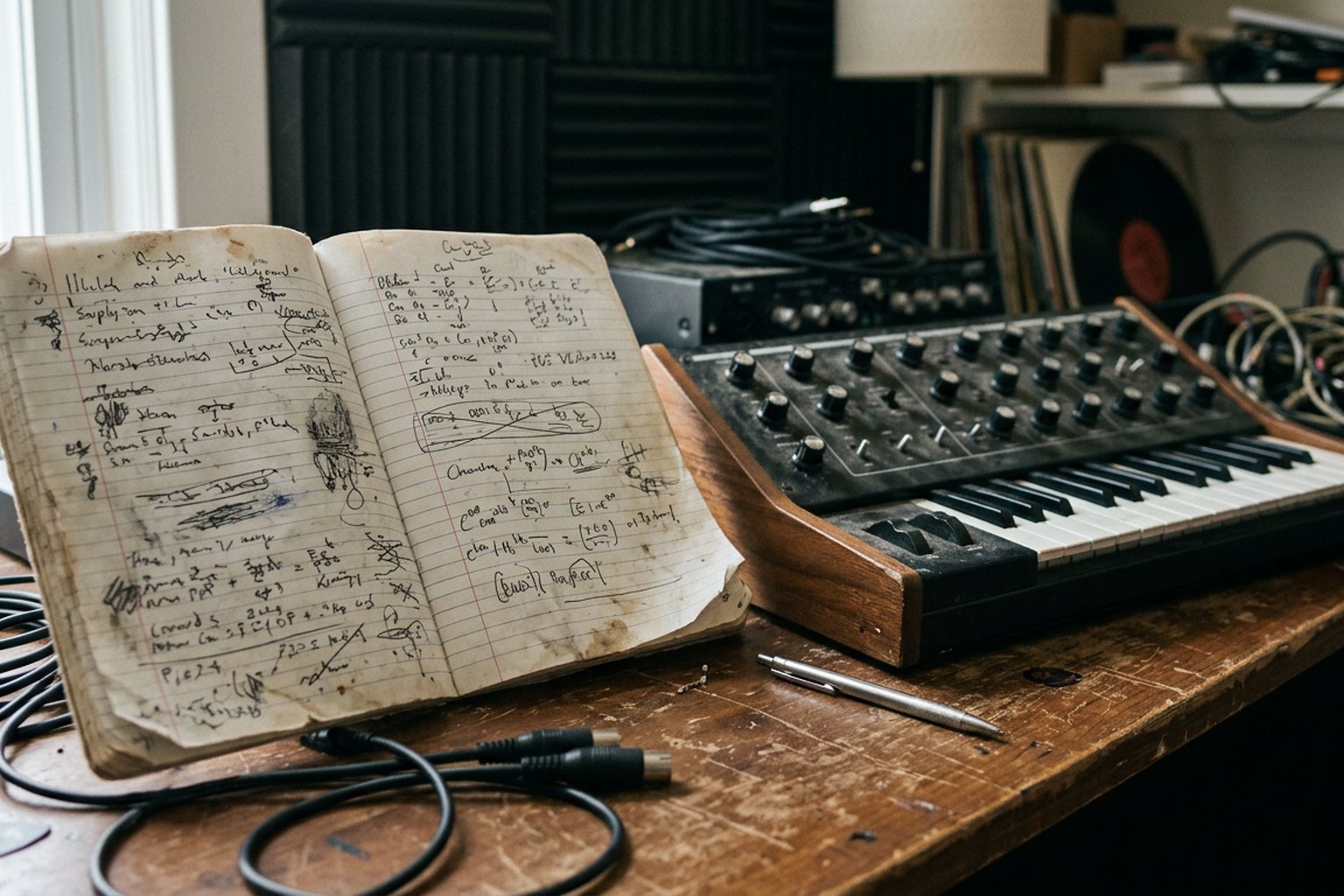
Most synth owners spend years turning knobs at random, relying on presets to cover up a basic lack of understanding. Learning synthesis is not about memorizing every control on a flagship polyphonic synth; it is about internalizing signal flow and physical sound behavior. This twelve-month plan strips away guesswork and builds a structured, practical routine for hardware and analog sound design.
Months 1–3: The Core Subtractive Engine
Month 1: Signal Flow and Raw Waveforms
Begin by clearing away all modulation, effects, and filtering. Your goal this month is to train your ears to recognize the fundamental harmonic profiles of basic analog waveforms: sawtooth, square, triangle, and sine. Connect a simple monophonic synthesizer or initialize a patch on a hardware synth like an Arturia MicroBrute or Korg Monologue. Spend thirty minutes a day listening to how pulse width modulation alters the harmonic balance of a square wave, changing it from a hollow reed-like tone to a thin, nasal buzzy sound. Learn how signal moves sequentially from the oscillator into the filter, through the amplifier, and out to the main output.
Month 2: Filter Topologies and Resonance
The filter shapes the raw tone by stripping away upper harmonics. Focus this month on understanding the structural differences between filter circuits. A 4-pole, 24dB-per-octave transistor ladder filter, famously designed for the Minimoog, darkens tone quickly and smooths out highs. A 2-pole, 12dB-per-octave state-variable or Sallen-Key filter, like the aggressive circuit found in the Korg MS-20, leaves more mid-range content intact and distorts heavily when driven hard. Practice setting the filter cutoff point manually, then increase resonance until the circuit self-oscillates, turning the filter itself into a pure sine wave source.
Month 3: Envelopes and Amplifiers
Sound changes over time, and envelope generators control that movement. Focus on the four stages of an ADSR (Attack, Decay, Sustain, Release) generator. Connect one envelope generator to the Voltage Controlled Amplifier (VCA) to govern volume contour, and a second envelope generator to the Voltage Controlled Filter (VCF) to control timbre over time. Practice creating distinct acoustic profiles: short attack and zero sustain for percussive plucks, slow attack and long release for ambient pads, and moderate decay with zero sustain for snappy basslines.
Months 4–6: Expression and Movement
Month 4: LFOs and Cyclic Modulation
Low-frequency oscillators operate below the limit of human hearing, typically under twenty hertz, adding movement to static sounds. Map an LFO to three primary destinations one at a time: pitch (producing vibrato), filter cutoff (producing tremolo or wah effects), and pulse width (creating a rich, dual-oscillator chorusing effect). Explore the Sample and Hold circuit, which feeds random voltage steps to your targets, creating step-sequenced patterns or classic sci-fi computer textures.
Month 5: Dual-Oscillator Architecture
Bring a second oscillator into your patch logic. Practice tuning the second oscillator to specific musical intervals: unison, octaves, and perfect fifths. Slight detuning between two sawtooth waves creates the natural phase interference responsible for classic, thick analog lead sounds. Next, master two key dual-oscillator techniques:
- Hard Sync: The secondary oscillator is forced to reset its wave cycle every time the primary oscillator completes a cycle, generating aggressive, tearing timbres when the secondary pitch is swept.
- Ring Modulation: The circuit multiplies two audio signals together, outputting only the sum and difference frequencies, producing metallic, bell-like, and non-harmonic sounds.
Month 6: Expressive Performance Controls
A synth patch should respond dynamically to your hands. Map velocity to filter cutoff and envelope attack speed, allowing harder key strikes to produce brighter, sharper notes. Route key tracking to the filter cutoff so that higher notes on the keyboard open the filter proportionally, maintaining bright timbre across the entire register. Assign aftertouch or a modulation wheel to control LFO depth or filter drive, giving you real-time physical control during performances.
Months 7–9: Complex Textures and Reconstruction
Month 7: Audio-Rate Modulation
Take modulation speed out of sub-audio territory and push it up into the audible spectrum. Route Oscillator 2 directly into the cutoff frequency of the filter (Filter FM) or into the frequency of Oscillator 1 (Oscillator FM). Unlike digital FM synths, analog FM is raw, unstable, and highly sensitive to subtle dial movements. Use audio-rate cross-modulation sparingly to add metallic edge, gritty transient attacks, and dirty low-end growl to analog patches.
Month 8: Noise, Transients, and Percussion
White noise contains equal energy across all audible frequencies, while pink noise rolls off upper harmonics at three decibels per octave. Use noise generators to synthesize non-pitched sounds like wind, ocean waves, and acoustic drum elements. Combine a ultra-short burst of noise with an envelope-driven filter spike to generate realistic attack transients, simulating the mallet strike on a marimba or the plectrum hitting a bass string.
Month 9: Ear Training and Patch Matching
Stop creating sounds from scratch and start matching real-world or classic recorded sounds. Pick notable synth patches from iconic records—such as a classic Roland Juno chorused pad, a Prophet-5 synth brass hit, or a deep Moog Taurus bass. Listen closely to analyze the sound: identify the underlying waveforms, estimate filter slope and cutoff positioning, break down the envelope decay times, and spot any dynamic modulation. Recreate the patch on your hardware without consulting cheat sheets or tutorials.
| Month | Focus Area | Core Technical Concept | Practical Milestone |
|---|---|---|---|
| 1 | Oscillators | Harmonics & Waveforms | Identify raw waves by ear alone |
| 2 | Filters | Slopes, Cutoff & Resonance | Dial in self-oscillating kick drum |
| 3 | Envelopes | ADSR & VCA/VCF Routing | Program distinct pluck and pad contours |
| 4 | LFOs | Low-Frequency Modulation | Dial in subtle vibrato and PWM chorusing |
| 5 | Dual-Oscillators | Detuning, Sync & Ring Mod | Patch a classic hard-sync solo lead |
| 6 | Performance | Key Tracking & Velocity | Build an expressive touch-sensitive bass |
| 7 | Audio-Rate Mod | Filter FM & Cross-Modulation | Create metallic tone shifts with FM |
| 8 | Noise & Transients | Spectral Density & Attacks | Synthesize a full drum kit sound set |
| 9 | Patch Matching | Critical Listening & Reconstruction | Duplicate three classic recorded patches |
| 10 | Semimodular | Control Voltage & Signal Routing | Bypass internal routing using patch cables |
| 11 | Polyphony | Voice Allocation & Stacking | Program a pad without lower-mid mud |
| 12 | Mix Integration | Gain Staging & Frequency Space | Track synth bass into a working mix |
Months 10–12: Advanced Systems and Integration
Month 10: Control Voltage and Semimodular Systems
Expand beyond hardwired signal paths using semimodular synthesizers such as a Moog Mother-32 or Behringer Neutron. Learn how control voltage (CV) drives pitch, gate signals trigger envelope cycles, and trigger signals reset LFOs. Use physical patch cables to override normalized internal connections: route an envelope to control LFO rate, or use an attenuverter to invert control voltage signals for reverse envelope contours.
Month 11: Polyphony and Voice Management
Transition from monophonic sound design to polyphonic patch building on instruments like a Sequential Prophet-6 or Novation Peak. Multi-voice patch design requires restraint. A thick, bass-heavy patch that sounds massive as a single note will instantly turn into dense, muddy chaos when playing five-note chords. Reduce sub-oscillator levels, trim envelope decay times, roll off low frequencies, and map voice panning to distribute chord notes wider across the stereo spectrum.
Month 12: Fitting Hardware Synths in the Mix
The final phase is learning how hardware synths interact with production environments. Analog hardware outputs hot, uncompressed dynamic signals that can easily overload interface preamps or crowd digital mixes. Use high-pass filtering to carve out unnecessary sub-bass rumble from non-bass patches. Apply surgical EQ notches to tame harsh resonance spikes produced by high-Q filter sweeps, and run synths through outboard analog delays or chorus units to add spatial depth without washing out direct transient punch.
Quick answers
Do I need an expensive hardware synth to follow this plan?
No. You can complete every exercise on an affordable monophonic synthesizer sitting in the low hundreds range. Simple hardware panels with dedicated controls per function are actually superior for learning compared to complex flagship synths buried in digital display menus.
What is the ideal synth panel layout for learning synthesis?
Look for a synth with a knob-per-function layout, meaning every synthesis parameter has a physical control on the front panel. Avoid synths that require deep menu diving or shifting through alternate button modes, as physical visual feedback accelerates muscle memory and signal flow comprehension.
How long should I practice each day?
Thirty minutes of focused, deliberate patching per day yields far better results than a six-hour session once a week. Dedicate fifteen minutes to exploring the month's target technical concept, and fifteen minutes to applying that concept to build a practical sound from scratch.
What should I do if I get stuck on a specific month?
Do not skip ahead. If audio-rate FM or envelope shaping proves confusing, strip the synthesizer back down to Month 1 fundamentals: initialize the patch, bypass all routing, and isolate individual signal paths. Re-trace voltage pathways step by step until you isolate exactly what each parameter is doing to the raw signal.
When starting any new patch, establish a strict habit: clear out presets and initialize panel settings manually. Force all oscillators down to a single raw sawtooth wave, open the filter wide, zero out modulation depth, and set flat envelopes. Building habit patterns around blank-slate programming forces intentional sound design choices, eliminating luck and turning technical signal flow into second nature.