 SAMPLED
Arpeggiators and sequencers: writing with hardware
Step entry, ratcheting, and gate length as a composition tool rather than a preset toy.
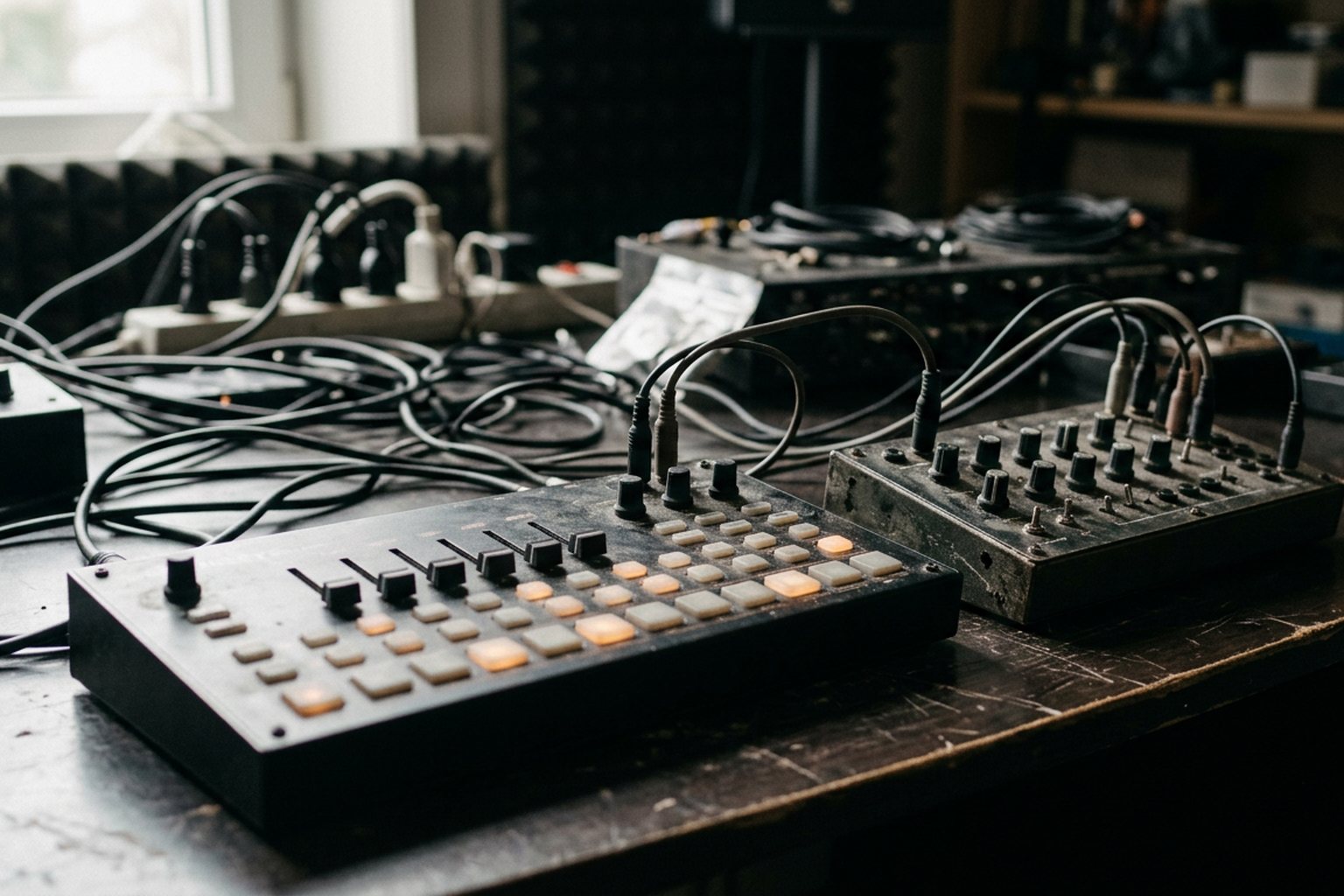
Hardware arpeggiators and sequencers are often treated as convenience features for players who lack keyboard chops, or simple background embellishments for basic synth patches. Used intentionally, these circuits become functional co-writers that force specific rhythmic and harmonic decisions you would never make by hand. Turning off the factory patterns and taking control of clock dividers, gate lengths, and step entry transforms these utilities into primary engines for structural composition.
The Mechanical Distinction: Arpeggiator vs. Sequencer
To use these tools compositionally, you need to separate how they handle memory and execution. An arpeggiator is a dynamic performance tool that requires real-time chord input. It reads a held buffer of notes, sorts them by a defined logic rule (Up, Down, Random, Order Played), and cycles through them at the incoming clock rate. Classic polyphonic analog synths like the Roland Juno-60 or Sequential Prophet-6 use arpeggiators to turn static chord voicings into moving rhythmic lines, but the composition remains tied to the physical keys you hold down.
A step sequencer is an absolute memory recorder. Instead of reacting to live key presses, it stores fixed pitch values, gate signals, and control voltages across a predetermined grid of steps. Early step sequencers, like the Korg SQ-1 or the internal memory of the Roland SH-101, decoupled performance from playback. Once a sequence is programmed, your hands are completely free to manipulate filter cutoffs, envelope decays, or oscillator cross-modulation.
The gray area between the two is where writing gets interesting. When an arpeggiator includes a key-latch function and an variable clock divider, it begins to function like a primitive sequencer. Conversely, when a hardware sequencer allows real-time transposition from a master keyboard, it acts like an programmable arpeggiator with custom intervals and rest steps.
Compositional Mechanics Beyond Up and Down
Relying on a standard 16-step straight-eighths pattern leads quickly to repetitive, predictable synth lines. Shifting your focus to step entry mechanics, gate times, and trigger subdivisions opens up sophisticated musical structures.
Step Entry and Non-Linear Timing
Real-time recording registers performance nuances, but step entry forces you to think about interval structure without the bias of tempo. By entering notes one step at a time, you listen to interval relationships in isolation.
Inserting rests and ties deliberately during step entry breaks the rigid grid. On hardware like the Arturia KeyStep series or vintage Roland gear, adding a rest holds the current envelope stage or silences the VCA, while a tie stretches the gate across step boundaries. A 16-step sequence built with five pitch entries, three ties, and eight rests creates off-beat syncopations that naturally pull against a standard four-on-the-floor kick drum.
Working with odd step counts—such as 5, 7, or 11 steps—decouples your melodic phrase from a 4/4 bar structure. The sequence rotates against the downbeat, generating evolving patterns without requiring long, memory-heavy arrangements.
Gate Length and Micro-Dynamics
Gate length dictates how long the synth circuit receives a key-down trigger signal during each step. This parameter controls envelope behavior far more than most players realize.
Short gate lengths (around 10% to 25% of step duration) produce tight, staccato blips. Because the gate turns off quickly, the Envelope Generator immediately drops into its Decay or Release phase, giving the patch a plucky, percussive dynamic. Long gate lengths (90% to 100%) allow the sustain phase of the envelope to trigger fully, filling the mix with wide, connected phrases.
Set gate length to overlap between steps to trigger the glide (portamento) circuit on monophonic synths. On synths with legato envelope retriggering, overlapping gates prevent the envelope from resetting to zero on the next step. This creates dynamic contours where some notes attack sharply while tied notes slide smoothly at constant amplitude.
Ratcheting and Subdivision
Ratcheting originated in the mid-1970s with Berlin School electronic music producers using modular systems and custom digital sequencers. The technique involves subdividing a single sequence step into multiple rapid trigger bursts—twos, threes, or fours—without altering the global clock tempo of the song.
On modern hardware like the Moog Sub 37 or specialized Eurorack trigger sequencers, ratcheting adds rhythmic emphasis to specific transitions. Applying a four-burst ratchet to step 15 or 16 of a line mimics a drum fill, driving momentum into the next bar. Applying irregular ratchets (such as triplets) to random steps breaks up the machine-like feel of a basic step pattern, introducing micro-rhythmic complexity while keeping the master grid intact.
Sequence and Arpeggiation Capabilities
| Tool Type | Pitch Source | Rhythm Control | Modulation Capability | Best Compositional Use |
|---|---|---|---|---|
| Standard Arpeggiator | Live held keys | Global clock division | None (follows note triggers) | Moving chord progressions, rhythmic ostinatos |
| Monophonic Step Sequencer | Stored step memory | Per-step gates, ties, and rests | Accent tracks, basic CV control | Basslines, hook melodies, polyrhythmic loops |
| Parameter Sequencer | Internal control lanes | Fixed step divisions | Cutoff, pitch, wavefold, pan, decay | Evolving timbral motion, automated patch shifts |
| Generative Sequencer | Algorithmic logic / probability | Variable skip, shift, and ratcheting | Dynamic CV / CC parameter assign | Unpredictable textures, complex lead fills |
Parameter Sequencing and CV Modulation
Pitch and gate sequences are only two pieces of the equation. Advanced hardware sequencers, like those found on Elektron machines or Eurorack CV sequencers, allow you to step-sequence synth parameters alongside note data.
Sequencing filter cutoff or envelope decay on a per-step basis turns a basic melody into a dynamic soundscape. For example, programming a short filter decay on steps 1, 5, 9, and 13 while opening the decay and cutoff fully on step 7 creates a self-contained drum and synth performance from a single patch.
In an analog ecosystem, control voltage (CV) patch points multiply these options. You can send a secondary CV sequence track to modulate parameters like:
- Oscillator pulse width for dynamic harmonic shifts.
- Noise generator volume for automated percussive accents.
- LFO speed to create localized vibrato on selected long notes.
- Feedback routing on analog delay circuits.
Connecting clock output signals to secondary hardware opens up creative timing networks. Running a master sequence at normal speed while feeding its clock output through a divider to trigger a second synth’s sequencer lets you build complex, multi-timbral arrangements that stay perfectly in sync without using a computer.
Quick Answers
How does gate length affect envelope behavior?
Gate length determines how long the gate voltage remains high for a given step. Short gates interrupt the envelope early, forcing it directly into the release phase for short, percussive sounds. Long gates allow the envelope to complete its attack and decay cycles and sit in the sustain stage, producing legato phrasing and sustained notes.
What is the difference between CV/Gate sequencing and MIDI sequencing?
CV/Gate uses analog voltage signals: CV (Control Voltage) dictates pitch height using explicit voltage standards (typically 1 Volt per Octave), while Gate sends a binary voltage pulse to trigger notes. MIDI is a digital data protocol that sends serial commands (Note On, Note Off, Velocity, Pitch Bend). CV/Gate offers continuous, instant response with zero latency, making it ideal for analog patch interplay, whereas MIDI handles polyphonic data and detailed performance control over a single cable.
How can I make simple 16-step sequences feel less repetitive?
Set the sequence length to an odd number of steps (such as 7, 11, or 13) so the pattern shifts relative to the main downbeat. You can also introduce variable gate lengths, step probability, or parameter locks on filter cutoff and decay times to add movement across repetitions.
Can an arpeggiator be transformed into a sequencer?
Yes. If your synth’s arpeggiator includes a key-latch feature, a step-rest function, and control over playback order, you can latch a complex chord, set the arpeggiator to read notes in the order played, and use clock division to convert that held chord into a custom melodic sequence.
Put It into Practice
Connect a step sequencer to a monophonic analog synth using CV/Gate or MIDI. Program an 8-step sequence using only three distinct pitches, leaving two steps as empty rests and two steps as sustained ties. Set your synth's envelope attack to zero, decay to mid-way, and sustain to zero. As the sequence plays, leave the pitch notes alone and adjust only the gate length knob on the sequencer alongside the synth's filter cutoff. You will quickly hear how dynamic length, rest placement, and envelope release points shape a musical hook far more effectively than throwing more pitch changes at the patch.