 SAMPLED
Ring mod, FM, and hard sync on analog synths
Three ways to get metallic, aggressive tones out of two humble oscillators.
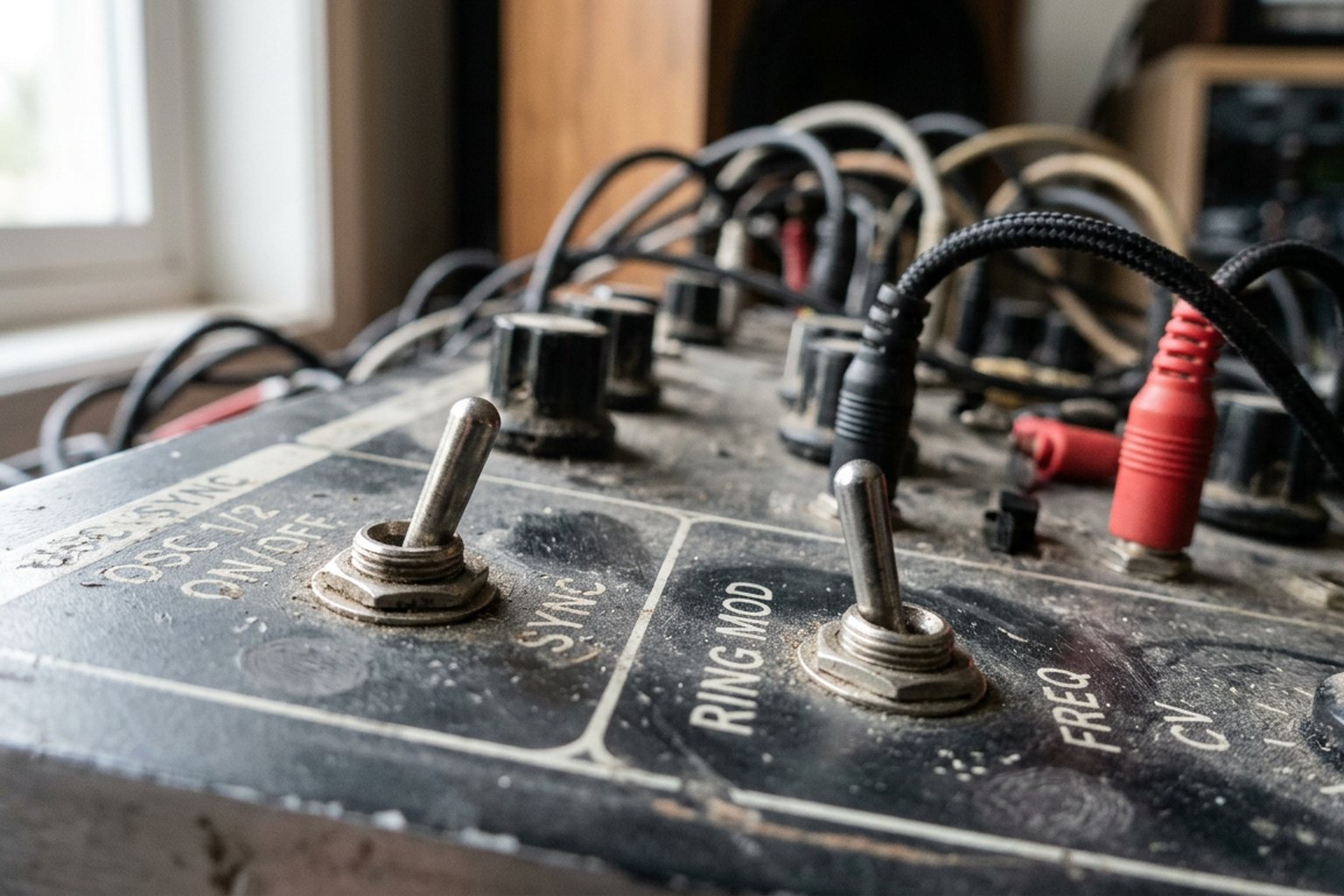
Standard subtractive synthesis gets predictable fast: two detuned sawtooth waves running into a four-pole lowpass filter can only take a track so far. When you force two analog voltage-controlled oscillators to cross-modulate using ring modulation, exponential FM, or hard sync, you bypass traditional subtractive limitations entirely. These three techniques generate dense sidebands, non-harmonic overtones, and aggressive, tearing timbres before the signal ever touches a filter ladder.
Ring Modulation: Inharmonic Harmonics and Sum/Difference Frequencies
A ring modulator is a four-quadrant multiplier circuit. Instead of mixing two audio signals together—which simply plays them side by side—a ring modulator multiplies the instant voltage of Oscillator 1 (the carrier) by the instant voltage of Oscillator 2 (the modulator).
In a traditional passive diode-bridge ring modulator or a modern integrated circuit multiplier (like an AD633 or classic MC1496), this mathematical multiplication suppresses the original fundamental frequencies of both oscillators. In their place, the circuit outputs only two new sets of frequencies: the sum of the input frequencies ($f_1 + f_2$) and the difference between them ($f_1 - f_2$).
Carrier (f1)  ──┐
                ├──> [ Ring Mod Multiplier ] ──> Output: (f1 + f2) and (f1 - f2)
Modulator (f2) ──┘
Because the original fundamentals vanish, the resulting sound depends entirely on the mathematical interval between the two oscillators. If the two oscillators are tuned to simple harmonic ratios—such as perfect fifths or octaves—the sum and difference frequencies align into a coherent, rich harmonic structure reminiscent of electric pianos, bells, or organs.
However, if you detune the oscillators by non-integer intervals (like minor seconds, tritones, or subtle fractions of a semitone), the sum and difference frequencies yield unpredictable, inharmonic sidebands. This is where ring modulation produces its signature metallic clangs, resonant gong textures, and robotic voice formants.
Circuit Implementation Variations
Not all ring modulators behave identically:
- Four-Quadrant Multipliers: Found on synths like the ARP Odyssey, Roland System-100m, or external processors like the Moogerfooger MF-102. These offer full multiplication, suppressing the source frequencies completely when trimmed correctly.
- XOR Logic Gates: Synthesizers like the Korg MS-20 use a digital Exclusive-OR (XOR) logic gate to simulate ring modulation. This circuit takes square waves from both oscillators and compares them. While it produces sharp, aggressive, metallic textures, it does not cancel out the fundamental frequencies in the same way a four-quadrant multiplier does, resulting in a harsher, fuzzier sound.
Practical Patching for Ring Mod
- Tracking Control: If you want ring-modulated metallic sounds to remain tonal across the keyboard, set both oscillators to track keyboard CV at 100% (1V/Oct). This keeps the frequency ratio between the two oscillators constant as you play up and down the keys, preserving the metallic timbre while allowing pitched melodies.
- Unpitched Percussion: Turn off keyboard tracking on Oscillator 2. As you play higher notes on Oscillator 1, the ratio between the fixed modulator and the moving carrier changes with every key, transforming a pitched synth line into a dynamic percussion generator.
Exponential Analog FM: Tearing Up the Audio Spectrum
Frequency modulation occurs when the audio-rate output of one oscillator is patched directly to modulate the pitch (frequency control voltage) of a second oscillator.
Oscillator 1 (Audio Rate) ──> Pitch CV Input of Oscillator 2 ──> Output
While digital FM synthesis (pioneered by John Chowning and popularized by the Yamaha DX7) typically relies on phase modulation with precise linear pitch tracking, analog FM is almost always exponential. Because standard analog synth oscillators operate on a logarithmic pitch scale (1 Volt per Octave), modulating the frequency input exponentially creates a distinct, chaotic, and aggressively saturated timbre.
In exponential FM, positive voltage swings shift the pitch up by a wider frequency range than equivalent negative voltage swings shift it down. This asymmetry creates pitch drift as you increase modulation depth. Far from being a defect, this uncalibrated instability gives analog FM its raw, snarling signature.
Carrier vs. Modulator Dynamics
To master analog FM, treat Oscillator 1 as the Modulator and Oscillator 2 as the Carrier (the signal you actually listen to):
- Low Modulator Pitch, High Modulation Depth: Yields heavy, tearing subterranean growls and buzzing textures.
- Audio-Rate Modulator, Mid-Range Depth: Creates woody, vocal, or buzzy timbres that add grit to brass and lead sounds.
- High Modulator Pitch, High Depth: Produces harsh, shredding noise bursts and intense metallic screaming.
Classic synths like the Sequential Circuits Prophet-5 utilize this heavily in their "Poly-Mod" section, where Oscillator 2 can drive the pitch of Oscillator 1. Modern mono synths, such as the Arturia MiniBrute series or modular VCOs like the Make Noise DPO, rely on dedicated FM knobs to dial in immediate audio-rate cross-modulation.
Patching Tips for Analog FM
To tame the wild nature of exponential FM without losing its teeth, route an ADSR envelope generator to control the FM depth via a Voltage Controlled Amplifier (VCA) or attenuverter. Setting a rapid decay with no sustain sends a high-voltage FM burst into the carrier oscillator at the key-strike, producing a violent, metallic transient attack that quickly drops into a warm, usable subtractive body.
Hard Oscillator Sync: Screaming Overtones and Laser Sweeps
Oscillator sync requires two oscillators working in tandem: a Master (Oscillator 1) and a Slave (Oscillator 2).
Unlike ring modulation or FM, hard sync does not multiply signals or alter pitch voltages directly. Instead, the electrical circuit forces the waveform phase of the Slave oscillator to reset to zero every time the Master oscillator completes a full wave cycle (crossing the zero-voltage threshold in a positive direction).
Master VCO (f1) Wave:  /\/\/\/\/\/\/\/\  (Determines base pitch)
                       │       │
                       ▼       ▼ (Triggers Reset)
Slave VCO (f2) Wave:   /|/|/|  /|/|/|/|  (Shape is sheared, pitch locked to f1)
Because the Slave oscillator's phase is forcefully restarted by the Master, the perceived fundamental pitch of the Slave remains locked to the Master, no matter how high or low you tune the Slave oscillator. However, as you adjust the Slave oscillator's frequency pitch knob, you change the physical shape and period of its reset waveform. This shearing action inserts sharp mathematical discontinuities into the wave shape, injecting dense upper harmonics into the signal.
Soft Sync vs. Hard Sync
- Hard Sync: Forces the Slave waveform back to zero instantly upon receiving the Master pulse, regardless of where the Slave waveform currently sits. This produces harsh, tearing, cutting edge tones.
- Soft Sync: Reverses the slope direction of the Slave wave or resets it only if it is already near the end of its cycle. Soft sync produces smoother, subtle octave-doubling and hollow, flute-like sounds.
Creating the Iconic Sync Sweep
Hard sync on a static pitch sounds like a bright, slightly hollow square wave. The classic, aggressive "sync sweep"—a staple of mid-seventies rock and eighties synth-punk on instruments like the Moog Prodigy, Roland SH-2, and Oberheim OB-Xa—relies on dynamic pitch movement of the Slave oscillator.
- Enable Hard Sync on your synthesizer, setting Oscillator 1 as Master and Oscillator 2 as Slave.
- Route only Oscillator 2 (Slave) to the audio mixer.
- Assign a dedicated pitch envelope or LFO to modulate the pitch of Oscillator 2 only.
- As the envelope drives Oscillator 2's frequency up and down, the fundamental pitch stays firmly locked to Oscillator 1, but the overtone spectrum sweeps violently, producing laser-like, vocal screaming timbres.
Cross-Modulation Comparison
| Technique | Circuit Mechanism | Frequency Output | Pitch Stability | Best Use Case |
|---|---|---|---|---|
| Ring Modulation | Four-quadrant multiplication (or XOR logic) | Sum ($f_1 + f_2$) and Difference ($f_1 - f_2$) frequencies; fundamentals canceled | Highly sensitive to interval tuning | Metallic bells, gongs, robotic vocoder-like timbres |
| Exponential FM | Audio-rate output modulating pitch CV input | Complex non-linear sidebands across audio spectrum | Unstable; pitch drifts as modulation depth increases | Aggressive bass growls, biting transients, harsh brass |
| Hard Sync | Master zero-crossing forcefully resets Slave phase | Fundamental locked to Master; harmonic spectrum dictated by Slave pitch | Absolute pitch stability locked to Master VCO | Screaming lead sweeps, biting metallic solos, laser attacks |
Quick Answers
Can I combine hard sync and FM on the same two oscillators?
Yes, and it is a classic technique for controlling chaotic analog FM. Routing Oscillator 1 to exponentially modulate the frequency of Oscillator 2 while simultaneously enabling Hard Sync forces Oscillator 2's chaotic sidebands to re-anchor to Oscillator 1's fundamental pitch. This produces extremely dense, gritty textures that stay in tune with the rest of your track.
Why does analog FM sound dirtier than digital FM?
Digital FM uses precise phase modulation and linear tracking, keeping all operator ratios mathematically exact to prevent unwanted pitch drift. Analog FM relies on exponential V/Oct circuits that respond non-linearly to audio-rate voltage modulation, introducing organic pitch instability, circuit saturation, and asymmetric distortion sidebands.
How do I keep ring-modulated patches playable across a keyboard?
Ensure both oscillators are set to track the keyboard's Pitch CV at 100% (1V/Oct) and calibrate their initial interval tuning to a musically congruent ratio, such as an octave, fifth, or fourth. This ensures that the sum and difference sidebands scale proportionally with every key pressed.
Do I need identical oscillator waveforms for these techniques to work?
No. While sawtooth and square waves yield the most aggressive metallic sidebands due to their existing harmonic density, using a pure sine or triangle wave as an FM modulator produces cleaner, more predictable sideband clusters. Experimenting with asymmetric pulse waves on a hard-synced slave oscillator yields drastically different phase discontinuities and tonalities.
For maximum sonic impact, avoid treating these three routing options as set-it-and-forget-it switches. Analog cross-modulation thrives on movement. Assigning real-time physical controllers—like a pitch wheel to a synced slave oscillator, or a foot pedal to FM depth—turns static electronic waveforms into expressive, highly responsive instruments.