 SAMPLED
Analog warmth is mostly distortion. Here is the proof
Harmonics, headroom, and noise floors. Naming what people hear when they say a synth sounds warm.
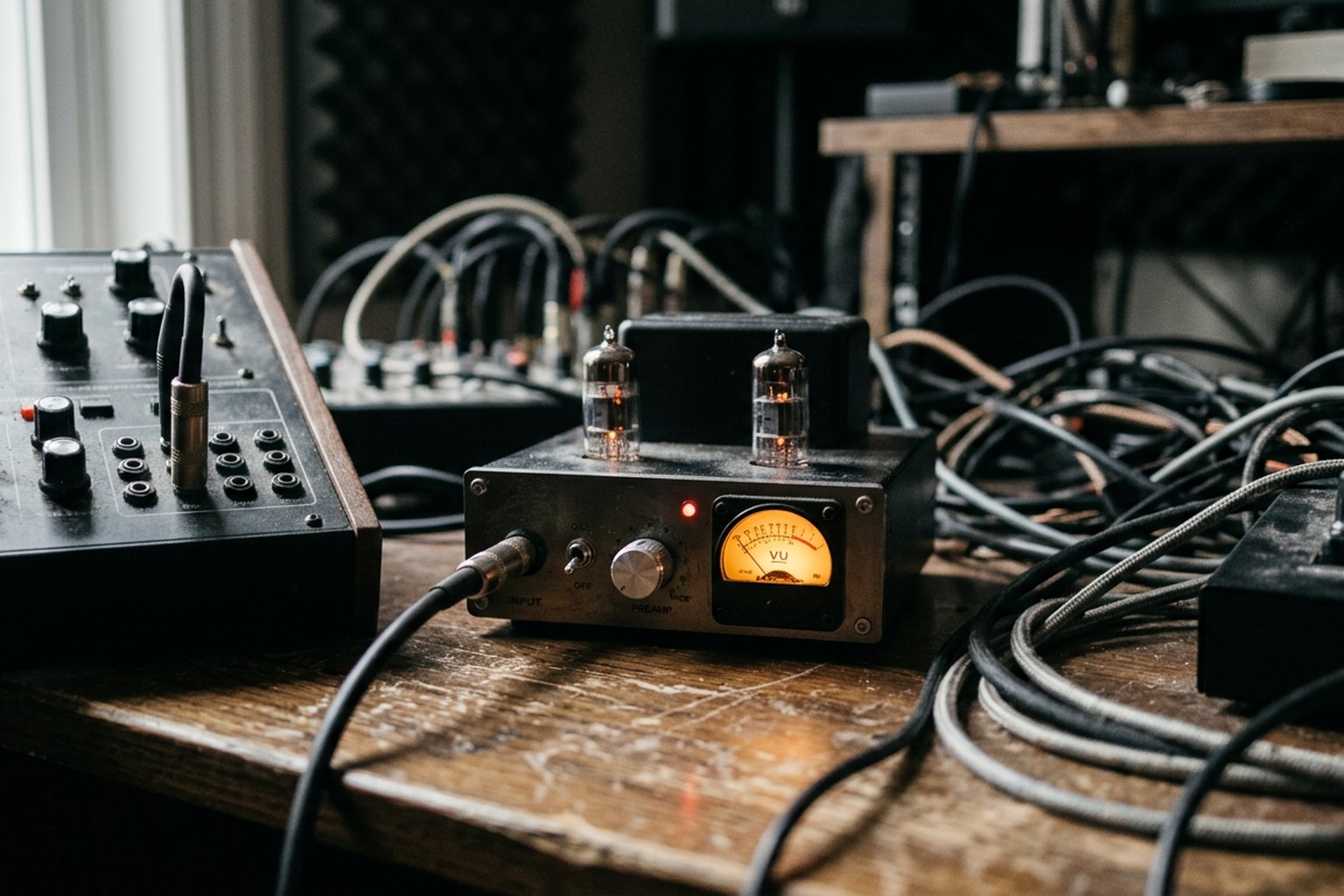
"Warmth" is the most abused adjective in music production. Ask three engineers what it means, and you will hear contradictory essays on nostalgia, vibe, and magic. In objective technical terms, analog warmth is not an unmeasurable aura; it is a specific set of circuit limitations, non-linear harmonic distortion, soft clipping, slow transient response, and high-frequency attenuation.
Harmonic Distortion: The Real Driver of Warmth
Pure digital oscillators generate mathematically precise waveforms. A digital sawtooth wave contains exact integer harmonics extending all the way to the Nyquist frequency limit, sharp and pristine. Analog oscillators, by contrast, are fundamentally imperfect devices built from physical components subject to voltage fluctuations, temperature shifts, and component tolerances.
When you push an audio signal through an analog circuit—whether it is a discrete transistor array like the ladder filter in a Minimoog Model D or integrated circuits like the Curtis chips found in late-1970s polyphonic synthesizers—you introduce Total Harmonic Distortion (THD). This distortion creates musical overtones that were not present in the original raw oscillator signal.
Distortion in analog synthesizers falls primarily into two categories: even-order and odd-order harmonics. Even-order harmonics (second, fourth, sixth) add intervals that sit an octave or an octave plus a fifth above the fundamental frequency. The human brain perceives these even harmonics as consonant, rich, and thickening, which is precisely what most musicians describe as "warm." Odd-order harmonics (third, fifth) add a hollower, sharper edge, similar to a square wave. A subtle blend of both, generated naturally as an analog signal stresses capacitors, operational amplifiers, and audio output transformers, turns a cold fundamental tone into a dense audio signal.
Frequency Shaping and Slow Circuits
Harmonic generation is only part of the equation. Another physical reality of analog hardware is limited bandwidth and sluggish transient response.
Digital audio systems maintain flat frequency response up to half the sample rate. Analog circuits cannot match that flat line. Output transformers, coupling capacitors, and amplifier stages naturally act as subtle low-pass filters. They roll off top-end frequencies well above the human hearing threshold, but their gentle slope often begins dipping slightly in the upper midrange. This tames harsh high-frequency harmonics, smoothing out the aggressive click at the start of a synth patch.
Operational amplifiers and discrete circuits also exhibit a property known as slew rate limiting. Slew rate refers to how fast an amplifier's output voltage can change in response to a sudden change at its input. When a fast synthesizer envelope fires an instantaneous transient into an analog output stage, a slow circuit cannot keep up. Instead of producing a razor-sharp step wave, the circuit slightly rounds off the leading edge. That instantaneous smoothing removes harsh, spiky transients, giving drum sounds and synth plucks a rounder, more natural dynamic profile.
Headroom and Soft Clipping
Analog power supplies operate on fixed voltage rails. When an internal signal level approaches these voltage limits—such as when you push the mixer section on a mono synth hard into its filter—the circuit does not instantly clip into harsh square-wave distortion like a digital audio bus hitting zero dBFS. Instead, it enters soft clipping.
During soft clipping, the peak peaks of the waveform are gently compressed and flattened long before total saturation occurs. This built-in dynamic compression reduces extreme transient peak spikes while boosting low-level sustain. The resulting signal sounds louder, fuller, and more controlled without feeling overly squashed by a dedicated master limiter.
| Audio Characteristic | Pristine Digital Signal | Analog Circuit Reality ("Warmth") |
|---|---|---|
| Harmonic Content | Only intended harmonics; zero unexpected overtones | Continuous addition of subtle even and odd THD |
| Transient Attack | Instantaneous rise time; sharp, uncompressed peaks | Slew rate limiting; naturally rounded leading edges |
| Overdrive Behavior | Instantaneous hard digital clipping at 0 dBFS | Gradual soft clipping and natural saturation |
| High-Frequency Response | Flat up to Nyquist limit; can sound overly sharp | Gentle physical roll-off; softened top end |
| Phase Relationship | Perfectly linear options available | Non-linear phase shifts near filter cutoffs |
| Background Floor | Zero noise floor | Thermal noise, power supply hum, bucket-brigade hiss |
Noise Floors and Phase Shift
Musicians often associate warmth with a heavy, thick low end. Much of this perceived weight actually comes from phase shift introduced by analog filtering circuits rather than actual sub-bass amplification.
Every analog filter alters the phase relationship of the frequencies passing through it. As a signal passes near the cutoff frequency of a four-pole transistor ladder filter, lower frequencies experience a slight time delay relative to upper frequencies. This phase rotation smears the waveform in the time domain.
When multiple oscillators undergo phase shifting through an analog circuit, the resulting constructive and destructive interference creates continuous dynamic movement. This temporal spreading makes low frequencies feel wider, rounder, and more present in a mix, even if a spectrum analyzer shows no net increase in decibels at fifty hertz.
The noise floor listed in the table also plays a functional role. The low-level thermal noise of physical resistors and low-frequency ripple from power supplies act as a subtle form of acoustic dither. This constant background activity prevents quiet signal decays from cutting off abruptly, filling empty spatial pockets in a digital mix with a subtle blanket of background energy.
How to Apply This Knowledge
Understanding that analog warmth is simply a combination of distortion, bandwidth limits, slew rate softening, and phase displacement changes how you approach production inside a DAW. You do not need expensive hardware to get these results; you simply need to apply these specific processes deliberately to your digital instruments.
To recreate genuine analog warmth on digital soft synths:
- Drive the input, not the output. Apply a dedicated saturation plugin directly after the digital oscillator or before the filter in your virtual signal chain. Saturating before the filter allows high-frequency distortion products to be smoothed by the filter cutoffs, matching actual hardware architecture.
- Shave off high-frequency spikes. Use a gentle low-pass filter with a 6 dB or 12 dB per octave slope set around 12 kHz to round off harsh digital transients without dulling the core tone.
- Emulate slow slew rates. Use transient shapers to slightly soften attack times on plucked sounds and basslines, or run audio through tape emulation plugins that naturally smooth fast attacks through tape saturation.
- Introduce subtle instability. Use slow pitch modulation or drift controls to slightly detune oscillators over time, imitating the thermal instability of physical componentry.
Quick answers
What is the primary cause of analog warmth?
Analog warmth is primarily driven by total harmonic distortion (THD), specifically even-order harmonics added by saturating transistors, tubes, and transformers, combined with a subtle high-frequency roll-off.
Why do digital synthesizers sometimes sound cold or harsh?
Digital synthesizers generate precise waveforms with instant attack times and flat frequency response up to the Nyquist limit. Without saturation, slew rate limiting, or phase shift, these ultra-clean sounds can feel unnaturally sharp to the human ear.
Can you make a digital synth sound genuinely warm?
Yes. By routing digital signals through saturation plugins, tape emulators, gentle low-pass filters, and transient shapers, you replicate the exact non-linearities—saturation, high-end smoothing, and soft clipping—that define analog hardware.
Is analog warmth always good for a mix?
No. Accumulating too much harmonic saturation, low-end phase rotation, and reduced high-frequency clarity across dozens of tracks creates a muddy, unfocused mix. Modern genres often rely on clean digital precision for punchy sub-bass and crisp transients.
Stop treating warmth like an unexplainable luxury reserved for vintage hardware collectors. Once you recognize that the analog sound is simply a collection of predictable circuit non-linearities, you gain complete control over it. Route your digital synths through targeted saturation, control your transient attacks, roll off unnecessary top end, and you can dial in as much or as little analog character as your mix actually requires.