 SAMPLED
Sub-bass on analog: getting weight without smear
Sine sub layers, sidechain alternatives, and the mono discipline that keeps clubs happy.
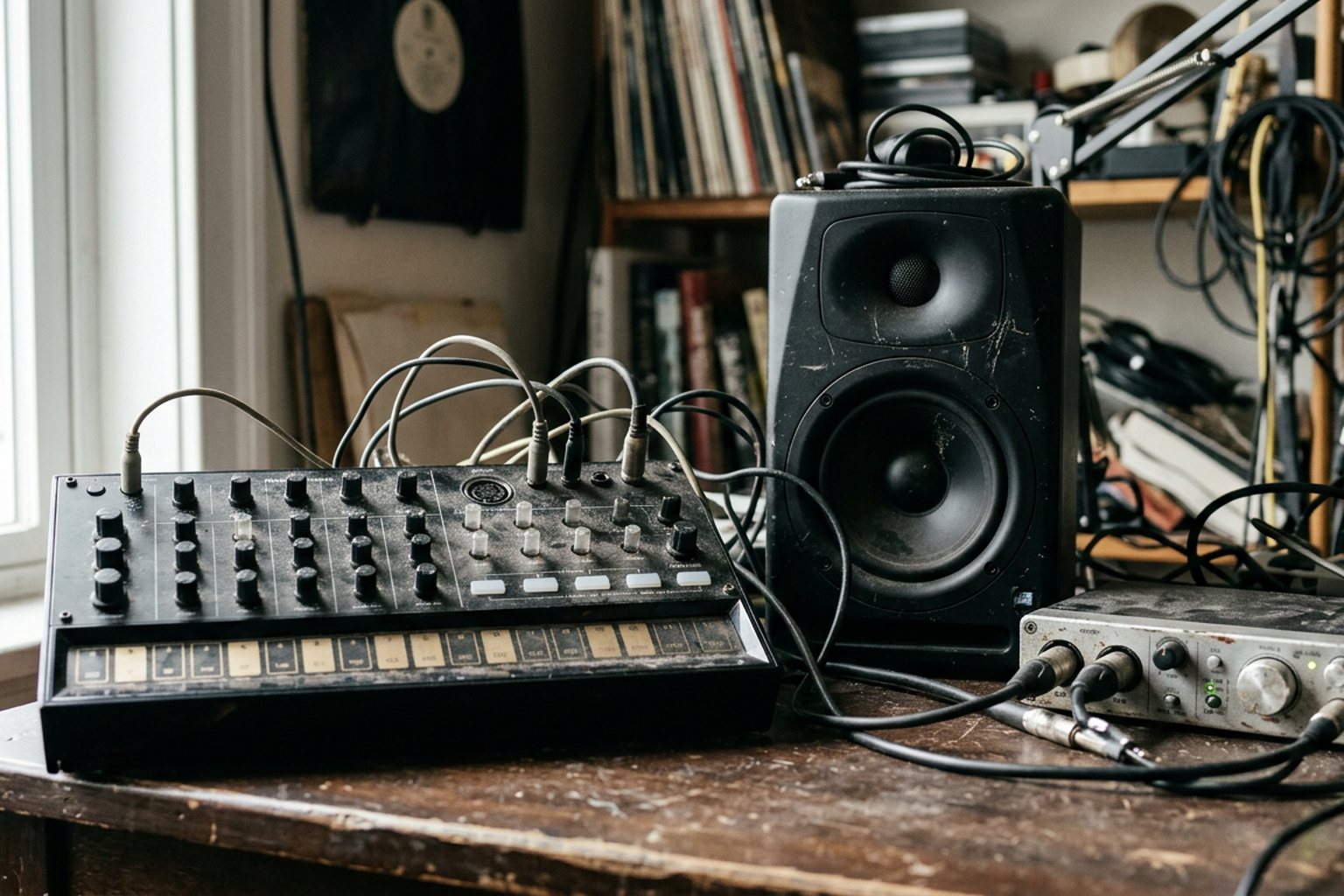
Analog synthesizers are celebrated for their organic instability, but that same unpredictability can turn a club sound system into a swamp of low-frequency mud. When multi-oscillator patches, pitch drift, and aggressive filter resonance collide below 100 Hz, the result is usually phase smearing rather than physical impact. Achieving a low end that hits hard on a large PA requires treating sub-bass not as a passive byproduct of a warm synth patch, but as a dedicated, surgically managed element of the mix.
The Anatomy of Low-End Smear
Low-end smear occurs when multiple low-frequency audio waves overlap with inconsistent phase relationships or excessive harmonic clutter. In full-range analog synthesizers like a Minimoog or Prophet-5, free-running Voltage Controlled Oscillators (VCOs) constantly shift in phase relative to one another. When two sawtooth or square waves beat against each other around 40 to 60 Hz, their fundamental frequencies periodically reinforce and cancel each other out. On studio monitors, this sounds like a pleasing, animated texture. On a large club system, it translates to unpredictable energy drops and blurred transient impact.
Furthermore, analog drive circuits and classic filter designs add saturation. Saturation generates upper harmonics, which aid audibility on small speakers, but it also creates sub-harmonic intermodulation distortion when complex low-frequency material passes through nonlinear stages.
Filter architecture plays a significant role here. The classic four-pole Moog ladder filter naturally attenuates low frequencies as resonance is increased—a phenomenon known as passband frequency resonance drop. Producers often compensate by cranking the mixer input into drive, which saturates the signal further, softening the transient attack and adding low-mid clutter around 150 to 300 Hz. If this harmonic buildup isn't separated from the root fundamental, the speaker cone spends more energy recovering from chaotic low-frequency excursion than delivering a tight, punchy hit.
The Two-Patch Strategy: Uncoupling Sub from Character
The most reliable method for achieving clean low-end weight with hardware is to divide the bass sound into two discrete signals: a character layer handling mid-range texture and a sub layer handling the root fundamental.
[ Synth MIDI / Gate ] ──┬──> Patch A: Character Synth (VCOs) ──> High-Pass Filter (100 Hz) ──> Stereo Mix
                        │
                        └──> Patch B: Pure Sub Layer (Sine) ───> Low-Pass Filter (80 Hz)  ───> Hard Mono
High-Passing the Character Synth
Take your main analog patch—whether it is a raw, detuned three-oscillator patch or a heavily modulated synth voice—and apply a high-pass filter. Set the cutoff frequency between 80 Hz and 120 Hz. This strips away the drifting fundamentals and chaotic phase interactions while preserving the bite, saturation, and stereo width that give the synth its character.
Generating the Pure Sub Layer
For the sub-bass layer (spanning roughly 30 Hz to 80 Hz), you need a stable wave with minimal harmonic distortion. A pure sine wave is ideal because it contains no upper harmonics; all of its energy is concentrated at the fundamental frequency.
There are three primary hardware methods to generate a clean sub layer:
- Self-Oscillating Filter Tracking: Take an analog synthesizer with a clean four-pole filter, turn off the oscillators, turn the filter resonance up to self-oscillation, and set key tracking to 100%. The filter becomes a clean, stable sine wave oscillator that tracks your keyboard perfectly across octaves.
- DCO or Digital Sine Source: Digitally Controlled Oscillators (DCOs) or digital synth modules eliminate pitch drift entirely. Devices like the Roland SH-101 utilize a dedicated sub-oscillator tied to a stable circuit, providing a rigid lower anchor.
- Dedicated Sub-Oscillator Circuit: Modern monophonics often feature built-in sub-oscillators locked one or two octaves below Oscillator 1. If using this, ensure the sub-oscillator outputs a sine wave rather than a sharp square wave, as square sub-oscillators introduce odd harmonics that clutter the 100–300 Hz space.
Beyond Traditional Sidechain Compression
The standard approach to making room for a kick drum is pumping the bass with sidechain compression. However, wideband sidechain compression on sub-bass can cause noticeable pumping artifacts, destroy the transient attack of the synth bass, or leave low-frequency energy hanging around if the release envelope is improperly set.
Amplitude Shaping and CV Ducking
Instead of using a compressor threshold triggered by audio, use precise amplitude shaping or Control Voltage (CV) ducking. In modular or semi-modular setups, route a duplicate of your kick drum’s gate or trigger signal into an inverted envelope generator connected to the VCA controlling your sub-bass. This provides direct control over the exact attack, decay, and depth of the sub-bass dip.
If working in a hybrid setup, dedicated volume automation tools or trigger-based utility plugins allow you to draw precise volume curves. Setting a immediate drop to zero volume the millisecond the kick hits, followed by a logarithmic recovery curve tuned to the length of the kick's tail, prevents transient masking entirely without creating an audible pumping effect.
Dynamic Notch Filtering
If full amplitude ducking makes the low end sound hollow, consider dynamic filtering. Place a dynamic EQ or static notch filter tuned to the kick drum's fundamental frequency (typically between 50 Hz and 70 Hz) on the sub-bass track. Ducking only that narrow frequency band during the kick impact maintains the perception of continuous sub-bass while leaving space for the kick's initial thud.
Mono Discipline and Phase Alignment
Sub-bass frequencies below 90 Hz must remain strictly monophonic. Low-frequency energy demands immense mechanical work from PA woofers. If the sub-bass contains stereo information—meaning the left and right channels carry differing phase information—the physical speaker cones push and pull out of sync. This leads to phase cancellation in the room, uneven coverage across the venue, and wasted amplifier headroom.
Phase Alignment Techniques
Even when a sub layer is mono, it can still clash with the kick drum or the high-passed character synth layer above it. Aligning phase manually is essential:
- Sub and Kick Phase Matching: Zoom into the waveform of your printed audio tracks. Check the initial cycle of your kick drum and your sub-bass note. If the kick's initial wave goes positive (upward) while the sub-bass wave goes negative (downward), they cancel each other on impact. Flip the phase polarity on the sub-bass track or micro-shift the start time of the sub note by a few milliseconds until the initial wave peaks align in the same direction.
- Managing Decay Times: Analog synths often feature envelope release stages that vary slightly from note to note due to component tolerances. If the release time of a sub note is too long, the tail of one note bleeds into the attack of the next note. Keep envelope decay and release parameters tightly calibrated so low frequencies clear out cleanly before the next transient arrives.
Hardware Sub Architecture Comparison
Choosing the right tool for generating sub-bass depends on the requirements of your track. The table below outlines how common hardware architectures perform when assigned sub-bass duties.
| Method | Harmonic Content | Phase Stability | Best Use Case |
|---|---|---|---|
| Self-Oscillating Resonance (VCF) | Pure Sine (No harmonics) | High | Minimalist club tracks requiring maximum low-end focus |
| DCO Sub-Oscillator (Sine) | Pure Sine | Very High | Driving, fast tempo basslines with zero pitch drift |
| Square-Wave Sub (VCO) | Rich (Odd Harmonics) | Moderate | Industrial or gritty mid-bass patches (requires high-pass filtering for pure sub use) |
| Multi-VCO Unsplit Patch | Variable / Complex | Low | Studio recordings where organic movement is prioritized over raw club PA impact |
Quick answers
Should I high-pass an analog synth if I want maximum bass?
Yes. High-passing a main analog patch around 80 Hz to 100 Hz removes chaotic, unstable low-frequency mud and phase cancelation. You then replace that removed range with a dedicated, phase-aligned sine sub layer, resulting in a cleaner, heavier low end.
Why does my analog sub sound inconsistent from note to note?
Free-running analog oscillators start their wave cycles at random points every time a key is pressed. If the wave cycle starts at a different phase angle relative to your kick drum on every note, the transient impact will vary. Using a gated digital sine source, a DCO, or hard-syncing the oscillator phase solves this issue.
Is a self-oscillating ladder filter a good source for sub-bass?
It is one of the cleanest sources available. When a 4-pole filter is pushed into self-oscillation with no signal fed into the inputs, it produces a pure sine wave. With key tracking set to 100%, it functions as an extremely stable sub-oscillator that tracks your notes accurately across the lower octaves.
How do I check for low-end phase cancellation without complex tools?
Sum your master bus to mono and listen on a single speaker or a reliable set of headphones. If the low end noticeably thins out, loses punch, or disappears entirely when summed to mono, you are experiencing phase cancellation between your stereo low-mids or between your kick and sub-bass.
Developing a solid low end requires treating sub-bass as an engineering task rather than an aesthetic choice. Strip away the unstable bottom end of your complex hardware patches, lock your sub fundamentals strictly to mono, and ensure your transient boundaries are surgically defined against the kick drum. When you give the venue's amplifiers a clean, predictable waveform to push, the system repays you with tight, effortless physical impact.