 SAMPLED
Patch design for house and techno leads
Short envelopes, filter accents, and the mixing space a lead actually needs in a club track.
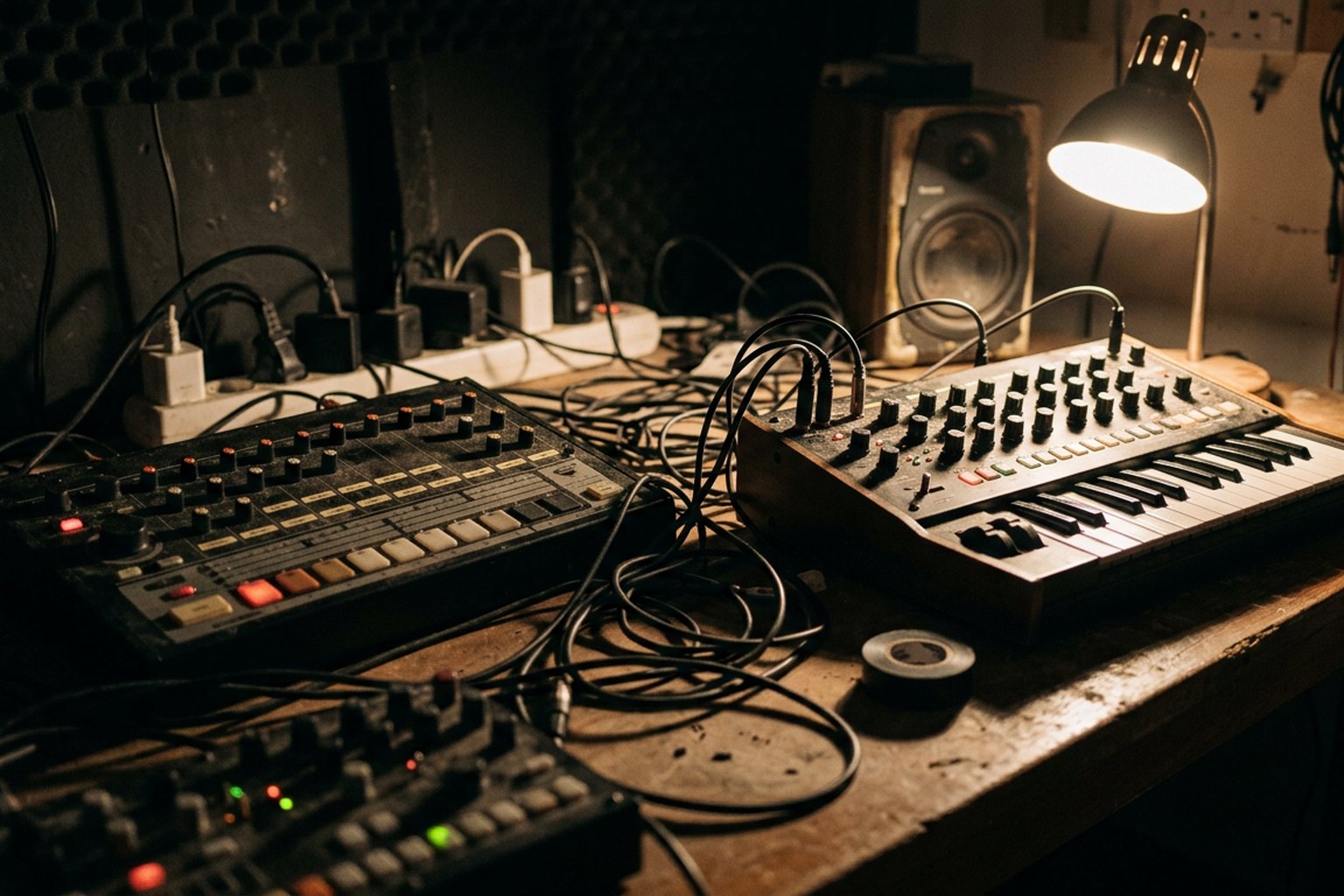
A reliable house or techno lead rarely sounds impressive when auditioned in solo. On a club system, the patches that cut through are lean, transient-heavy, and stripped of the lower-mid energy that clutters the space between the kick and the hi-hats. Designing a functional lead patch on hardware requires thinking like a drummer: it is an exercise in envelope control, harmonic selection, and strict frequency allocation.
The Mechanics of Club Transients
The primary job of a lead synth in dance music is to establish a rhythmic anchor without stealing dynamic headroom from the low end. That starts at the oscillator section. While complex wavetables and multi-oscillator detuning sound huge in a bedroom studio, single-oscillator setups or hard-synced double oscillators usually fare far better on a large sound system. A basic sawtooth or variable pulse wave provides a predictable spectrum of odd and even harmonics that can be shaped cleanly by a downstream filter.
If you are using two oscillators, avoid heavy detuning unless you are deliberately aiming for a wide synth-pop pad sound. Detuning creates phase cancellation that causes the perceived volume of the synth to fluctuate unpredictably in mono. Instead, tune the second oscillator to a fixed harmonic interval—such as a perfect fifth or an octave above—or set up hard sync. On synths like the Sequential Pro One or Moog Subsequent 37, slaving Oscillator 2 to Oscillator 1 and modulating the pitch of Oscillator 2 with a fast envelope creates a distinct, biting transient that slices through dense drum tracks without needing extra gain.
Envelope geometry dictates whether a lead feels snappy or sluggish. The amplifier envelope should almost always start with a zero attack time. Set the decay between 80 and 300 milliseconds, drop the sustain to zero, and set the release just short enough to prevent notes from bleeding into one another. To add extra snap to the front of the note, route a dedicated envelope generator to modulate the master pitch or filter cutoff by a small fraction. A pitch envelope with a zero attack and a 15-millisecond decay adds an acoustic-style click to the start of every note, giving the synth an immediate, percussive presence on small monitors and big rigs alike.
Filter Modulation and Circuit Selection
The character of a hardware lead comes down to filter architecture and how aggressive the envelope depth is set. Different filter topologies handle high-amplitude transients in fundamentally different ways:
- Transistor Ladder (e.g., Moog): Smooth, warm low-pass filtering with a rounded drive profile. Excellent for thick, liquid techno riffs, but high resonance settings cause noticeable low-end loss (the classic ladder filter drop).
- Cascaded OTA (e.g., Roland SH-101, Alpha Juno): Bright, aggressive, and highly linear. Keeps its punch even with high resonance, making it the benchmark for rubbery house baselines and fast lead sequences.
- State-Variable (e.g., Oberheim SEM style): Offers 12dB/octave slopes that sound open and raw. Great for mid-range stabs that need to feel breathy rather than laser-focused.
Setting the filter envelope is a balancing act. Keep the static cutoff frequency relatively low—around 200 Hz to 500 Hz—so the patch rests completely in the dark when stationary. Use a negative or high positive envelope intensity so the filter opens instantly on note-on and snaps shut within the same timeframe as the amp decay.
       Envelope Open (Transient attack)
          / \
         /   \
        /     \
       /       \_______ Envelope Settles (Zero sustain)
      /
Cutoff (Base frequency: 200-500 Hz)
Resonance should be used as a frequency accent rather than a sweeping dramatic effect. Dialing in moderate resonance pushes a narrow peak around the filter's cutoff point, usually between 1 kHz and 3 kHz. This peak emphasizes the initial decay phase of the envelope, turning a standard sawtooth into an expressive, vocal-sounding spike. Be cautious with self-oscillating resonance settings; uncalibrated self-oscillation can produce out-of-tune sine tones that overpower the fundamental pitch of your sequence.
Hardware Patch Archetypes
Different club subgenres require distinct patch architectures. The table below outlines three classic configurations built around widely available hardware layouts.
| Patch Style | Oscillator Config | Filter Type & Setup | Envelope Settings | Primary Application |
|---|---|---|---|---|
| Monophonic Snapper | Single Saw or Narrow Pulse + Sub-Oscillator off | 24dB Low-Pass, 40% Resonance, Key Tracking on | Amp Decay: 120ms, Sustain: 0, Filter Decay: 100ms | Fast, bouncy classic house sequences and acid-adjacent lines. |
| Sync/FM Techno Stab | Two Saws, Osc 2 Synced to Osc 1, pitch modulation active | 24dB Low-Pass, Low Resonance, Envelope Depth 70% | Amp Decay: 200ms, Sustain: 0, Pitch Env Decay: 15ms | Aggressive, industrial techno main riffs and dark hypnotic loops. |
| Detuned Poly Stab | Two Pulse Waves, slight detune, 4-voice polyphony | 12dB or 24dB Low-Pass, 20% Resonance | Amp Decay: 350ms, Sustain: 10%, Release: 150ms | Deep house chord inversions and dub-techno atmospheric accents. |
Frequency Allocation and Mix Integration
A patch that occupies 100 Hz to 10 kHz in isolation will wreak havoc on a final mixdown. Hardware synths, particularly analog monophonics, generate significant low-end resonance and sub-audible thumps from fast VCA gates. These sub-frequencies offer no musical value in a lead patch and directly conflict with the kick drum and bassline.
The first utility inserted on a lead channel should be a sharp high-pass filter. Set the cutoff frequency somewhere between 150 Hz and 250 Hz. This feels counterintuitive when designing the patch on monitors, as it thins out the synth in solo. However, in a full mix, it frees up dynamic range for the low-end track elements while allowing the mid-range transients of the lead to sit higher in the perceived loudness curve.
Avoid using stereo chorus or wide spatial effects directly on the synth channel insert. Heavy spatial processing dilutes the point-source impact of a lead synth, causing it to blur across the soundstage. Keep the dry signal dead-center in mono. If you need spatial dimension, route the synth to a send bus containing a ping-pong delay or a high-passed algorithmic reverb. High-pass the delay/reverb return track above 400 Hz so that time-based reflections do not muddy the rhythm of the main lead.
Finally, introduce subtle velocity or key-tracking modulation. Mapping key position to filter cutoff ensures higher notes open up slightly more than lower notes, maintaining consistent brightness across different octaves. Mapping velocity to VCA decay time gives a hardware performance human variation, preventing repetitive 16th-note patterns from sounding like a static test tone.
Quick answers
Should I use analog or digital hardware for techno leads?
Both excel in different areas. Analog hardware offers rich non-linear drive, distinct filter behavior, and immediate physical control, making it ideal for raw, percussive, or rubbery sequences. Digital hardware (including wavetable, FM, and Virtual Analog synths) excels at sharp, complex digital transients, precise hard sync, and crystalline chord stabs that remain completely stable across wide pitch ranges.
How do I make a lead cut through without turning up its volume fader?
Focus on the attack transient rather than master volume. Increase the filter envelope depth while shortening the decay time, or add a short pitch envelope sweep (10–20 ms) to the attack. You can also saturate the signal slightly using an overdrive pedal or mixer preamp. Saturation adds upper-harmonic overtones, making the lead sound subjectively louder and sharper without increasing peak digital output levels.
Why does my hardware filter sweep sound weak on a club PA?
This usually happens because high filter resonance causes a drop in lower frequencies, or because wide stereo modulation effects are cancelling out when summed to mono on a large system. Keep resonance moderate, high-pass the patch to remove uncontrolled low rumble, and check your track in mono to ensure phase coherence remains intact throughout the sweep.
Keep your hardware lead patches simple, lock down your envelope times, and trim the bottom end before you start layering processing. When the initial transient is tight and the sub-frequencies are cleared out, a lead takes up minimal space in the mix while projecting maximum impact on a big system.