 SAMPLED
How to record analog synths without ruining the low end
Gain staging, DI vs line, and the high-pass decisions that keep a fat patch fat in a mix.
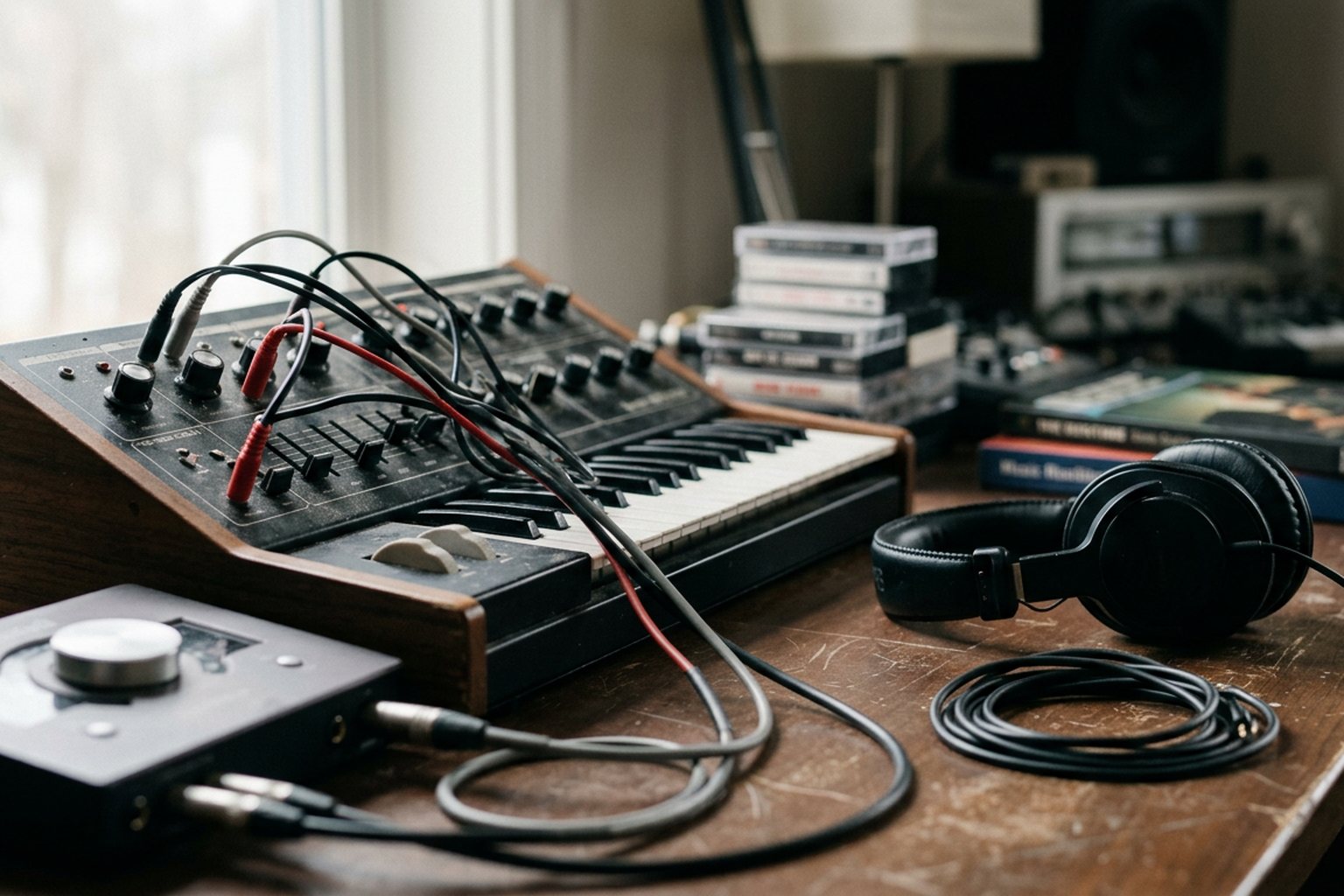
A patch that shakes the studio monitors directly from a synthesizer's main output often turns into a thin, boomy mess by the time it sits in a DAW session. Preserving the massive low end of an analog synthesizer requires treating the instrument's output circuit with the same technical discipline you would give a kick drum or a bass guitar. From impedance mismatches to phase-distorting high-pass filters, a handful of critical signal path choices dictate whether your low end stays punchy or collapses in the mix.
Impedance, Signal Levels, and the DI Question
Synthesizers output a line-level signal, but that label hides a wide variety of circuit behaviors. Vintage synths like a Moog Minimoog Model D or an ARP 2600 often have high output impedance and unbalanced quarter-inch connections, while modern desktop units might output a standard balanced line-level signal. Plugging an unbalanced, high-impedance synth output directly into a low-impedance interface line input causes impedance bridging issues, high-frequency roll-off, and an unpredictable loss of sub-bass punch.
For unbalanced synths, using a direct injection (DI) box before the preamp is standard practice. A high-quality passive DI with a robust transformer isolates ground loops and steps down high-impedance signals while smoothing out aggressive transient spikes. Active DIs excel at preserving fast attack transients on lower-output vintage gear. If your synthesizer, like a Sequential Prophet-5, provides robust balanced outputs, you can skip the DI and patch straight into your interface or outboard line preamps. However, driving a transformer-balanced mic preamp via a DI box allows you to add gentle harmonic saturation that thickens low frequencies before conversion.
Gain Staging: Analog Headroom vs. Digital Clipping
The low frequencies of an analog synth require significant voltage to reproduce. Sub-bass waves contain heavy energy, which means poorly gain-staged synth tracks easily overload audio converters before mid-range notes sound loud enough in the room. A common mistake is cranking the synth’s master volume to maximum to achieve a hotter signal in the DAW, which can saturate the instrument's internal VCA output buffer into harsh, unintentional distortion.
To keep the low end tight, set the synth’s master volume to its linear sweet spot—usually around three-quarters full—and let your outboard preamp or interface gain handle the rest. Aim for average digital signal levels between -18 dBFS and -12 dBFS on your DAW meters, with peaks no higher than -6 dBFS. This leaves comfortable headroom for sub-bass cycles to complete without hitting converter soft-limiters or clipping digital inputs. Keeping digital gain conservative preserves the natural transient punch of fast envelope generators, such as those found on a Korg MS-20 or Moog Sub 37.
High-Pass Filtering Without Phase Distortion
It sounds counterintuitive to cut low frequencies on a synth patch designed for bass, but unmanaged sub-bass below human hearing (10 Hz to 25 Hz) eats up headroom and causes monitor woofers to pump uselessly. However, applying the wrong high-pass filter (HPF) curve can actually destroy the low end you intend to save.
Standard digital minimum-phase HPFs introduce phase shift around the cutoff frequency. When you apply a steep 24 dB/octave filter at 30 Hz, the phase response shifts dramatically in the 30 Hz to 80 Hz region, where fundamental bass notes sit. This phase rotation can smear transient attacks, making the bass sound hollow or out of time with the kick drum.
To maintain low-end punch:
- Use gentle filter slopes (6 dB/octave or 12 dB/octave) set low, around 20 Hz to 25 Hz, to clean up sub-audible rumble without twisting phase relationships in the audible bass register.
- Consider linear-phase EQs for deep cuts, but watch out for pre-ringing artifacts on heavy transient attacks.
- Try a low-frequency shelf EQ to dip extreme lows by 2 to 3 dB rather than using an aggressive high-pass filter.
Signal Path Workflow Comparison
| Connection Method | Target Instruments | Signal Path | Low-End Character |
|---|---|---|---|
| Passive DI to Mic Preamp | Vintage unbalanced synths (Minimoog, ARP Odyssey) | Unbalanced Out -> Passive DI -> Mic Preamp | Rounded, warm transients with full sub-bass retention |
| Active DI to Mic Preamp | Low-output or high-impedance synths | Unbalanced Out -> Active DI -> Mic Preamp | Fast, punchy transient response; clean sub-bass |
| Direct Line Input | Modern balanced synths (Prophet-5 Rev 4, Peak) | Balanced Out -> Interface Line In | Unaltered, precise frequency reproduction; neutral character |
| Outboard Line Preamp | Modern or vintage balanced synths | Line Out -> Hardware Line Preamp / EQ | Harmonic drive; saturated low-mid emphasis |
Phase Cancellation in Stereo and Unison Patches
Analog synthesizers often feature built-in chorus circuits, multiple detuned oscillators, or voice-panning modes that sound immense in headphones. Roland Juno-106 chorus or modern synth stereo unison modes create width by introducing phase differences between the left and right channels.
When summed to mono or played on club sound systems with single subwoofer setups, these phase differences trigger destructive interference, causing the low end to completely vanish. If a patch is designated for bass duties, keep the core fundamental frequencies (below 120 Hz) strictly mono.
If a synth patch relies on stereo effects:
- Track the patch dry in mono for the core bass channel.
- Track a second wet stereo take with the spatial effects engaged.
- High-pass the wet stereo channel above 150 Hz in your mix, allowing the dry mono track to carry the low-end weight while the wet track provides width in the upper midrange.
Quick answers
Should I always use a DI box when recording analog synths?
No. Use a DI box if your synthesizer has unbalanced outputs, high output impedance, or long cable runs prone to ground hum. If your synth outputs low-impedance balanced line signals, direct line inputs on your interface or preamp will work fine without tone degradation.
Why does my synth bass lose impact when mixed with a kick drum?
This usually stems from frequency masking or phase cancellation. If the synth fundamental sits at the exact same frequency as the kick drum transient, the waves can cancel each other out. Use subtle EQ cuts, phase inversion on one of the sources, or sidechain compression to clear space for both sounds.
Is analog saturation good for synth low end?
Controlled analog saturation adds upper harmonics, making sub-bass frequencies audible on smaller speakers without increasing low-end energy. However, over-saturating the signal rounds off transient punch and can turn tight sub-bass into muddy, uncontrolled distortion.
Preserving analog bass takes equal parts gain discipline, impedance awareness, and restraint with EQ. Get the hardware routing right before hitting record, leave clean digital headroom, and treat your sub-frequencies with a light touch in the DAW.