 SAMPLED
Portable synths worth taking on a train
Battery power, built-in speakers, and keybeds that survive a backpack. Sketching away from the studio.
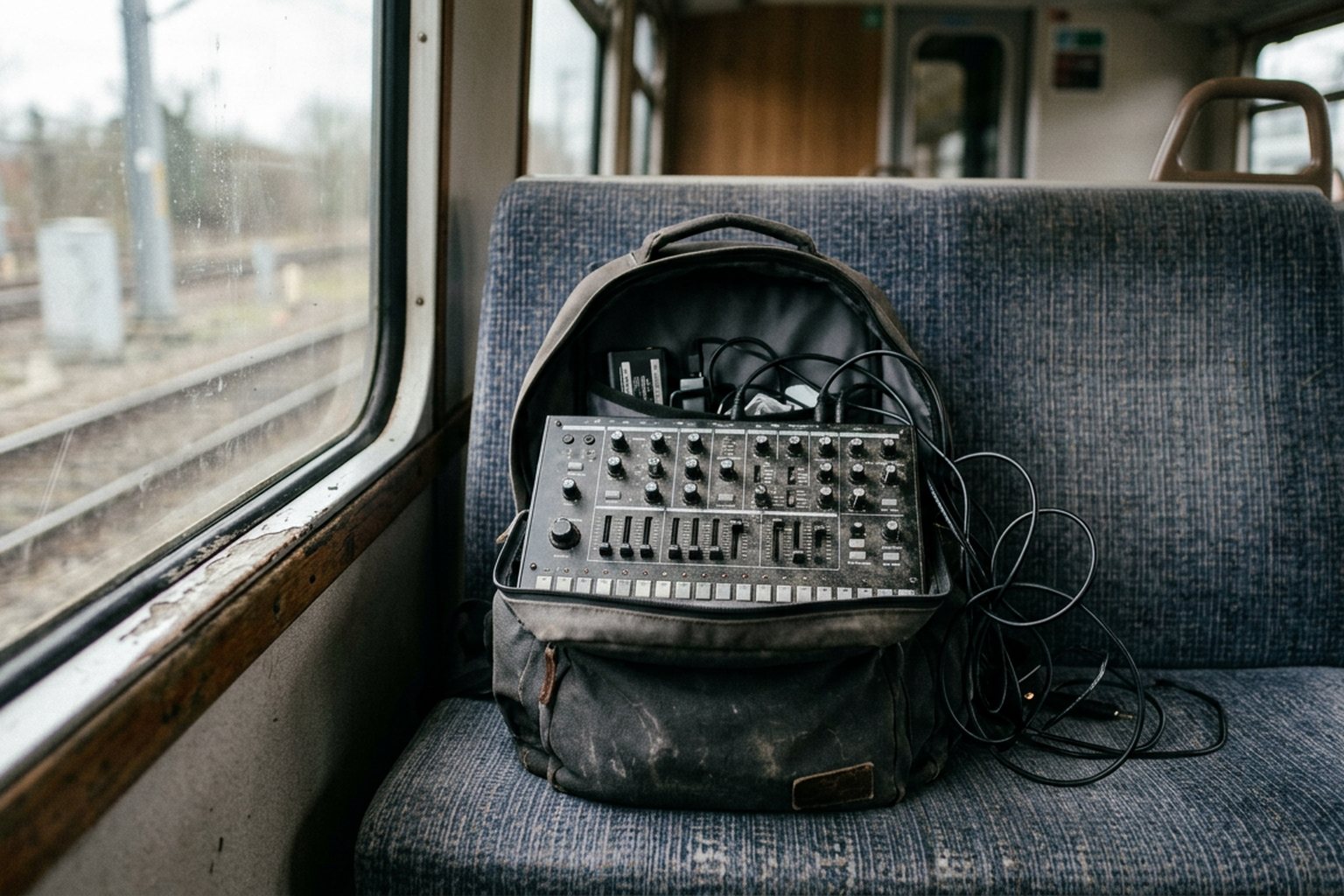
Writing music on a commuter train demands a specific kind of hardware design. You need an instrument that boots instantly, runs for hours without a wall outlet, and tolerates the turbulence of a moving car without spilling parameters across a tray table. A laptop and a DAW often feel too much like your day job, whereas a dedicated portable synthesizer turns an unscheduled delay into a productive sound design session.
What Makes a Synth Train-Worthy?
Not every compact synth belongs in a backpack. True portability requires a balance of chassis durability, sensible power management, and an interface that does not rely on fragile external dongles or constant computer connection.
When evaluating a synth for mobile sketching, focus on these physical criteria:
- Power Independence: Internal rechargeable lithium-ion batteries or standard AA slots are mandatory. USB-C bus power is useful, but only if the unit does not introduce ground-loop noise when connected to a power bank.
- Keybed and Interface Tactility: Tiny touch-strips and capacitive pads work in a quiet room, but physical keys or high-friction rubber buttons offer better feedback on a bumpier ride. Potentiometers should feel smooth and offer enough resistance that a sudden jolt does not send your filter cutoff to maximum.
- Audio Out and Monitoring: Integrated speakers are useful for quick auditioning at low volumes, but a clean, high-output headphone jack is non-negotiable. Trains produce high ambient noise, so the internal headphone amplifier needs enough headroom to drive closed-back dynamic headphones without distorting.
The Contenders: Portable Powerhouses
Roland S-1 Tweak Synth: Pocket-Sized SH-101 Lineage
The Roland S-1 packs the company's Analog Circuit Behavior (ACB) modeling into an enclosure roughly the size of a paperback book. Based on the classic SH-101 monophonic synth, the S-1 expands the original topology into a four-voice polyphonic engine with square, sawtooth, sub-oscillator, and noise generators.
Roland added modern features like oscillator draw modes, wave chopping, and an onboard sequencer with motion recording. The built-in lithium-ion battery recharges via USB-C and lasts roughly four hours per charge. The micro-knobs require a delicate touch, but the rubberized button grid is surprisingly responsive for inputting step-sequenced basslines and pads while holding the unit in your hands.
Yamaha Reface CS: The Musician’s Mini-Keybed
If your sketching workflow relies on actual playing rather than step sequencing, the Yamaha Reface CS remains the standard for compact playability. Its 37-note high-quality mini-keyboard provides velocity sensitivity and key travel that puts most standard MIDI controllers to shame.
The engine is an eight-voice virtual analog setup managed entirely through physical sliders. There are no menus or preset storage slots; what you see on the front panel is what you hear. It runs on six AA batteries for about five hours and features built-in stereo speakers that provide reasonable monitoring when working without headphones. The plastic chassis is thick, durable, and easily withstands being stuffed into a messenger bag without a hard case.
Teenage Engineering OP-1 Field: The Self-Contained Studio
The OP-1 Field is built around an anodized aluminum frame that feels indestructible. It combines multiple synthesis engines—ranging from FM and phase modulation to physical modeling—with a four-track stereo tape deck system, built-in microphone, FM transmitter and receiver, and an internal battery rated for over twenty hours of use.
Its mini-keys use scissor switches similar to a high-end laptop keyboard, making tactile entry fast and reliable. The color-coded display is bright enough to read in direct sunlight through a train window. While its price point sits far above typical portable hardware, its ability to carry a complete production from initial synthesis to finished multi-track arrangement without extra gear makes it an unmatched standalone travel tool.
Korg Volca FM2: Deep Digital Synthesis on a Budget
Korg’s Volca series established the modern standard for portable synth modules, but the Volca FM2 is arguably the most capable of the lineup for travel. It is a six-operator FM synthesizer with 64-voice memory slots, full compatibility with original Yamaha DX7 patch SysEx files, and built-in chorus and reverb effects.
The FM2 doubles the polyphony of the original Volca FM to six voices, making full chord pads possible. It runs on six AA batteries or USB power and includes a tiny built-in speaker alongside its headphone jack. The capacitive touch panel requires a flat surface or stable hands, but as a compact engine for rich digital textures, metallic percussion, and classic electric pianos, its sound density relative to its physical size is exceptional.
Technical Feature Comparison
| Synthesizer | Synthesis Type | Polyphony | Power Source | Primary Input | Native Speaker? |
|---|---|---|---|---|---|
| Roland S-1 | Virtual Analog (ACB) | 4 Voices | Internal Li-ion (USB-C) | Rubber step pads | No |
| Yamaha Reface CS | Virtual Analog | 8 Voices | 6x AA Batteries / DC | 37 Mini-Keys | Yes |
| Teenage Engineering OP-1 Field | Multi-Engine / Digital | 24 Voices | Internal Li-ion (USB-C) | 24 Scissor Keys | Yes |
| Korg Volca FM2 | 6-Operator FM | 6 Voices | 6x AA Batteries / USB | Multi-touch strip | Yes |
Workflow Strategies for Commuter Sketching
Working on a train forces constraints that can actually help finish ideas faster, provided your rig is configured correctly.
Cable Management and Audio Routing
Avoid long, rigid audio cables that stick straight out of synth panels; a accidental bump from a passing passenger can strip a 3.5mm jack off the internal circuit board. Use short audio cables with right-angle connectors. If you run a multi-synth setup on a tray table, a passive two-channel passive mini-mixer keeps you from swapping headphone plugs back and forth.
Patch Management Without a Computer
Choose hardware that allows direct patch saving to internal memory without requiring an internet connection or librarian app. The Roland S-1 and Volca FM2 allow instant onboard storage. The Reface CS takes the opposite approach: because it lacks patch memory, keep a smartphone photo album of slider settings or treat the unit purely as an ephemeral sketching tool where every session starts from scratch.
Managing Low-Frequency Monitoring
Small headphones often overcompensate on low-end response, leading to muddy mixes when you transfer your train sketches back to studio monitors. When designing bass patches on small synths, use your filter envelope to trim sub-bass frequencies below 40Hz and rely on mid-range harmonics (using wave folding, saturation, or resonance tricks) to ensure the sound cuts through ambient train hum without overdriving your output.
Quick Answers
Do built-in synth speakers sound good enough to use for sound design?
No. Integrated mini-speakers on devices like the Yamaha Reface or Korg Volca series are designed for basic pitch monitoring and casual playing. They roll off sharply below 200Hz and distort quickly at higher volumes. Always use a pair of decent closed-back headphones or in-ear monitors when tweaking filters, resonance, or low-end sub-oscillators.
How do I prevent USB-C power banks from creating audio hum in small synths?
Ground-loop noise is common when powering synths and monitoring audio through connected gear powered by the same battery bank. Use an inline USB ground-loop isolator on the power line, or rely on the synth’s internal battery power when monitoring audio over headphones to keep the ground path clean.
Are capacitive touch keys reliable on a moving vehicle?
Capacitive keys (like those on the Korg Volca line) rely on skin contact rather than physical travel. They work fine on a train, but they offer no physical resistance, which makes blind playing difficult. Physical mini-keys or soft-click rubber buttons are much easier to play accurately when vibrating or moving.
Selecting a train synthesizer comes down to deciding whether you prioritize keybed feel or overall footprint. If you want to play two-handed chords and shape sounds with physical faders, the Yamaha Reface CS is the most reliable option. If your space is limited to a coat pocket and you prefer step-sequencing intricate electronic patterns, the Roland S-1 offers the deepest feature set per square inch. Pick the unit that matches your input style, pack a short pair of right-angle headphone cables, and treat your commute as scheduled studio time.