 SAMPLED
LFOs beyond wobble: modulation that stays musical
Slow drift, keyed retrigger, and routing choices that add movement without cartoon effects.
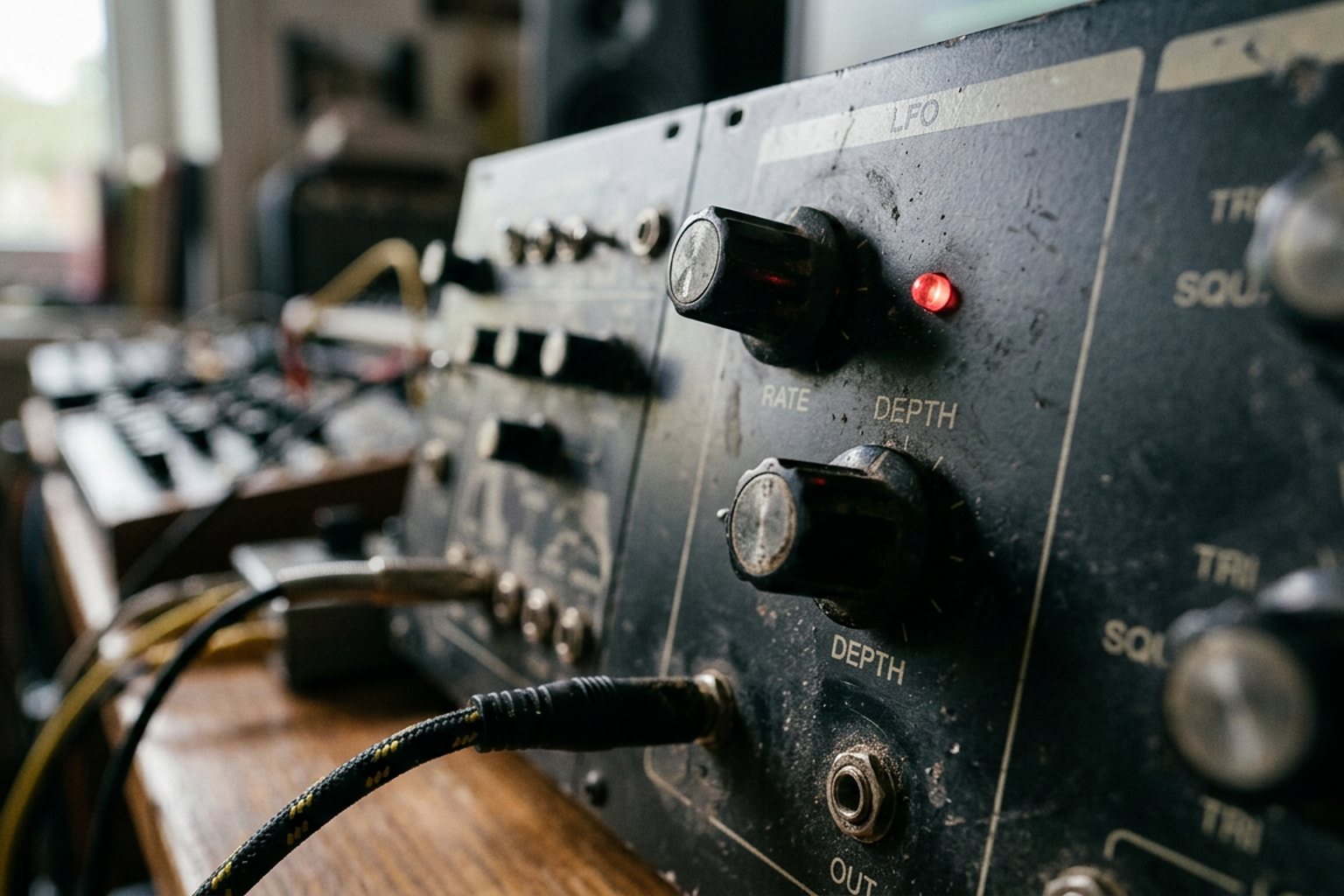
Most synth programmers engage an LFO, assign it to filter cutoff or main pitch, and immediately regret it. The result is usually a mechanical siren or an obnoxious wobble that overwhelms the note's fundamental pitch and dominates the mix. Used with restraint, low-frequency oscillators are what transform static analog patches into breathing, three-dimensional sounds.
The Subtlety Problem: Why LFOs Default to Cartoons
The main reason LFO modulation sounds heavy-handed in modern hardware setups comes down to gain staging in the control path. Modern analog synths and hybrid instruments often give you massive modulation depth ranges, allowing an LFO to sweep a filter across eight octaves or pitch-bend an oscillator into dog-whisker territory. When you dial in depth by ear without attenuating the signal, you quickly cross the line between acoustic realism and cartoon sound effects.
Human hearing is exceptionally sensitive to periodic pitch fluctuation. A pitch vibrato deeper than a quarter-tone sounds instantly comical or drunken unless it is delayed or scaled dynamically. Filter sweeps face a similar issue: when a filter opens and closes over a wide frequency band at a steady cyclic rate, the brain identifies the movement as an artificial process rather than a physical instrument reacting to physical energy. To keep modulation musical, the LFO must act as a subtle bias on the circuit rather than its primary driver.
Slow Drift and Unsynced Cycling
The most effective use of an LFO is setting it so slow that the listener notices the presence of the movement without tracking its period. Speeds below 0.2 Hz (one full cycle every five seconds or longer) alter the timbre of held chords and sustained bass notes without creating a predictable rhythm.
Free-running LFO (Unsynced):
Voice 1 Phase:  [--/^\_--/^\_--]
Voice 2 Phase:  [/\_--/^\_--/^\]  <-- Micro-phase offsets create natural width
Voice 3 Phase:  [_--/^\_--/^\_-]

Tempo-Synced LFO (Key-Retriggered):
Voice 1 Phase:  [|/^\_--|/^\_--]
Voice 2 Phase:  [|/^\_--|/^\_--]  <-- All voices sweep identically; can sound rigid
Voice 3 Phase:  [|/^\_--|/^\_--]
When designing patches on polysynths like the Sequential Prophet-5, Roland Juno-106, or Oberheim OB-Xa, avoid locking every LFO to MIDI clock. Tempo-synced modulation locks the synth's internal movement to the grid, which strips away the micro-timing variances that make analog hardware sound organic.
Instead, leave the LFO in free-running mode at a fractional rate. Target subtle parameters:
- Pulse Width Modulation (PWM): Driving square wave width with a slow triangle wave creates phase cancellation inside the oscillator core, mimicking the natural chorus effect of two physical strings vibrating slightly out of tune.
- Fine Pitch Drift: Assigning a slow, low-depth sine wave to oscillator B pitch (with an depth under 1% of a semitone) recreates the thermal drift of vintage discrete oscillators without pushing the patch out of key.
- Filter Bias Offset: Directing a slow triangle LFO to cutoff frequency with minimal depth shifts the brightness of a pad over several measures, keeping long notes from growing stale in a multi-track arrangement.
Phase, Retriggering, and Voice Logic
How an LFO starts its cycle determines whether a patch feels tight or floating. Hardware synths typically offer two key-triggering modes for modulation generators: retriggered (mono or polyphonic) and free-running.
| LFO Sync Mode | Voice Retrigger Behavior | Ideal Musical Application | Recommended Destinations |
|---|---|---|---|
| Free-Running (Unsynced) | LFO cycles continuously regardless of note-on events. | Ambient pads, drone textures, subtle oscillator drift. | Oscillator Fine Tune, Filter Cutoff, PWM |
| Key-Retriggered (Poly) | Each voice starts its own LFO cycle at phase zero on note-on. | Sequenced arp lines, rhythmic brass stabs, dynamic pluck attacks. | Filter Resonance, VCA Level, Wavefolding |
| Key-Retriggered (Mono) | All active voices reset to a shared LFO phase when a new note strikes. | Aggressive basslines, unison leads, hard-panned tremolo. | Filter Cutoff, Main Pitch |
| Tempo-Synced (Clocked) | LFO cycle rate is locked to MIDI clock divisions (e.g., 1/4, 1/8d). | Gated rhythmic pads, pumping sidechain simulation. | VCA Volume, Sub-Oscillator Level |
For bass patches, key retriggering is vital. If an LFO assigned to filter cutoff is free-running, the transient attack of your bass note will hit at a different point in the LFO phase every time you trigger a key. One note will attack crisp and bright, while the next will start dull and muffled. Setting the LFO to reset its phase to zero on every keypress ensures that every transient lands with identical punch.
Conversely, for polyphonic pads, free-running LFOs are superior. If every note in a five-part chord resets its LFO on keypress, all five voices sweep their filters in exact unison, producing a thick, sweepy flanging effect. When the LFO runs free across all voices, each note lands at a different point in the modulation cycle. This phase offset spreads the voices across the frequency spectrum, creating a sense of physical space and acoustic complexity without relying on outboard stereo processing.
Advanced Routing: Modulating the Modulator
Direct routing (LFO directly to Cutoff or Pitch) is responsible for most clunky synth sounds. Professional patch design relies on indirect routing, where a secondary control source scales the depth or rate of the primary LFO.
Dynamic Vibrato via VCAs
In classic mono synths like the Moog Minimoog or modern semi-modular gear like the Moog Matriarch, routing an LFO straight to pitch produces constant, mechanical vibrato. To make this musical, pass the LFO signal through a Voltage Controlled Amplifier (VCA) before it hits the oscillator pitch input.
By driving that intermediate VCA with a secondary envelope generator set to a slow attack, the LFO depth scales up gradually after a key is held. The note strikes true and perfectly tuned, then gently develops vibrato over time—exactly as an orchestral string player or vocalist executes sustained notes.
[Secondary Envelope] ---> [VCA Signal Level]
                               |
[LFO Output] ----------> [VCA Signal Input] ---> [Oscillator Pitch]
Randomization via Sample and Hold
Step-based or random modulation doesn't have to sound like a 1970s mainframe computer. By routing a Sample and Hold (S&H) circuit fed by a internal white noise generator to a filter or resonance control, you generate step changes in tone with every key strike.
To keep this from sounding chaotic:
- Pass the S&H output through a slew limiter (also labeled as "lag" or "glide" on instruments like the Korg MS-20 or Sequential Prophet-6).
- The slew limiter rounds off the sharp stair-step transitions between random voltages, converting them into a smooth, wandering control signal.
- Attenuate the output depth down to single-digit percentage values.
The resulting modulation delivers a non-repeating, continuous tone curve that keeps acoustic acoustic-style patches from sounding static, without ruining the fundamental harmony.
Three Patch Architectures for Hardware Synths
1. The Dynamic Brass Pad
- Target Synth: Any dual-oscillator polyphonic analog synth (e.g., Sequential Rev2, Novation Peak, Oberheim OB-6).
- LFO Setup: Low rate (approx. 0.3 Hz), Triangle wave, Unsynced (free-running).
- Routing: Modulate Oscillator B Fine Tune only. Keep depth restricted to 1–3 cents.
- Secondary Routing: Envelope 2 (Aux) assigned to modulate LFO Rate upward slightly as notes are held.
- Result: A chord hit starts clean and tight, then slowly blooms as micro-detuning expands the stereo width and high-frequency chorusing.
2. The Articulated Analog Bass
- Target Synth: Monophonic hardware synth (e.g., Moog Sub 37, Dreadbox Typhon, Arturia MiniBrute).
- LFO Setup: Medium rate (approx 4–6 Hz), Ramp Down (Sawtooth) wave, Key-Retrigger enabled.
- Routing: Modulate Filter Cutoff.
- Depth Control: Set LFO depth to near-zero, but route Velocity to LFO Depth in the synth matrix.
- Result: Softly played notes yield a clean, sub-heavy response. Harder key strikes trigger a rapid, snapping filter envelope decay driven by the single LFO ramp cycle, adding transient slap without sacrificing low-end stability.
3. The Un-quantized Ambient Drone
- Target Synth: Semi-modular analog synth (e.g., Behringer Neutron, Make Noise 0-Coast, Moog Mother-32).
- LFO Setup 1: Rate set to 0.1 Hz, Triangle wave. Modulating LFO 2 Rate.
- LFO Setup 2: Rate set to 0.5 Hz, Sine wave. Modulating Filter Cutoff and Pulse Width.
- Result: Because LFO 1 continuously speeds up and slows down LFO 2, the actual filter modulation pattern never repeats on a fixed time grid. The sound continuously shifts and morphs without hitting distinct cyclical loops.
Quick Answers
Should I always turn off LFO tempo sync for analog patches?
Turn off tempo sync for ambient pads, acoustic emulations, and natural polyphonic textures where you want organic movement. Keep tempo sync turned on when designing rhythmic elements like gated chord sequences, basslines meant to lock to a kick drum, or pulse-width effects keyed directly to the track's tempo grid.
How do I stop LFO pitch modulation from making my synth sound out of tune?
Limit the modulation depth to a tight threshold—typically under 5 to 10 cents of pitch shift. Alternatively, switch your LFO routing to target a secondary oscillator rather than all oscillators at once, or use a delayed/envelope-scaled VCA so pitch drift only occurs at the tail end of a note rather than during the initial attack.
What is the difference between a free-running LFO and a key-triggered LFO?
A free-running LFO cycles endlessly in the background regardless of when you play a note, causing notes to pick up the modulation cycle at random points. A key-triggered LFO resets its waveform back to phase zero every time a new key is pressed, ensuring consistent note attacks and predictable modulation behavior.
Can I use Sample and Hold without getting sci-fi computer sounds?
Yes, by routing the Sample and Hold signal through a slew processor (or glide/lag circuit) and dialing the depth down below 10 percent. This turns stepped, harsh random jumps into a smooth, natural wandering control voltage that subtly alters tone without obvious erratic jumps.
Panel Strategy
Stop thinking of the LFO as an effect to turn on and off. Treat it as a utility voltage that models the natural instability of physical materials. High depth settings and fast rates have their place in sound design, but day-to-day mix utility lives in the bottom ten percent of your synth's attenuator dials. Keep rates unsynced, scale depths dynamically with envelopes and velocity, and let your control voltages wander in the background.