 SAMPLED
Vintage vs reissue vs clone: which one should you buy?
Three ways to get the same architecture at wildly different prices and risk levels.
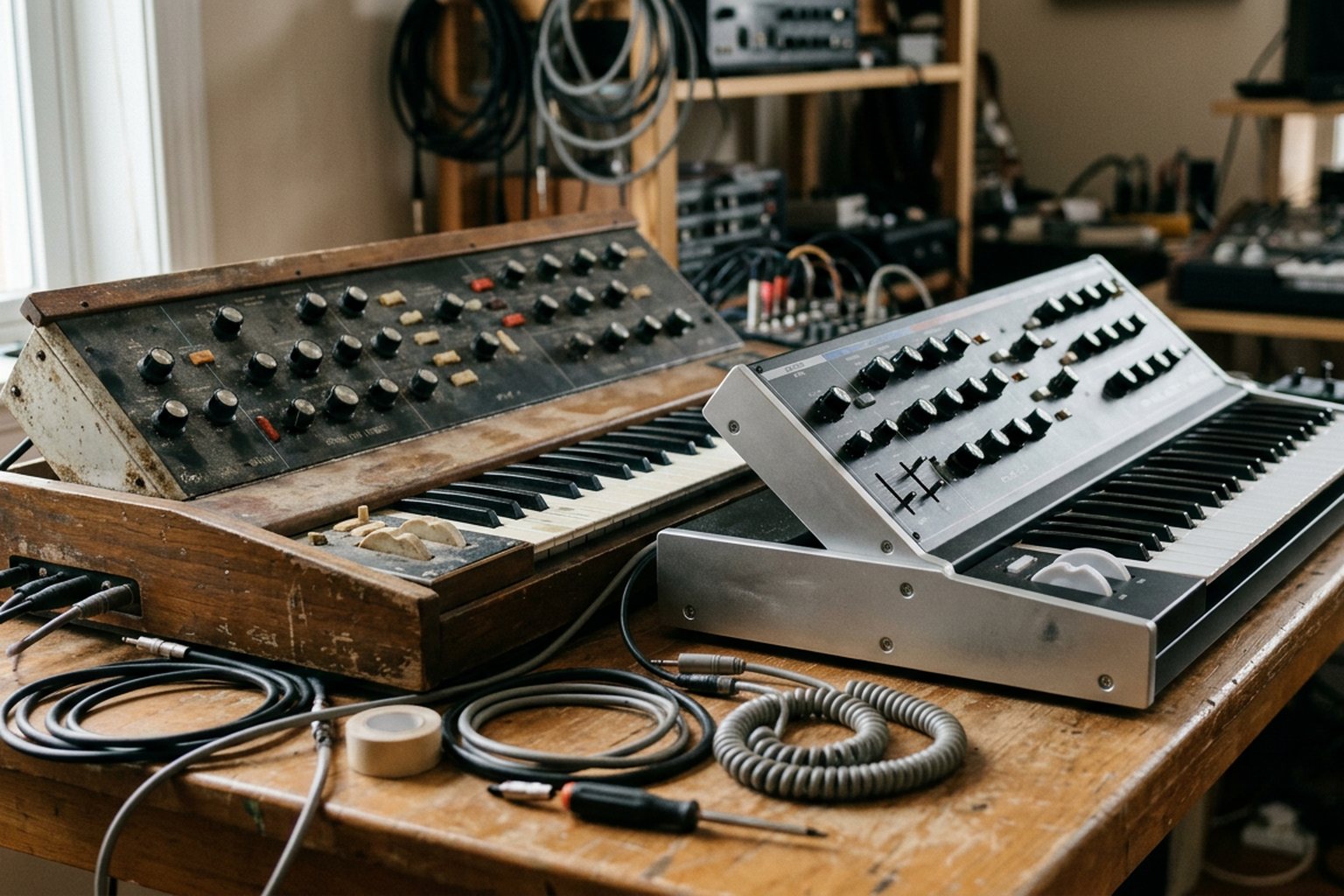
Buying a classic analog synthesizer used to mean scouring classifieds, praying the internal power supply wouldn’t catch fire, and keeping a local bench tech on speed dial. Today, synth buyers face a completely different landscape: you can buy an untouched original from the late 1970s, a factory-authorized reissue built by the original manufacturer, or a mass-produced clone that costs less than a replacement voice card. Each option delivers a fundamentally similar voice architecture, but the ownership experience, long-term maintenance costs, and workflow realities couldn't be more distinct.
The Vintage Original: Magic, Drift, and Maintenance
The case for vintage hardware rests on historical authenticity and specific circuit behavior. Synthesizers like an original 1970s Minimoog Model D, a Sequential Circuits Prophet-5 Rev 2, or a Roland Juno-106 were built using through-hole components, discrete transistor networks, and early integrated circuits from manufacturers like Curtis (CEM) and Solid State Music (SSM). Over four decades, thermal cycling, component aging, and power rail tolerances have altered how these instruments behave. Electrolytic capacitors dry out, carbon composition resistors drift in value, and discrete oscillators wander out of tune as the synth warms up.
For purists and high-end recording facilities, this instability is a feature, not a bug. Microscopic pitch fluctuations between polyphonic voices create natural chorus effects and phase cancellations that digital modeling and tight modern analog circuits rarely duplicate without artificial aid. A vintage Oberheim OB-Xa or Jupiter-8 feels alive because its components operate at the outer edges of their original manufacturing tolerances.
However, owning vintage hardware means accepting an ongoing maintenance tax. Obsolete components are increasingly difficult to source. Roland Juno-106 owners frequently deal with failing 80017A VCA/VCF hybrid chips, which require delicate chemical stripping or aftermarket replacements. Early Prophet-5s rely on fragile SSM chips that carry exorbitant replacement costs on the secondary market. Beyond part failures, vintage keybeds often suffer from degraded rubber contact strips, corroded J-wires, or brittle bushings. If you buy vintage, you are not just purchasing an instrument—you are managing a legacy electronic system that requires routine calibration, clean power, and occasional bench service.
The Official Reissue: Modern Reliability Meets Legacy Design
Official reissues bridge the gap between historical design and modern manufacturing reliability. Over the past decade, manufacturers like Moog, Sequential, and Korg have re-issued iconic instruments such as the Minimoog Model D, the Prophet-5 Rev 4, and the ARP 2600.
These instruments typically retain the original signal paths, discrete ladder filters, and core oscillator topologies, but they update the surrounding infrastructure. Reissues replace failing internal power supplies with stable, modern switching or linear units, add complete MIDI implementation, and introduce velocity and aftertouch sensitivity to keybeds that originally lacked them. In instruments like the Prophet-5 Rev 4, designers even included a knob to artificially introduce circuit-drift, allowing players to dial in the loose tolerances of earlier revisions while keeping the core tuning stable.
Vintage Signal Path:
[Discrete VCO] -> [Drifting Ladder Filter] -> [Aging VCA] -> [Noisy Power Rail]

Modern Reissue/Clone Signal Path:
[Precision VCO] -> [Matched Component Filter] -> [Low-Noise VCA] -> [Regulated DC Power]
The primary drawback of official reissues is cost. Because they are manufactured in lower volumes using premium enclosures, full-sized keybeds, and high-quality potentiometers, street prices often rival or exceed the lower end of the vintage market. Additionally, some purists argue that modern surface-mount technology (SMT) and tight component tolerances make reissues sound too clean or sterile compared to their drift-prone ancestors. In practice, however, a modern reissue sits seamlessly in a mix without the noise floor, VCA bleed, or tuning headaches associated with forty-year-old hardware.
The Modern Clone: Democratized Signal Paths
The explosion of budget clones has completely changed hardware synth access. Brands like Behringer, along with various Eurorack module makers and boutique hardware outfits, have reverse-engineered classic schematics and reproduced them using low-cost SMT assembly and specialized clone chips from manufacturers like Alfa RPAR and Coolaudio.
Instruments like the Behringer Model D, Pro-800, or 2600 replicate the original voice architectures down to the filter pole counts and modulation routes, often scaling them down into compact, desktop-friendly formats. In blind listening tests, these instruments get remarkably close to the raw tone of the original circuits. The basic saw waves, square wave sub-oscillators, and resonant filter sweeps sound convincing, cut through modern mixes, and offer modern conveniences like USB-MIDI control and automated patch storage on architectures that were historically strictly manual.
The trade-offs associated with clones show up in mechanical build quality, user interface scale, and long-term serviceability. To keep prices low, manufacturers utilize smaller, board-mounted potentiometers with less mechanical resistance, lighter chassis materials, and compact keybeds or module layouts. While vintage synths and high-end reissues can be serviced down to individual through-hole components, a broken budget clone is usually cheaper to replace entirely than to repair at a shop charging standard hourly bench rates.
Technical and Ownership Breakdown
| Feature / Consideration | Vintage Original | Official Reissue | Modern Clone |
|---|---|---|---|
| Component Type | Through-hole, discrete, legacy ICs | Mixed (SMT and discrete re-creations) | Surface-Mount Technology (SMT) |
| Tuning Stability | Poor to moderate; temperature sensitive | High; digitally stabilized or tight-tolerance analog | High; modern power regulation |
| Maintenance Cost | High; requires specialized tech support | Low; covered by modern warranties | Low; disposable/replaceable model |
| Connectivity | CV/Gate original, primitive MIDI (if retrofitted) | Full MIDI, USB, extensive CV/Gate | USB-MIDI, modern CV integration |
| Build Quality | Heavy-duty steel/wood; aged mechanical parts | Premium keybeds, high-grade chassis, sturdy pots | Lightweight plastics/metals, smaller pots |
| Value Retention | High; appreciates or holds steady | Moderate to high; slow depreciation | Low; high supply depresses secondary market |
How to Choose Your Signal Path
Selecting the right direction comes down to your operational environment, budget, and tolerance for hardware maintenance.
If you run a commercial recording studio where clients expect specific, iconic gear for aesthetic or historical reasons—or if you are a collector who views instruments as tangible assets—a vintage original remains a compelling choice. Just budget an additional twenty percent of the purchase price for an initial overhaul by a qualified technician.
If you are a touring musician, professional composer, or session player who needs the distinct sound and tactile control of a classic synth without the fear of voice loss mid-show, buy an official reissue. You get the sonic weight, full-scale controls, and physical presence of the original design backed by a manufacturer warranty and steady pitch stability under hot stage lights.
If you are a bedroom producer, electronic music hobbyist, or studio musician who needs real analog voltage for sound design but cares more about track count than badge prestige, buy a modern clone. The price-to-performance ratio is unmatched, and in a dense digital audio workstation mix processed with modern software effects, the subtle sonic gap between a cloned circuit and an original original vanishes entirely.
Quick Answers
Does a vintage synthesizer sound warmer than a modern clone?
The perception of warmth in vintage synthesizers usually comes from a combination of component drift, lower signal-to-noise ratios, and subtle high-frequency attenuation caused by aging capacitors and lower-grade operational amplifiers. Modern reissues and clones use tighter tolerance components and cleaner power supplies, resulting in a slightly brighter and more precise tone, though careful gain staging and EQ can bridge the gap.
Can surface-mount technology (SMT) synthesizers be repaired?
SMT circuit boards can be repaired, but the process requires specialized micro-soldering equipment, hot-air rework stations, and steady magnification. While individual through-hole components on older synths are easier for a hobbyist to swap with a standard soldering iron, modern SMT boards are often serviced by swapping entire daughterboards rather than replacing individual micro-capacitors or surface-mount transistors.
Will a modern clone synth retain its financial value?
Unlikely. Modern budget clones are produced in high volumes using automated manufacturing processes. Because supply is high and replacement parts are inexpensive, clones tend to follow standard consumer electronics depreciation curves, making them functional tools rather than investment-grade audio gear.
Base your decision on how you actually make music rather than theoretical debate over circuit purity. If an instrument sits on a repair bench for six months waiting for rare integrated circuits, it isn't making records. Choose the architecture that fits your working space, your repair tolerance, and your financial baseline, then put it to work in the studio.