 SAMPLED
Prophet-style polys: the sound of stacked voices
How voice cards, unison, and detune create the width people chase with plugins.
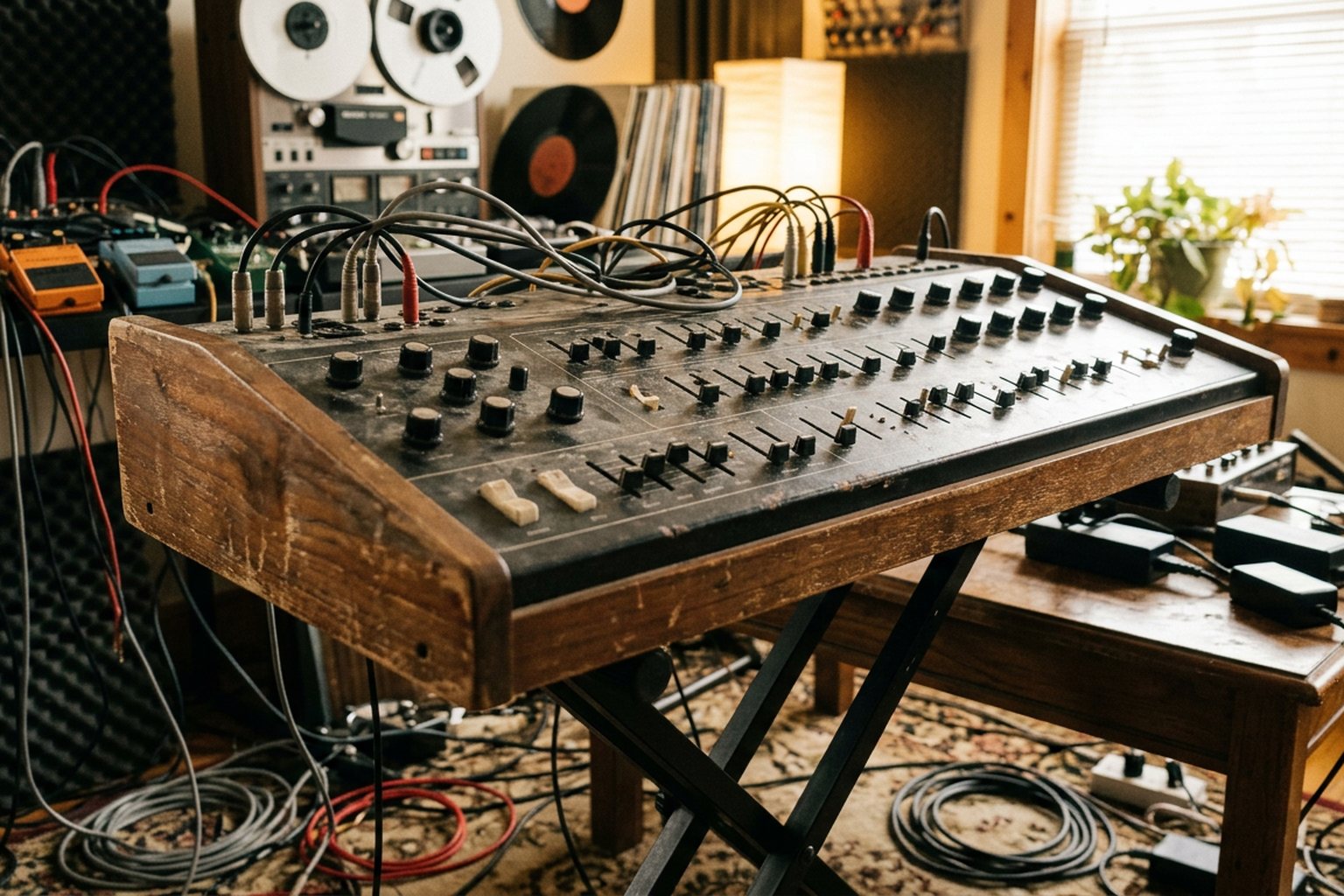
When Dave Smith and John Bowen wired five independent synthesizer voice cards to a central microprocessor in the late 1970s, they were solving an ergonomics problem rather than attempting to reinvent stereo width. The resulting Sequential Circuits Prophet-5 became legendary because those discrete hardware voice cards never perform identically. When you stack multiple voices on a single note, microscopic circuit variances produce a physical width and density that software plugins spend massive processing power trying to replicate.
Architecture of the Stacked Poly
A classic polyphonic analog synthesizer is not a single instrument producing multiple notes simultaneously. It is a cluster of complete monophonic synthesizers housed on separate circuit boards—or dedicated regions of a single board—managed by a central assigner chip. In a five-voice synth like a Prophet-5, or an eight-voice synth like an Oberheim OB-8 or Roland Jupiter-8, every voice card contains its own dedicated set of voltage-controlled oscillators (VCOs), voltage-controlled filters (VCFs), voltage-controlled amplifiers (VCAs), and envelope generators.
Early Prophet-5 revision 1 and 2 models relied on Solid State Music (SSM) integrated circuits before switching to Curtis Electromusic Specialties (CEM) chips for the revision 3. Modern reissues, such as the Prophet-5 Rev 4, feature selectable chip topologies to reproduce both behaviors. Regardless of the chip manufacturer, analog components carry physical manufacturing tolerances. Resistors vary slightly in resistance, capacitors show minor variance in charge rates, and internal temperatures fluctuate across different areas of the motherboard.
Because of these physical realities, Voice 1 never sounds identical to Voice 2. Its filter cutoff might sit three Hertz lower, its second oscillator might drift two micro-cents sharp, and its envelope attack stage might execute two milliseconds faster. When playing polyphonically, these tiny discrepancies make each note of a chord feel distinct. When all voices are summed together on a single note, those minor discrepancies transform into extreme timbral density.
Unison Mode and the Mechanics of Phase
Engaging unison mode overrides the voice assigner, forcing every available voice card to fire simultaneously from a single key trigger. On an eight-voice, dual-oscillator synthesizer, pressing one key activates sixteen oscillators, eight filters, eight VCAs, and sixteen envelope generators aimed at a single pitch.
Key Press -> Voice Assigner -> [Voice Card 1: VCO A + B / VCF / VCA] \
                            -> [Voice Card 2: VCO A + B / VCF / VCA]  |-> Audio Summing Bus -> Main Output
                            -> [Voice Card 3: VCO A + B / VCF / VCA] /
The raw sonic power of an analog unison stack comes down to phase behavior. In a digital synthesizer or software instrument, trigger events often start oscillator waveforms at identical phase points unless explicitly set to free-run. When ten identical digital saw waves trigger at precisely zero degrees phase, their voltage peaks align, producing severe constructive interference followed by cancellation. This results in a harsh, static transient and a hollow comb-filtering effect that collapses the sound.
Analog free-running VCOs never reset their phase upon receiving a gate signal unless oscillator sync is active. When ten physical oscillators trigger in unison, their starting phase angles are completely random. As the oscillators drift micro-cents apart due to subtle voltage changes, their phase relationships shift continuously. This dynamic phase movement prevents permanent cancellation, yielding a rich chorus effect inherent to the synth's hardware layout rather than an added effect pedal.
Panning and Spatial Width
Pitch detuning provides vertical thickness, but spatial width relies on voice placement across the stereo field. Classic polyphonic synthesizers handled voice output routing in a few distinct ways:
- Mono Summed: Instruments like the original Prophet-5 route all voice cards into a single mono audio path. Width comes purely from phase displacement and pitch beating between voice cards.
- Hard-Panned Split: Synths like the Roland Jupiter-8 feature dual audio outputs, allowing lower and upper split layers to be panned hard left and right.
- Per-Voice Pan Spreading: Systems found in the Oberheim OB-8, as well as modern synths like the Sequential Prophet-6 and Trigon-6, allow individual voice cards to be positioned across the stereo panorama.
When voice panning is applied to a unison stack, the sound expands dramatically. If Voice 1 is panned hard left, Voice 2 hard right, Voice 3 mid-left, and Voice 4 mid-right, the ear receives distinct, non-phase-locked analog signals in each ear. Because the left and right channels contain distinct hardware circuits drifting independently, the stereo field sounds naturally wide. This avoids the hollow phase artifacts caused by stereo chorus circuits or delay-based Haas-effect widening tricks.
Voice Stacking Across Classic Architectures
| Synthesizer | Voice Count | Oscillator Type | Voice Drift Profile | Stereo Routing Capability |
|---|---|---|---|---|
| Sequential Prophet-5 (Rev 1/2) | 5 | Analog VCO (SSM) | High thermal drift, organic instability | Mono output sum |
| Sequential Prophet-5 (Rev 3) | 5 | Analog VCO (CEM) | Moderately stable, tight tracking | Mono output sum |
| Roland Jupiter-8 | 8 | Analog VCO (Discrete) | Moderate drift, bright filter tracking | Dual mono outputs / Voice split |
| Oberheim OB-8 | 8 | Analog VCO (CEM) | Moderate drift with page 2 pan control | Individual voice pan pots |
| Sequential Prophet-6 | 6 | Analog VCO (Discrete) | High precision with variable Slop/Vintage | Continuous stereo voice pan spread |
| Sequential Rev2 | 8 or 16 | Analog DCO | Ultra-stable pitch, drift simulated via firmware | Gated stereo voice pan allocation |
Modeling Drift: Hardware vs. Software Realities
Modern surface-mount technology (SMT) allows component manufacturing to hit incredibly tight tolerances. Consequently, modern analog synthesizers can suffer from being too stable, losing the organic width of vintage through-hole instruments. To counteract this, modern hardware designers build intentional instability back into their systems.
Sequential introduced the "Slop" control on modern instruments, which evolved into the dedicated "Vintage" knob on the Prophet-5 Rev 4 and Prophet-6. Rather than simply adding a random low-frequency oscillator (LFO) to pitch, the Vintage knob accesses offset lookup tables modeled on original instruments. Turning the knob changes oscillator pitch offsets per voice, alters filter envelope attack speeds per voice, and introduces subtle shifts in filter cutoff calibration across the entire voice array.
Software synthesizers use similar modeling schemes to replicate voice stacking. Algorithms apply micro-randomization to pitch, filter cutoff, and envelope timing across simulated voice channels. However, software unison faces digital signal processing challenges:
- Aliasing: Combining eight or sixteen detuned digital oscillators rich in high-frequency harmonics generates severe intermodulation distortion near the Nyquist frequency.
- Processor Load: Compensating for aliasing requires heavy oversampling (4x, 8x, or higher), multiplying CPU draw exponentially for a single patch.
- Phase Alignment: Digital oscillators must be programmed with complex offset behaviors to avoid predictable comb-filtering artifacts when triggered simultaneously.
Physical voice cards face none of these digital constraints. An analog circuit rolls off high frequencies naturally through physical parasitic capacitance, allowing massive voice stacks to stay warm and smooth without harsh upper-midrange harshness.
Quick Answers
Why does unison mode sound thin on some digital synths?
If a digital synth resets the phase of its oscillators to zero every time a key is pressed, all stacked waveforms trigger simultaneously in perfect alignment. This creates immediate constructive and destructive phase interference, resulting in comb-filtering that cancels out low end and flattens transients.
What is the difference between oscillator detune and voice detune?
Oscillator detune alters the pitch ratio between two oscillators within the same voice card (for example, setting Oscillator B slightly sharp relative to Oscillator A). Voice detune alters the pitch and parameter calibration between entirely separate voice cards across the instrument, creating depth even if every individual voice card has its internal oscillators tuned to octave intervals.
Does voice panning cause phase issues when a track is summed to mono?
True voice-panned analog unison retains excellent mono compatibility. Because the left and right channels are generated by separate physical oscillators running independently, summing them to mono simply folds the phase interactions into a single channel without the predictable signal cancellation produced by delay-based stereo effects.
What is the difference between VCOs and DCOs in voice stacks?
Voltage-Controlled Oscillators (VCOs) use core analog circuits that naturally drift with temperature changes and voltage supply variations. Digitally-Controlled Oscillators (DCOs) use an analog wave-shaping circuit driven by a rock-solid digital clock. DCO synths stay in tune, but require software-driven pitch modulation or dedicated voice spread functions to achieve the lush, un-clocked width of VCO voice stacks.
Applying Voice Stacking in Patch Design
Translating these mechanical realities into practical patch design requires restraint. Over-detuning oscillators in a unison stack degrades pitch clarity, turning a musical chord or bassline into a smear of clashing frequencies. To achieve maximum width with minimal mud, keep pitch detuning subtle—just one to three cents per voice—and instead introduce asymmetry across non-pitch parameters. Try assigning a tiny amount of key-tracking drift to the filter cutoff or adding minor timing differences to envelope attack times. This creates the structural asymmetry of a classic hardware voice array while keeping the core fundamental pitch clean and focused in the mix.