 SAMPLED
Country's biggest records are being cut in living rooms — including one at Vince Gill's house
Kenny Whitmire recorded his new single with a Country Music Hall of Famer in a Nashville home studio. That location detail explains more about modern country production than most chart analysis does.
Kenny Whitmire released "Movin' On's Movin' In," a duet with Vince Gill, according to uDiscoverMusic (opens in a new tab). Whitmire co-wrote it with Carson Peters and Dan Alley. Gill is a Country Music Hall of Famer, Grand Ole Opry member and 22-time Grammy winner.
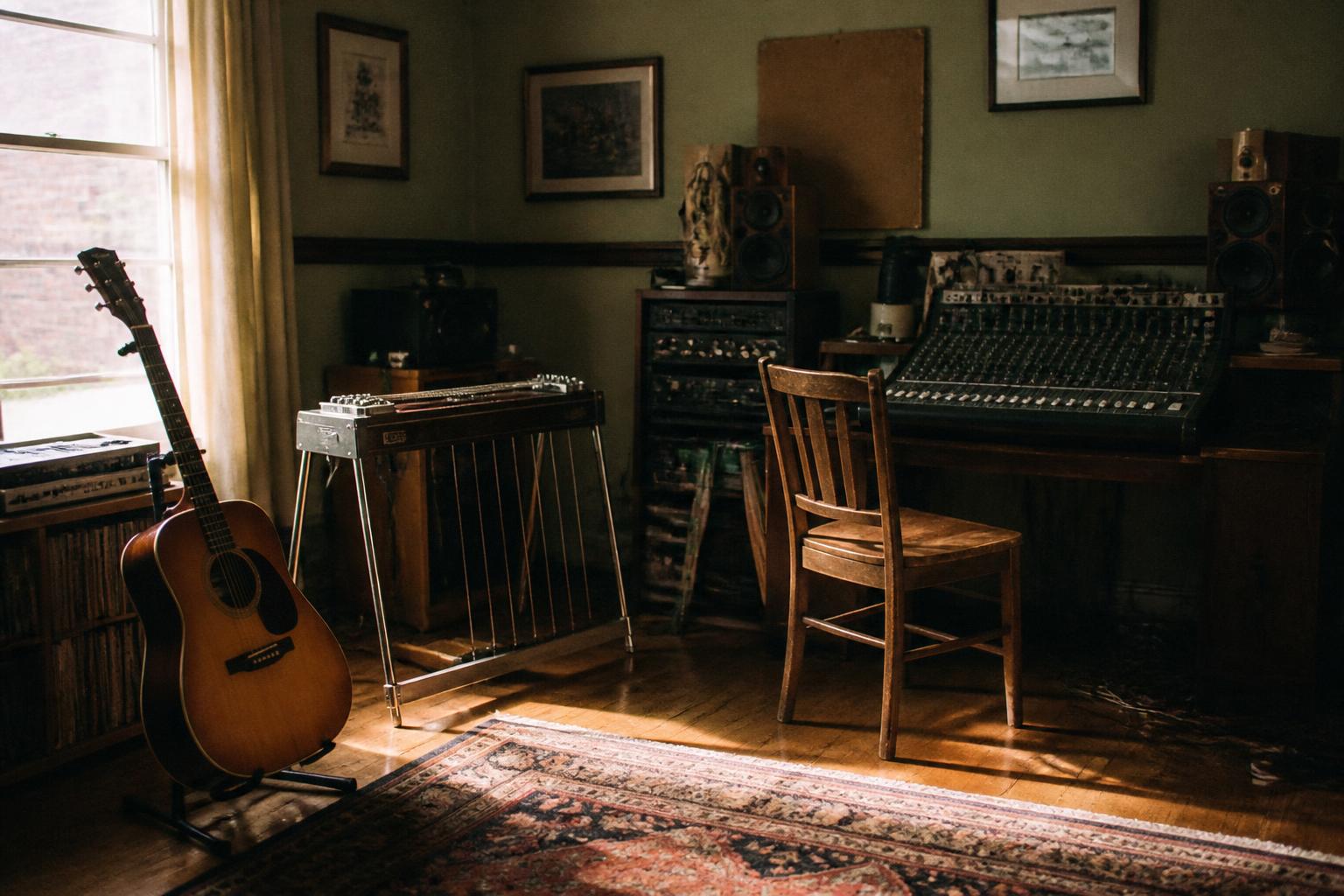
And the honky-tonk track was recorded at Gill's home studio in Nashville.
That last sentence is the one worth stopping on. A major-label country single, featuring one of the genre's most decorated musicians, tracked in a house.
The room moved, the standards did not
Nashville built its reputation on rooms — Studio B, the Quonset Hut, the specific sound of a large tracking space with a rhythm section in it at the same time. Those rooms still exist and still get used. But the economics changed underneath them, and a growing share of what ends up on country radio now starts in a converted den with treated corners and a converted garage for drums.
The reasons are practical:
- Time pressure disappears. No hourly rate means you can chase a vocal take for three hours because the third verse is not sitting right.
- The players are the studio. A Hall of Famer with a home rig brings decades of mic technique, guitar tone and arrangement instinct. The console is not what makes the record; he is.
- Comfort changes performance. Duets in particular benefit from two people singing in a living room instead of two isolation booths and a talkback button.
What still has to be right
A home studio does not lower the bar for country, because country vocals are exposed in a way that most genres are not. There is nowhere to hide a bad take under a wall of synths. The technical must-haves:
A quiet, controlled vocal position. Not a whole treated room — one corner, with broadband absorption behind the singer and a reflection filter or blanket wall in front of the mic. Slap echo off a bare wall is the single most obvious tell of an untreated country vocal.
A real preamp and a large-diaphragm condenser. Nothing exotic. The chain matters less than the placement: six to eight inches out, slightly off-axis, pop filter between.
Acoustic guitars recorded, not sampled. Country arrangements live on the interaction between a strummed acoustic, a pedal steel and a vocal. A sampled acoustic loop cannot breathe with the singer.
Pedal steel and fiddle tracked by the player, remotely if needed. The session player economy in Nashville is fully hybrid now — home studio to home studio, files traded overnight.
Headroom discipline. Home rigs get loud in the mix because nobody is enforcing gain staging. Country masters that survive radio compression are the ones that were not squashed on the way in.
The bigger pattern
This connects to something we wrote about when country took the entire Hot 100 top five: the production has quietly converged on a smaller, drier, more intimate sound. Fewer stacked guitars. Vocals further forward. Less reverb than country used ten years ago.
That aesthetic did not arrive from nowhere. It is what a well-run home studio naturally produces — close mics, controlled rooms, no giant live space to make use of. The gear changed the sound, and then the sound became the taste.
Whitmire is direct about why the session mattered to him beyond the recording. "I have listened to country music my whole life, and Vince Gill has played a massive role in the influence of my sound and songs," he said. "I wouldn't be who I am today as an artist if it wasn't for him."
The song is about leaving heartbreak behind and making room for something new. It was cut in a room somebody lives in. That is not a downgrade — it is where the genre is being made now.