 SAMPLED
FM synthesis: how to program it on purpose instead of by accident
Operators, algorithms and ratios — the three things that decide whether FM gives you a bell, an electric piano or a mess.
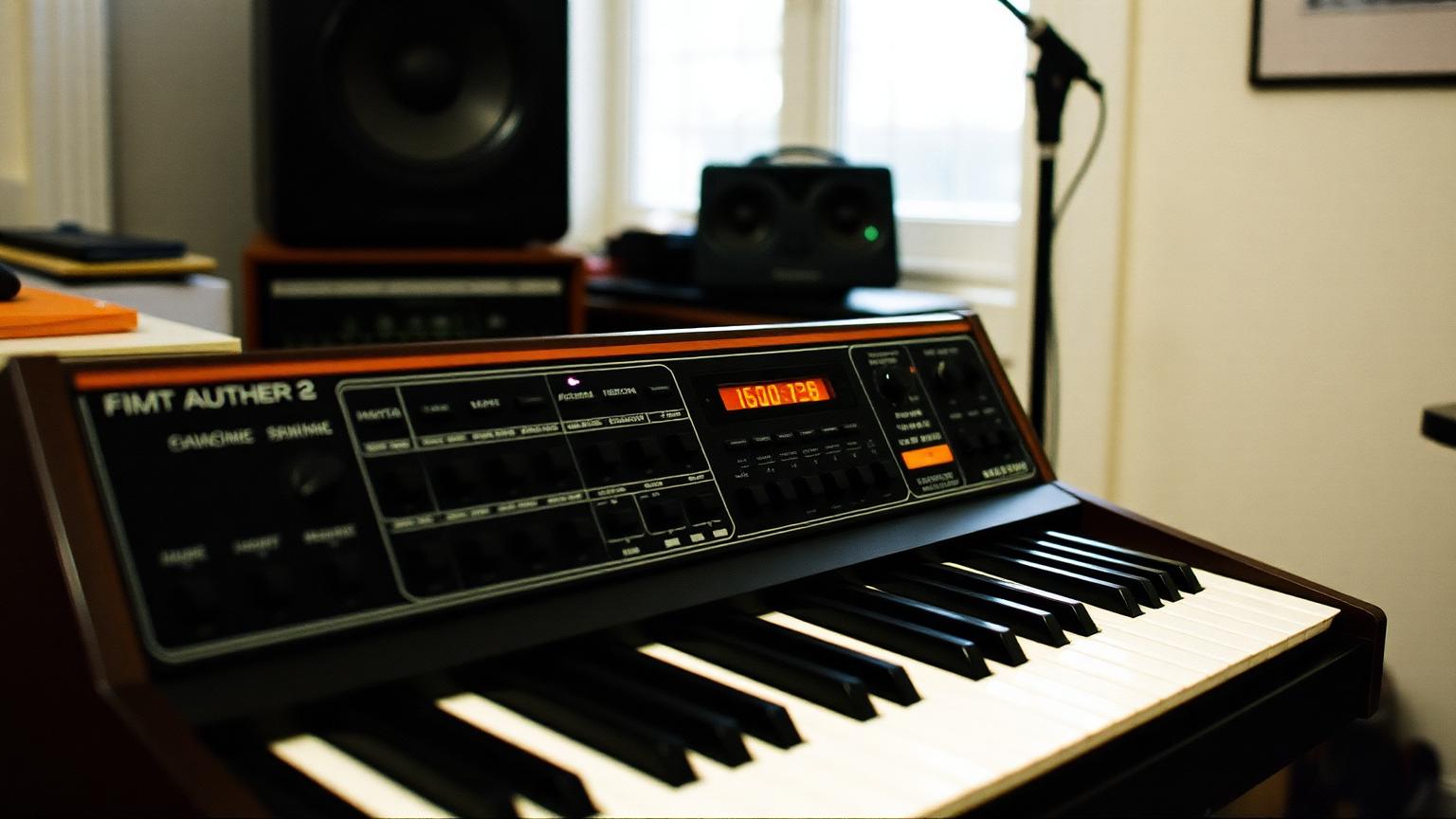
FM synthesis has a reputation for being impenetrable, and the reputation is deserved if you approach it like a subtractive synth. There is no filter to sweep and no waveform to choose. What there is instead is a small number of sine oscillators, called operators, wired so that some of them change the frequency of others. Get three concepts straight and the rest is detail.
Operators: carriers and modulators
Any operator you can hear directly is a carrier. Any operator wired into another operator's frequency input is a modulator, and you never hear it directly — you hear its effect on the carrier.
Modulating a carrier's frequency at audio rate creates sidebands: new frequencies above and below the carrier, spaced by the modulator's frequency. More modulation depth means more sidebands, which means a brighter, more complex sound. This is why in FM, modulation depth behaves like a filter cutoff behaves elsewhere, and why an envelope on modulation depth is the single most important connection in the whole system.
Ratio decides harmonic or inharmonic
The frequency of the modulator relative to the carrier — the ratio — determines what kind of sound you get.
- Whole-number ratios (1:1, 2:1, 3:1) produce sidebands that land on the harmonic series. Result: recognisably pitched, musical tones. Electric pianos, basses, organs, brass.
- Non-whole-number ratios (1:1.41, 1:3.36) produce sidebands unrelated to the fundamental. Result: bells, metal, gongs, industrial clang.
- Ratios very close to but not exactly whole (1:2.01) produce slow beating and a chorused, detuned character.
That is the whole map. If your patch sounds like a broken telephone when you wanted a bass, check the ratio before anything else.
Algorithms are just wiring diagrams
An algorithm is a preset routing showing which operators modulate which, and which reach the output. Two carriers side by side is effectively a layer. A long chain of one operator modulating the next produces extremely complex, often harsh spectra. Algorithms with several independent carriers are far easier to control and are where most usable sounds live.
Practical advice for beginners: pick an algorithm with two independent pairs — two carriers, each with its own modulator. Programme one pair as the body of the sound and one as the attack. That structure covers electric pianos, plucks, basses and most brass.
The classic electric piano, step by step
- Choose a two-pair algorithm.
- Pair A: ratio 1:1, moderate modulation depth, long decay. This is the body — a slightly nasal, hollow sustained tone.
- Pair B: ratio 1:14 or thereabouts, high modulation depth, very short decay (under 100 ms). This is the tine strike, and the high ratio makes it metallic.
- Route velocity to modulation depth on both pairs, more strongly on pair B.
- Give the carriers a long overall release.
Step 4 is why the classic FM piano sounds soft and wooden when played gently and bright and barking when hit hard. Nothing else in the patch changes; only the modulation depth does.
Feedback, briefly
Most FM engines let an operator modulate itself. Low feedback adds harmonics gradually, turning a sine into something approximating a sawtooth. High feedback tips into noise. A feedback operator with a fast envelope makes a very convincing noise transient without a dedicated noise source — useful for snares, breath and pick attacks.
Why bother in 2026
Because FM does things subtractive cannot: sharp metallic attacks, glassy sustains, basses that stay defined on small speakers because their harmonics are placed rather than filtered, and inharmonic material that sits in a mix without eating midrange.
And because the parameter count is small. Six operators, a handful of ratios and envelopes. Once the mapping between ratio and character is in your ear, FM stops being trial and error and becomes the fastest way to reach a specific sound you already have in your head.