 SAMPLED
Building drums on an analog synth: noise, pitch envelopes and the 90 ms rule
Kicks, snares, hats and toms from a single voice — what actually creates each sound, and the envelope settings that matter.
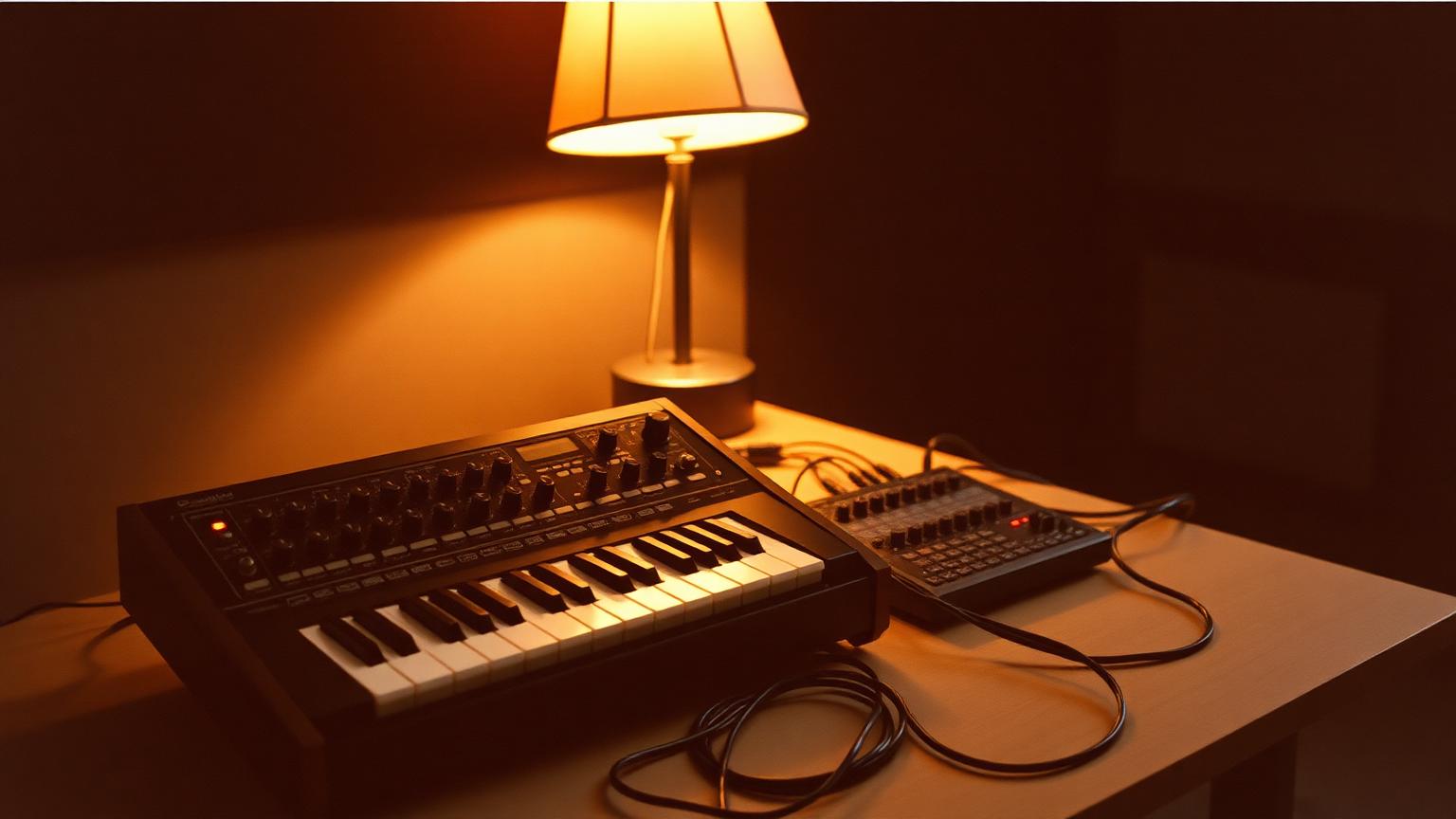
Every classic analog drum machine is a small collection of synth voices with fixed patches. Once you know what each one is doing, you can build the same sounds on any mono synth with a noise source and a fast envelope — and then you are no longer limited to what a drum machine's designer decided in 1982.
The kick: a pitch envelope, and not much else
An analog kick is a sine or triangle oscillator with a very fast downward pitch sweep and a short amplitude decay. The sweep is the sound. Without it you have a bass note; with it you have a beater hitting a head.
Practical starting point: oscillator at roughly 50 Hz, a pitch envelope with instant attack and a 30 to 60 ms decay sweeping down about two octaves, and an amplitude decay between 150 and 700 ms depending on genre. Longer decay for techno, shorter for hip-hop and house.
Two refinements. Add a click by mixing in a few milliseconds of noise or a fast filtered blip at the very start — the ear reads that as attack and it survives on small speakers. And drive the output into gentle saturation, which raises the perceived loudness without raising peak level.
The snare: two layers, always
A snare is a tuned body plus a noise burst, and it fails if you try to do it with one element. Body: two oscillators around 180 and 330 Hz, triangle or sine, with a short pitch drop and roughly a 120 ms decay. Rattle: white noise through a band-pass or high-pass filter, decaying over 150 to 300 ms.
The relationship between the two layers is the character. More body, more tom-like and more useful under a busy mix. More noise, more crack and more likely to disappear when a hi-hat plays.
Add a very small amount of pitch modulation to the body layer and each hit stops sounding identical.
Hi-hats: why noise alone is not enough
Filtered white noise makes a passable closed hat, but it sounds like a shaker, not metal. Real cymbals are inharmonic — a mess of unrelated frequencies. The classic drum machines solved this by mixing six square-wave oscillators tuned to non-harmonic intervals, then band-passing the result.
On a modern synth you can approximate it: run a square oscillator into a ring modulator against another square at an unrelated frequency, then high-pass the output around 6 to 8 kHz. Closed hat gets a 20 to 50 ms decay. Open hat gets 300 to 800 ms, and should choke the closed hat if your setup allows it — that mutual exclusivity is a big part of why drum machine hats groove.
Toms and claps
Toms are kicks with less pitch sweep and more decay, plus a small amount of noise mixed in for skin texture. Tune three of them a fourth apart and you have a usable fill.
Claps are the interesting one: a short noise burst repeated three or four times about 10 ms apart, followed by a longer noise tail with a slight reverb-like decay. If your synth has a delay with very short times and limited feedback, put a single noise burst through it and you have a clap.
The 90 ms rule
Most drum programming problems are envelope problems, and specifically decay problems. As a rough guide, anything intended to read as percussive rather than tonal needs to be substantially done inside 90 milliseconds. Beyond that, the ear starts hearing pitch and the element begins competing with the bass and the chords.
When a drum patch sounds flabby, halve the decay before touching the filter. When a pattern sounds cluttered, shorten the hats before shortening the reverb.
Why do this at all
A drum machine gives you eight fixed sounds. A synth voice with a noise source gives you every sound in that family plus the ones in between, all tunable to the key of the track. The trade is speed — you can only build one at a time, and you have to sample or record each as you go.
That constraint is not entirely bad. Records built from a handful of hand-made hits tend to have more identity than records built from the same three sample packs everyone else downloaded.