 SAMPLED
West Coast synthesis: wavefolding, low-pass gates and why it sounds nothing like a Moog
Subtractive synthesis starts loud and removes harmonics. West Coast synthesis starts simple and adds them. Here is how that changes the way you patch.
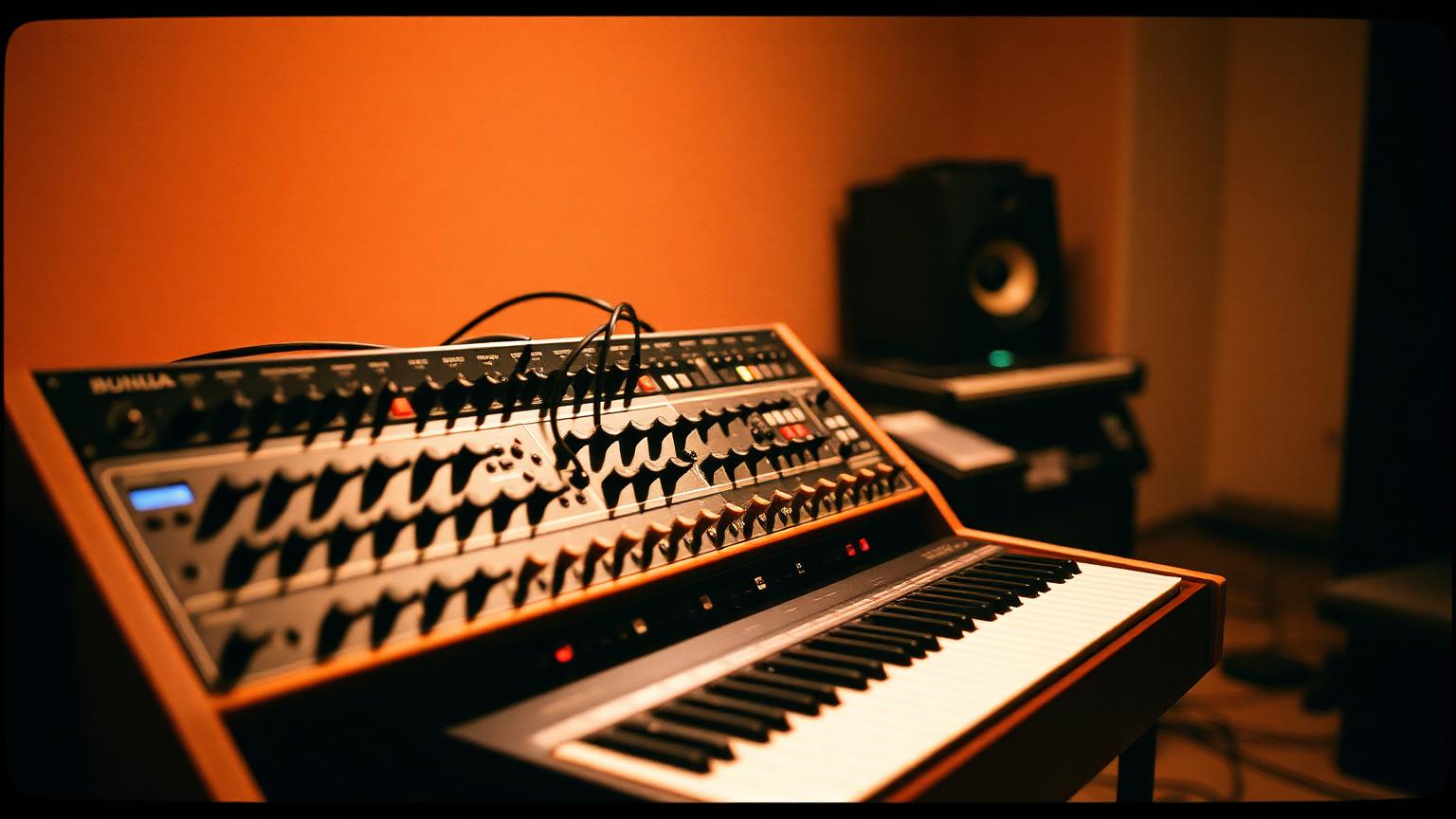
Most synth education is East Coast: an oscillator rich in harmonics, a filter that removes them, an amplifier envelope on the end. West Coast synthesis, the lineage that runs through Don Buchla's instruments and the Serge modular system, inverts the premise. You begin with something close to a sine wave and generate complexity on purpose, using wavefolding, frequency modulation and non-linear circuits. The filter is often not the star at all.
Wavefolding in one paragraph
A wavefolder takes a waveform and folds any part of it that exceeds a threshold back on itself. Push a sine wave into a folder at low drive and nothing happens. Increase drive and the peaks fold, creating new harmonics that appear in a specific, non-linear order rather than the smooth harmonic series of a saw wave. Because the harmonics arrive in bursts as the fold count increases, sweeping a folder sounds nothing like sweeping a filter: it is jagged, vocal, and full of odd resonances that move unpredictably.
The most useful control is not the folder amount but what modulates it. An envelope into fold depth gives a bright attack that decays into a pure tone. An audio-rate LFO into fold depth gives metallic, bell-like tones with no FM in sight.
Low-pass gates, and the reason this music sounds "plucked"
A low-pass gate combines amplitude and brightness in one circuit, historically using a vactrol — a light-dependent resistor paired with an LED. Because the vactrol responds slowly and non-linearly, a short trigger produces a note that gets quiet and dark at the same time, with a natural decay curve you cannot easily draw with an ADSR.
That behaviour is why West Coast patches so often sound like struck or plucked objects. Acoustic instruments lose high frequencies faster than they lose volume; a low-pass gate does the same thing by accident of physics. If your VCA-based patch sounds synthetic, try routing your envelope to both amplitude and filter cutoff with the filter envelope slightly shorter. It is an approximation, but it gets you most of the way.
Complex oscillators: two oscillators that are not two voices
A complex oscillator pairs a principal oscillator with a modulation oscillator, wired for through-zero FM, hard sync and ring modulation before either signal leaves the module. The modulator is not there to play notes. It is there to alter the principal oscillator's timbre in ways a filter cannot reach — inharmonic metals, glassy formants, and the whole family of "not quite a bell, not quite a voice" sounds.
Start with the modulator well below audio rate and slowly raise its frequency while listening. At sub-audio rates you hear vibrato or timbral wobble. As it crosses into the audio range, the wobble becomes a new set of sidebands and the pitch you hear may no longer be the pitch you are playing. That crossover point is where most of the interesting material lives.
Random and non-linear control
The other half of the philosophy is control. East Coast patching tends toward deterministic sequences and repeatable envelopes. West Coast instruments ship with sources of controlled randomness — stepped random voltages, fluctuating noise, and logic modules that make decisions. The idea is a patch that plays itself and never repeats exactly, rather than a preset you perform.
You do not need a Buchla to try this. Any modular or semi-modular with a sample-and-hold and a noise source can produce stepped random voltage. Send it to wavefolder depth at a shallow amount, clocked at a lazy division of your sequencer, and a static drone starts breathing.
What to take back to your normal setup
You do not have to convert. Three ideas transfer cleanly to any synth you already own:
- Generate harmonics rather than only removing them. Overdrive, ring mod, sync and folding all count.
- Tie brightness to loudness. Every acoustic sound does this; most synth patches do not.
- Let one modulation source be genuinely unpredictable, at a small depth.
Those three changes will do more for the character of your patches than another filter type ever will.