 SAMPLED
Wavetable synthesis on hardware, explained without the math
What a wavetable actually is, why scanning it sounds different from a filter sweep, and how to program moving timbres that stay musical.
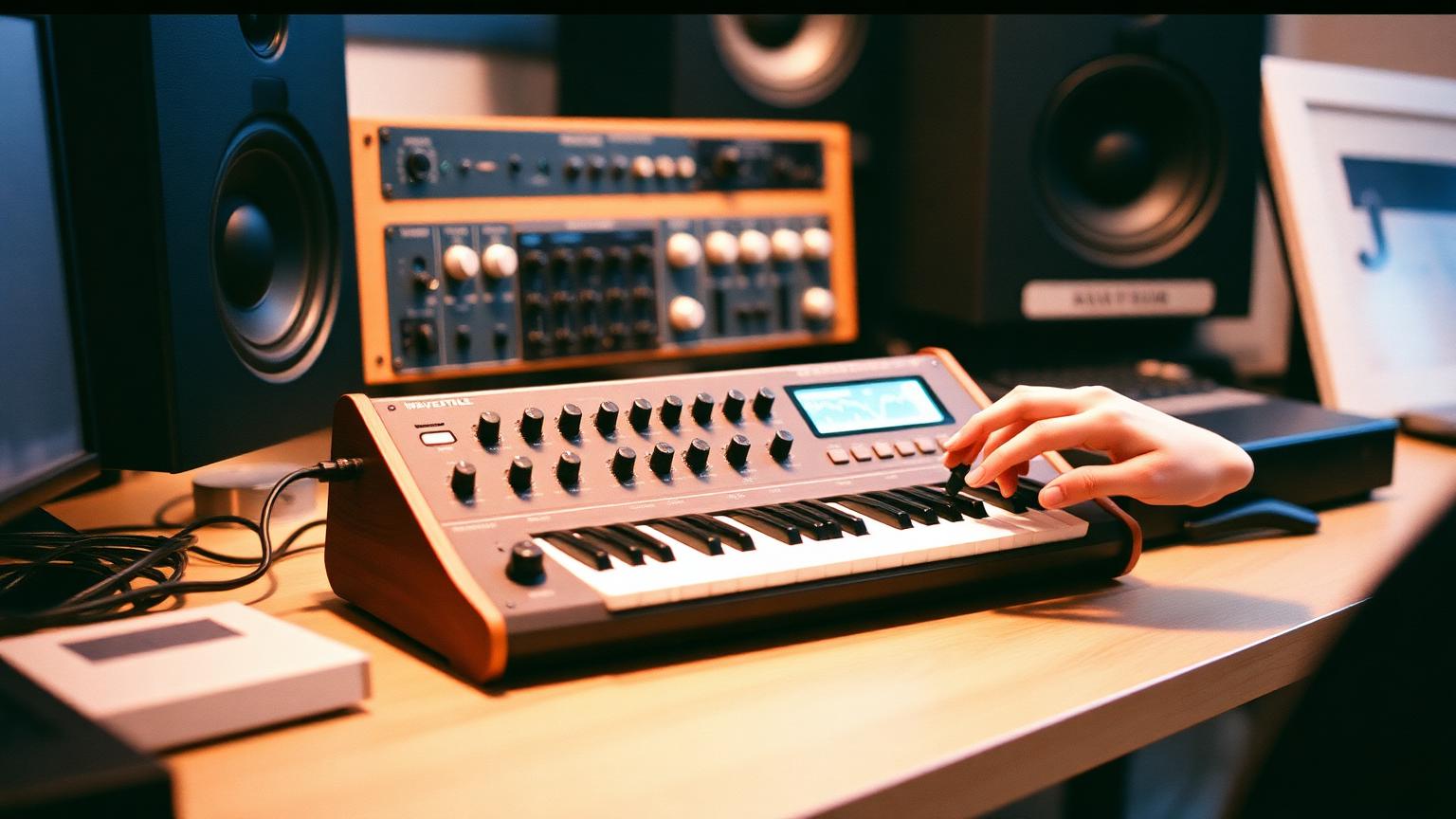
A wavetable is not a magic sound source. It is a list of single-cycle waveforms stored in order, and a pointer that decides which one you are hearing right now. Move the pointer and the harmonic content changes. That is the whole idea. Everything else on the panel — filters, envelopes, effects — behaves the way it does on any subtractive synth.
Scanning is not filtering
A filter sweep removes harmonics that already exist. Scanning a wavetable replaces one harmonic recipe with another. The difference is audible: a filter sweep gets darker or brighter along one axis, while a wavetable scan can move from a hollow square to a nasal formant to a bright, buzzing stack without ever losing low end. If your patch sounds like a filter sweep with extra steps, you are probably scanning a table whose adjacent frames are too similar.
Practical fix: check the table you loaded. Tables built from a single morph (sine to saw, for example) are smooth but boring. Tables built from sampled sources or additive spectra jump between frames and reward slow scanning.
Interpolation and the "digital grit" people chase
When the pointer sits between two frames, the synth has to invent what is in the middle. Interpolating engines crossfade, giving a smooth glide. Non-interpolating or low-resolution engines step, producing the crunchy, slightly aliased character that made early wavetable machines famous. Neither is correct. Interpolation is safer for pads; stepping is more interesting for leads and basses, especially when you modulate the position quickly.
If your synth offers both, program the same patch twice and compare. You will hear the stepped version cut through a busy mix at lower volume.
Three modulation sources worth wiring first
Envelope to position. The most useful move in wavetable programming. A short attack that pushes the pointer forward for 80 to 200 ms and then settles gives you a plucked, consonant-like transient without touching the filter. It reads as articulation, not as a sweep.
Velocity to position depth. Scale how far that envelope travels with how hard you play. Soft notes stay in one part of the table, hard notes travel further. This single connection is why some wavetable patches feel played and others feel typed in.
Slow LFO to position, small depth. Two or three percent of the table range at a fraction of a hertz keeps a pad alive. Anything more and it turns into an effect.
Keeping the low end usable
Wavetables often contain frames with heavy upper harmonics and very little fundamental. If you scan across those frames on a bass patch, the note loses weight in the middle of a phrase — a problem you will not hear on headphones but will hear on a club system. Two reliable answers: restrict the scan range on low notes with key tracking, or layer a plain sine or triangle oscillator an octave down and leave it unmodulated. The second option is what most records actually do.
Aliasing, and when to care
Digital oscillators fold high harmonics back down when they exceed half the sample rate, producing inharmonic tones that do not track the keyboard. On bass and mid-range parts this reads as character. On high leads it reads as a broken synth. If a patch sounds fine at C2 and sour at C5, aliasing is the first suspect. Roll the table position back on high notes with negative key tracking, or use a table designed with band-limited frames.
A patch to build tonight
Start from an initialised patch. Load a table with obvious frame-to-frame variety. Set the filter wide open — resist the urge to close it. Assign envelope 2 to table position with a 5 ms attack, 150 ms decay, zero sustain. Set velocity to scale that envelope's depth. Add a second oscillator, plain saw, detuned by six cents, one octave down, no modulation. Now play. You should hear a sound that moves at the start of every note and settles into a stable tone — which is exactly what acoustic instruments do, and exactly what static synth patches never do.
Once that works, everything else is arrangement. The filter becomes a mix tool rather than the source of all motion, and the patch stops needing a chorus pedal to sound interesting.