 SAMPLED
Envelopes: attack, decay, and the shape of a sound
Most bad patches are envelope problems. A working method for shaping transients and tails.
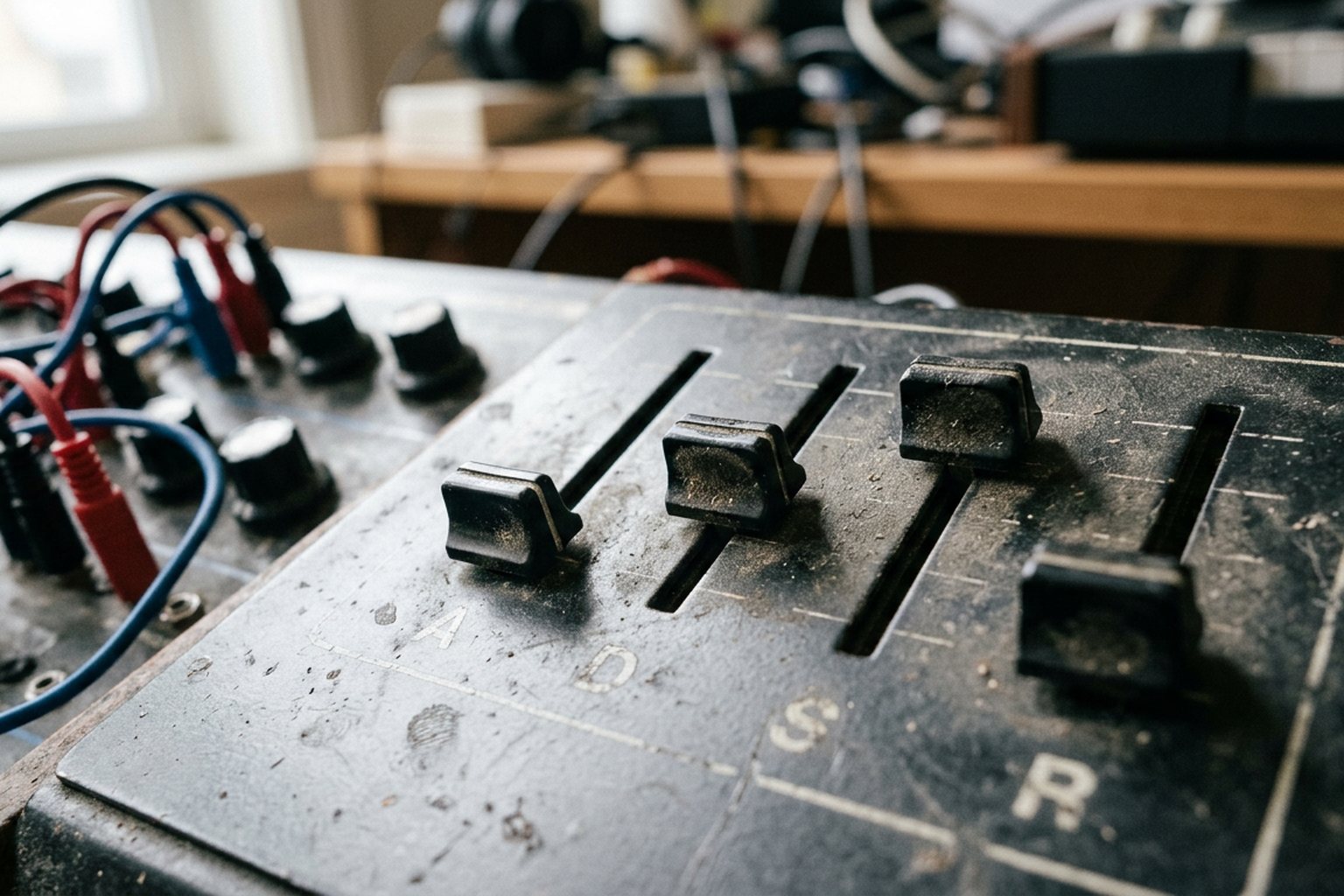
When a synth patch feels sluggish, buried, or aggressive in all the wrong frequencies, the immediate instinct is usually to change the oscillator waveform or swap the filter model. More often than not, the real issue is time-based. Envelope settings dictate how energy moves through a patch, and mastering their shapes is what separates flat, static tones from dynamic instruments that fit naturally into a mix.
Transient Mechanics: Attack and Decay Curves
An envelope generator outputs a dynamic control voltage signal, typically rising from zero volts to a maximum peak and then returning to zero. When routed to a voltage-controlled amplifier (VCA) or voltage-controlled filter (VCF), this control signal dictates how the volume and brightness of a tone evolve over time.
The mathematical shape of that voltage response matters just as much as the time values set on the front panel. Linear envelopes change voltage at a uniform rate, producing a straight line that can sound robotic or unnatural to human ears. Exponential envelopes change voltage rapidly at first and taper off as they near their target, mimicking the natural physics of struck or plucked acoustic objects like drumheads and piano strings. Logarithmic curves do the opposite, starting slowly and accelerating toward the peak.
Linear:      / \
Exponential: (  \
Logarithmic:  )  )
Hardware circuit design heavily influences these curves. Early analog synths used simple resistor-capacitor (RC) networks that inherently created exponential charge and discharge curves. The speed and slope of these curves determine whether an envelope feels "snappy" or sluggish, which is why two synths with identical millisecond ratings on paper can feel drastically different under the keys.
Designing the Transient: VCA vs. VCF Interaction
The transient portion of a sound occurs within the first few dozen milliseconds of note onset. Setting up a punchy percussive strike requires careful coordination between the amplitude envelope (VCA) and the filter envelope (VCF).
For a tight synth bass or percussive pluck, set the filter envelope attack to zero, give it a short decay, and turn the envelope depth up high. This briefly sweeps the filter cutoff open at the exact instant the note triggers, producing a sharp high-frequency transient that cuts through dense track arrangements.
| Target Sound | Envelope | Attack | Decay | Sustain | Release | Key Consideration |
|---|---|---|---|---|---|---|
| Punchy Bass | VCF | 0ms | Short | Zero | Short | High envelope depth for transient crack |
| VCA | 2-5ms | Medium | Low | Short | Slight attack prevents phase-click pops | |
| Plucked Lead | VCF | 0ms | Medium | Low | Medium | Match decay to track tempo for natural decay |
| VCA | 0ms | Medium | Low | Medium | Set release equal to decay for smooth note-offs | |
| Ambient Pad | VCF | Slow | Long | High | Long | Keep cutoff low; let envelope gently lift top end |
| VCA | Slow | Long | High | Long | Stagger attack slightly behind VCF to prevent harshness | |
| Percussive Stab | VCF | 0ms | Short | Zero | Short | Pair with high resonance for localized punch |
| VCA | 0ms | Short | Zero | Short | Keep sustain at zero to preserve dynamic space |
If the amplitude envelope attack is set slower than the filter envelope attack, the VCA will still be closed while the filter peak occurs, swallowing the transient entirely and leaving the sound feeling muted. Conversely, setting an instantaneous VCA attack time on a low-frequency oscillator waveform can cut across the voltage cycle mid-wave, introducing an unwanted mechanical pop. Adding two to five milliseconds of attack time on the VCA smooths out that zero-crossing click while maintaining low-end punch.
Managing the Tail: Decay, Sustain, and Space
Once the initial attack transient passes, the decay and sustain stages determine how much acoustic real estate the sound occupies in a mix.
Sustain is a level parameter, not a time duration; it establishes the resting voltage held for as long as a key remains pressed. Decay controls how long the signal takes to fall from its maximum attack voltage to that sustain floor.
A common mixing mistake is leaving the sustain level turned up high on low-frequency sounds. High sustain keeps the VCA and VCF wide open for the entire duration of a held note, filling the low end with continuous energy that smothers kick drums and vocal tails. Dropping the sustain to zero and relying on a medium decay time creates a self-clearing bass tone that delivers its punch and then gets out of the way.
Release time dictates what happens after key-off. In dense multi-track arrangements, long release times on low-frequency elements quickly turn mix busses into mud. A practical approach to mix management is keeping release times inversely proportional to frequency: brief tails for sub-bass and kick elements, and longer, spreading tails reserved for mid-range pads and high-frequency effects.
Circuit Behavior and Hardware Quirks
Hardware envelope circuits carry distinct personalities based on their underlying components. The classic Minimoog Model D features an Attack-Decay-Sustain layout where a toggle switch applies the decay time to the release phase upon note-off. Its aggressive, snappy response comes from discrete transistor networks that charge capacitors rapidly at the beginning of the attack phase.
By the late seventies, dedicated Integrated Circuits like the Curtis CEM3310—found in the Sequential Prophet-5, Oberheim OB-Xa, and Roland System 100m—standardized exponential ADSR curves across polyphonic synthesizers. Later hybrid synths, such as the Roland Juno-106, moved to software-generated envelopes calculated by an onboard microprocessor. While digital envelopes ensure perfectly identical timing across all voice cards, analog discrete envelopes re-trigger with subtle variations based on residual charge remaining in the circuit's capacitors.
Modular synthesizers unlock further possibilities through utility functions like end-of-stage triggers and looping envelopes. Routing an "end of decay" pulse back into an envelope's gate input converts an ADSR generator into a complex, fully shapeable LFO. Inverting a filter envelope yields negative control curves, dropping the filter cutoff on key press to create automatic ducking or swells.
Quick Answers
Why does my synth patch click at the start of every note?
Clicks occur when the VCA envelope attack is set to absolute zero, forcing the amplifier to turn on instantly in the middle of an oscillator's waveform cycle. Increasing the VCA attack time by just two to five milliseconds smooths out the initial phase jump while keeping the sound perceptionally instant.
What is the difference between linear and exponential envelopes?
Linear envelopes alter voltage at a steady rate, creating a constant straight-line slope. Exponential envelopes change voltage rapidly at the start and taper off near their destination. Exponential curves mirror how sound energy decays in physical space, making them feel more natural and dynamic for acoustic and percussive patch design.
Should my filter envelope match my amp envelope?
Not necessarily. Decoupling the two envelopes gives you far greater control over tone and movement. For example, using a short filter decay alongside a high VCA sustain produces a sound with a sharp, bright impact that settles into a dark, warm tone while held.
How do I keep sub-bass patches from muddying a mix?
Set the sustain level on both the filter and amplitude envelopes to zero, then adjust the decay time to fit the tempo of the song. This ensures every bass note delivers its initial punch before dropping down in volume, leaving clean space for kick drums and secondary basslines.
When building patches from scratch, get into the habit of setting envelope shapes before touching modulation matrices, spatial effects, or complex filter resonance settings. Start by dialing in a simple gate shape on the VCA to evaluate the raw oscillator balance, then switch to the filter envelope to establish the transient impact and tonal character. Once the filter response feels right under your fingers, return to the VCA envelope to lock in the decay time and release footprint for the mix.