 SAMPLED
Analog synths in 2026: why the oscillators came back
Analog is not nostalgia anymore. Here is what actually changed in circuits, prices, and workflows to put voltage back in bedrooms.
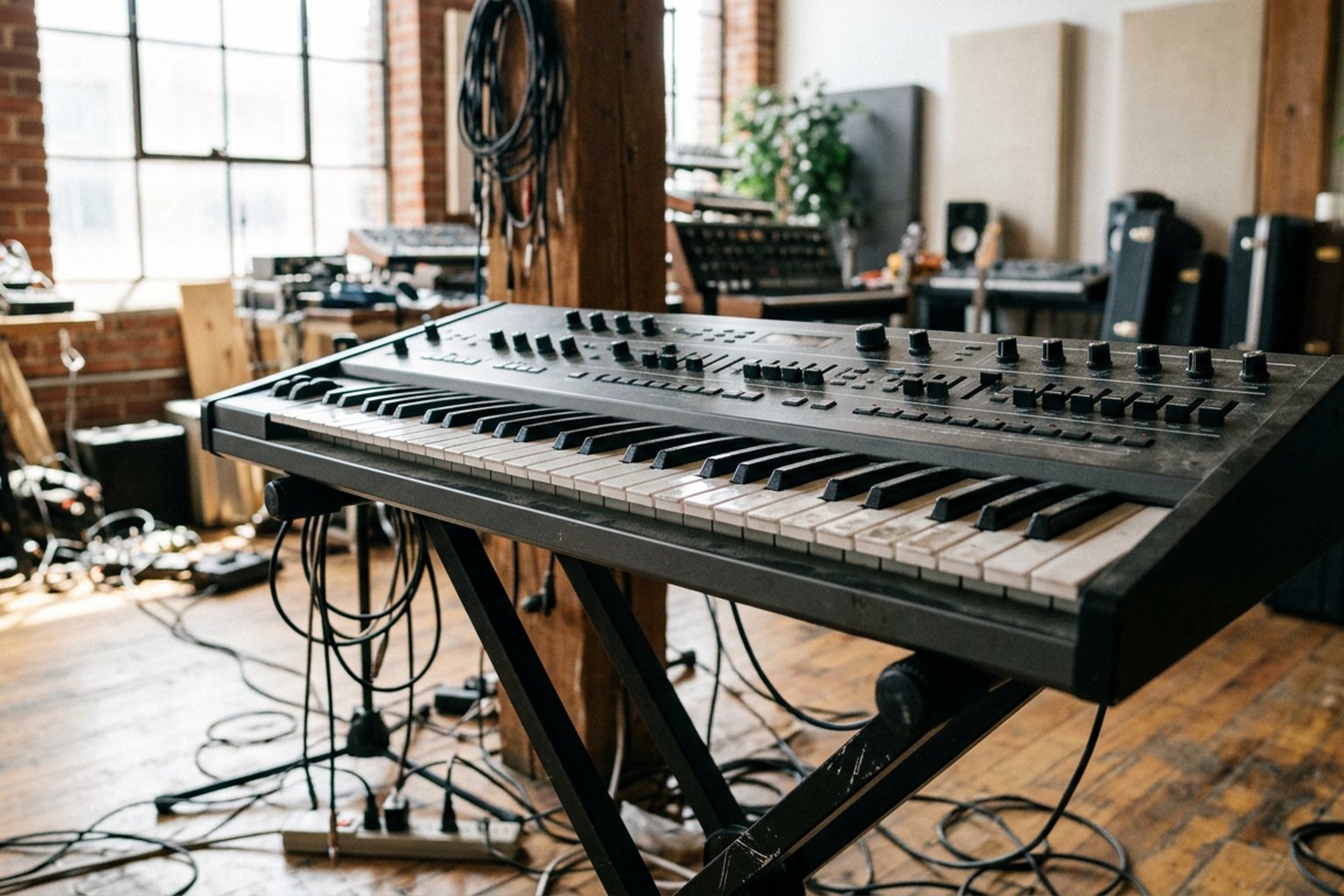
Ten years ago, buying an analog synthesizer meant choosing between temperamental vintage hardware or overpriced boutique monosynths. Today, true voltage-controlled circuits sit inside compact desktops and polyphonic keybeds across every price bracket. The sustained relevance of analog hardware is no longer driven by retro-fetishism, but by smarter circuit manufacturing, tight digital integration, and a generation of producers seeking tactile physical interfaces to complement their digital audio workstations.
The Circuit Shift: From Discrete Drift to Smart Calibration
When modern analog synthesizers began reclaiming market share, purists argued that digitally controlled oscillators (DCOs) lacked the organic movement of true voltage-controlled oscillators (VCOs). Early vintage VCOs, such as those in original Minimoog or Prophet-5 units, relied on discrete transistors that drifted wildly as internal case temperatures shifted. That drift created rich inter-oscillator phasing, but it also forced musicians to pause performances for manual tuning adjustments.
Modern circuit design solved this stability problem without stripping away the nonlinearities that give analog audio its character. Microcontrollers now monitor transistor temperatures and execute silent calibration routines in the background when voices are idle. Modern VCO instruments—ranging from affordable desktop modules like the Korg Volca series up to high-end polyphonic instruments like the Sequential Prophet-6—stay in tune without sacrificing subtle phase drift.
Simultaneously, the revival of legacy integrated circuit designs transformed the manufacturing process. Modern remakes of classic Curtis (CEM) and Solid State Music (SSM/SSI) synthesizer chips allowed engineers to pack complex filter structures and envelope generators onto dense circuit boards. By combining these integrated circuits with microcontrollers, manufacturers gained precise control over analog parameters without running dozens of prone-to-failure mechanical wiring looms inside the chassis.
Surface Mounts and Scale: The Economics of Cheap Voltage
The historical barrier to affordable analog hardware was rarely circuit design; it was manufacturing cost. Hand-soldering through-hole components onto large double-sided circuit boards required extensive manual assembly, quality control testing, and physical real estate. The industry-wide transition to automated surface-mount technology (SMT) changed the financial equation entirely. SMT allows robotic placement of microscopic surface-mount components, shrinking circuit board footprints, reducing physical points of failure, and cutting assembly times down to seconds.
+-------------------------------------------------------------------+
| Modern SMT Analog Voice Architecture                              |
|                                                                   |
| [Microcontroller] ---> [DAC System] ---> [SMT Analog Core]        |
|  (Background Tuning)   (Control Voltage)  - Dual VCOs / DCOs      |
|                                           - Integrated IC Filter  |
|                                           - Discrete VCA Stage    |
+-------------------------------------------------------------------+
This manufacturing pivot enabled mass-market instruments like the Arturia MiniBrute and Korg Minilogue to lower the cost barrier for real analog voice architecture. What once required a rack-mounted frame or a heavy wooden enclosure can now be printed onto a single multi-layer circuit board.
Crucially, smaller components did not degrade the signal path. Modern passive components hold far tighter electrical tolerances than their vintage counterparts. A modern ladder filter built with surface-mount transistor arrays behaves with far greater predictability across voice counts than a 1970s discrete equivalent, while retaining the exact same mathematical saturation curve when pushed hard into self-oscillation.
Comparing Analog Generations
| Feature | Vintage Discrete (1970s–1980s) | Early Revival (2010s) | Modern Integrated (Present) |
|---|---|---|---|
| Oscillator Core | Discrete VCO or early DCO | Hybrid / Monophonic VCO | Temperature-compensated VCO or DCO |
| Manufacturing | Hand-assembled through-hole | Mixed through-hole and SMT | High-density automated SMT |
| Tuning Stability | Thermal drift; frequent tuning | Moderate; manual calibration routines | High; background micro-tuning |
| Patch Memory | Non-existent or primitive | Basic digital storage | Full digital control and DAW recall |
| Signal-to-Noise | Moderate to low; high noise floor | Moderate | High; isolated digital/analog planes |
| Maintenance | High; recapping and alignment | Low | Minimal; sealed component architecture |
Solving the DAW Bottleneck: Analog in a Digital Timeline
For years, hardware synths created friction in modern music production environments. Software plugins offered instantaneous project recall, infinite instances, and sample-accurate parameter automation; hardware required manual patch sheets, external audio interface routing, and real-time audio printing. The current generation of analog hardware holds its position on the studio desk specifically because it bridges this operational gap.
Today's analog synths treat digital control as an asset rather than a compromise. High-resolution digital-to-analog converters (DACs) translate digital instructions into smooth control voltages directly on the circuit board. This enables parameter automation over USB-MIDI that matches software resolution, eliminating the audible step-resolution zipper noise that plagued early digital-analog hybrids.
Furthermore, desktop units and keyboards frequently ship with dedicated software editor-librarians that communicate with the hardware in real time. These utilities store total patch states directly inside your DAW project file. When you open a session, the software sends the stored parameter values to the synthesizer over USB, instantly snapping the physical sound engine back to the precise state of your last mix session.
What You Actually Pay For: Breaking Down the Tiers
With functional analog synths available from the low hundreds to several thousand dollars, identifying where engineering money goes is straightforward once you look past the front panel.
Entry-level analog synths rely on highly integrated, single-chip voice architectures, simplified chassis designs, and shared control pots. They sound genuinely analog because the signal path is built from true voltage-controlled components, but they trade away physical control real estate, deep modulation routing, and expensive output transformers.
As you step up to mid-tier and flagship instruments, hardware costs scale up across three primary areas:
- Interface Density: A true "knob-per-function" control panel requires dozens of physical potentiometers, multiplexer chips to read those controls, and rigid mechanical mounting.
- Polyphonic Scale: Unlike a digital synth that generates additional polyphony by running extra algorithmic cycles on a DSP chip, an eight-voice polyphonic analog synth requires eight complete, physically distinct hardware synthesizers running on its internal boards.
- Audio Headroom and Power: Premium hardware uses isolated power supplies to keep digital control noise out of the audio path, alongside discrete output stages and balanced line drivers that handle high dynamic swings without unpleasing distortion.
Quick answers
Is modern analog audio quality superior to modern software emulation?
It is less about overall quality and more about physical behavior under extreme settings. Modern software emulations model filter curves and circuit saturation with high mathematical accuracy. However, real analog hardware processes audio instantaneously without buffer latency, and complex feedback loops—like driving a filter into self-oscillation while modulating it at audio rate—react with unpredictable, continuous characteristics that software still struggles to replicate cleanly.
What is the actual technical difference between a VCO and a DCO?
Both generate a genuine analog audio signal. A VCO (Voltage-Controlled Oscillator) uses variable control voltage to dictate pitch, leaving it vulnerable to minor temperature variations that cause subtle pitch drift. A DCO (Digitally-Controlled Oscillator) uses a precise digital master clock signal to trigger the reset point of an analog wave-generating circuit. The resulting wave is 100% analog audio, but its base pitch is locked to digital timing, preventing tuning drift.
Do modern surface-mount analog synths require regular calibration?
No. Vintage synthesizers degrade over time due to drying electrolytic capacitors, carbon composition resistors drifting out of spec, and oxidized open-frame potentiometers. Modern SMT synthesizers use stable film capacitors, precise thin-film resistors, and sealed pots on multi-layer ground planes. Barring physical damage or power supply failure, they do not require routine manual re-capping or trim-pot alignment.
Why do analog polysynths cost significantly more than digital synths?
A digital synth scales voice counts by executing software instructions on a single processor chip. An analog polysynth must replicate its physical components for every voice offered. A 12-voice analog synth contains 12 physical filter circuits, 12 or 24 physical oscillator circuits, and 12 physical VCA circuits. The bill of materials and circuit board area scale linearly with every voice added to the instrument.
Before buying an analog synthesizer, skip the internet forum debates about circuit warmth and analyze how you actually compose music. If your workflow relies on fast-paced arrangement, multiple project iterations, and fast export times, prioritize an instrument that features deep USB-MIDI implementation, patch storage, and software librarian support. If you treat synthesis as an exploratory performance tool, prioritize panel ergonomics and discrete filter control over voice count. The primary advantage of modern analog isn't that it recreates vintage records—it's that you can integrate true physical voltage into a modern rig without managing thermal drift or fighting unstable hardware.