 SAMPLED
Is the Sequential Prophet-10 Worth It for Your Sound?
Ten voices of true analog polyphony, two filter revisions and the Vintage knob — why the Prophet-10 is the piece of gear that finally gives a producer a fingerprint.
You already know what your records are missing. It is not another sample pack. It is not a fifth plugin that emulates the same circuit as the other four. It is the sound of an instrument that pushes back — that makes you play differently because it responds differently.
That is the argument for the Sequential Prophet-10 (opens in a new tab). Not as a collector's piece, but as the one investment that changes what comes out of your room.
What you are actually buying
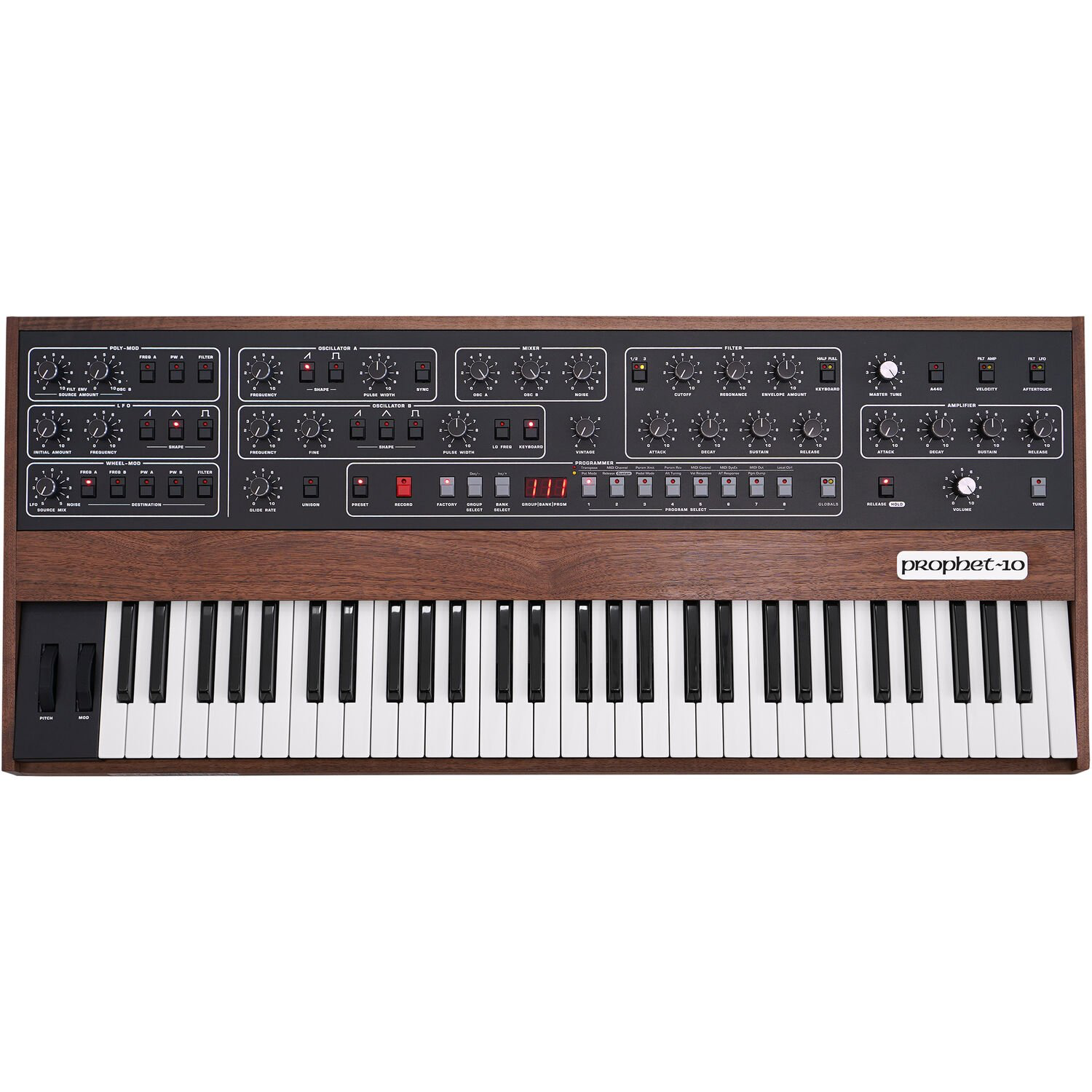
Ten voices of true analog polyphony. Two voltage-controlled oscillators per voice, a resonant four-pole low-pass filter, dedicated envelopes for filter and amplifier, and Poly-Mod — the routing that made the original Prophet sound like nothing else in 1978 and still does.
Sixty-one semi-weighted keys with velocity and aftertouch. A front panel where every function has its own knob or switch, so nothing is buried in a menu. Five hundred program slots, half of them yours to fill.
Two filter characters are built in: the Rev 1/2 Curtis-era voice and the Rev 3 voice, switchable per patch. One is looser and more vocal, the other tighter and more aggressive. You are not choosing between two synths at purchase — you own both.
Then there is the Vintage knob. It walks the whole instrument from surgically stable to gloriously drifting, oscillators and envelopes and filters slipping out of lockstep the way old gear does. That drift is the thing your in-the-box chords have never had.
| Control | What it does for your track |
|---|---|
| Poly-Mod | Filter envelope and Osc B modulate pitch, pulse width, filter — metallic, unstable, alive |
| Rev 1/2 vs Rev 3 filter | Warm and vocal, or tight and cutting — per patch |
| Vintage knob | Adds analog drift so stacked voices stop phasing identically |
| Unison + Chord memory | Ten voices stacked into one monster lead or bass |
| Aftertouch | Lean into a held chord and the filter opens under your hands |
How this elevates your game
Here is the honest part. A Prophet-10 (opens in a new tab) will not write your song. What it will do is change your working habits, and habits are what separate producers who plateau from producers who keep climbing.
You stop auditioning and start playing. Scrolling presets in a browser is shopping. Ten voices under your fingers with the panel laid out in front of you is playing. Ideas arrive faster because your hands are on the sound, not on a mouse.
Your mixes get easier. Analog voices sit in a mix without three plugins of help. The width, the drift, the way the filter behaves at resonance — that is character baked in at the source, not glued on at the end.
You get a signature. Every producer at your level has the same stock libraries. Nobody else has your patch bank, your Poly-Mod settings, your Vintage-knob sweet spot. That is how a sound becomes recognizable, and recognizable is what gets you booked, licensed, and remembered.
It raises the stakes in a useful way. Sit down at an instrument this serious and you show up more focused. That is not romance, it is just how people work.
The practical side
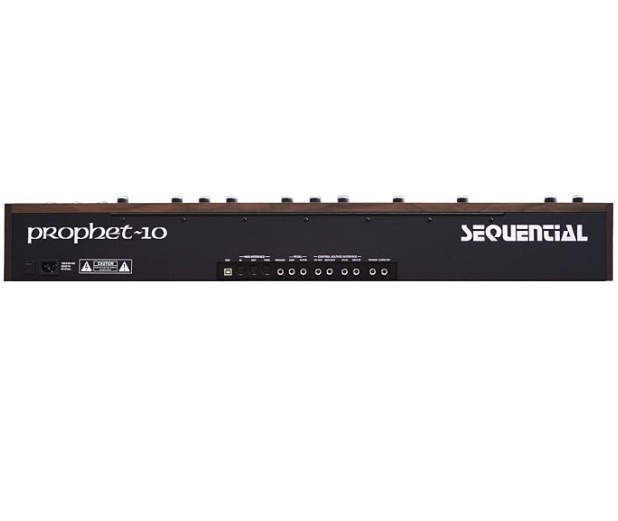
Around the back you get MIDI In, Out and Thru, USB for your DAW, a control-voltage interface for gate and filter and sequencer sync, plus sustain and expression pedal inputs and a balanced-friendly output pair. It integrates into whatever you already run — laptop rig, modular case, or a room full of hardware.
Weight and footprint are real considerations. This is a 61-key wooden-body instrument, not a desktop module. Give it a proper stand and a permanent spot in the room. Instruments you have to set up get played less.
Who should pull the trigger
If you are already finishing music, already releasing, and you have hit the point where your productions sound competent but interchangeable — this is the correction. If you score to picture, do sound design, or sell sample packs and stems, it pays for itself in original material other people cannot generate from the same free libraries.
If you have never finished a track, buy nothing. Finish five songs first. The synth will still be there.
The investment framing
Think of it against what you already spend. Subscriptions renew forever and leave you nothing. Plugin sales come every quarter and the folder keeps growing. A Prophet-10 (opens in a new tab) is a one-time purchase into an instrument that Sequential has kept in production, that holds resale value better than almost anything digital, and that will still be worth playing in twenty years.
Amortize it over the records you will make on it. Over the sample libraries you can build with it. Over the sessions you can charge for because you own something the person down the street does not.
That is the whole case: one more investment, but the kind that compounds. Check the current price on the Prophet-10 here (opens in a new tab) and decide whether this is the year your sound gets its own fingerprint.
Sampled uses affiliate links. If you buy through the links in this article we may earn a commission at no extra cost to you. Photos: Sequential.