 SAMPLED
Is the Behringer Pro VS Mini Worth It? A Pocket Prophet VS Review
Four morphing digital oscillators, a real analog low-pass filter and a joystick, in a box that fits in a laptop bag. Here is what the Pro VS Mini actually does — and where it frustrates.
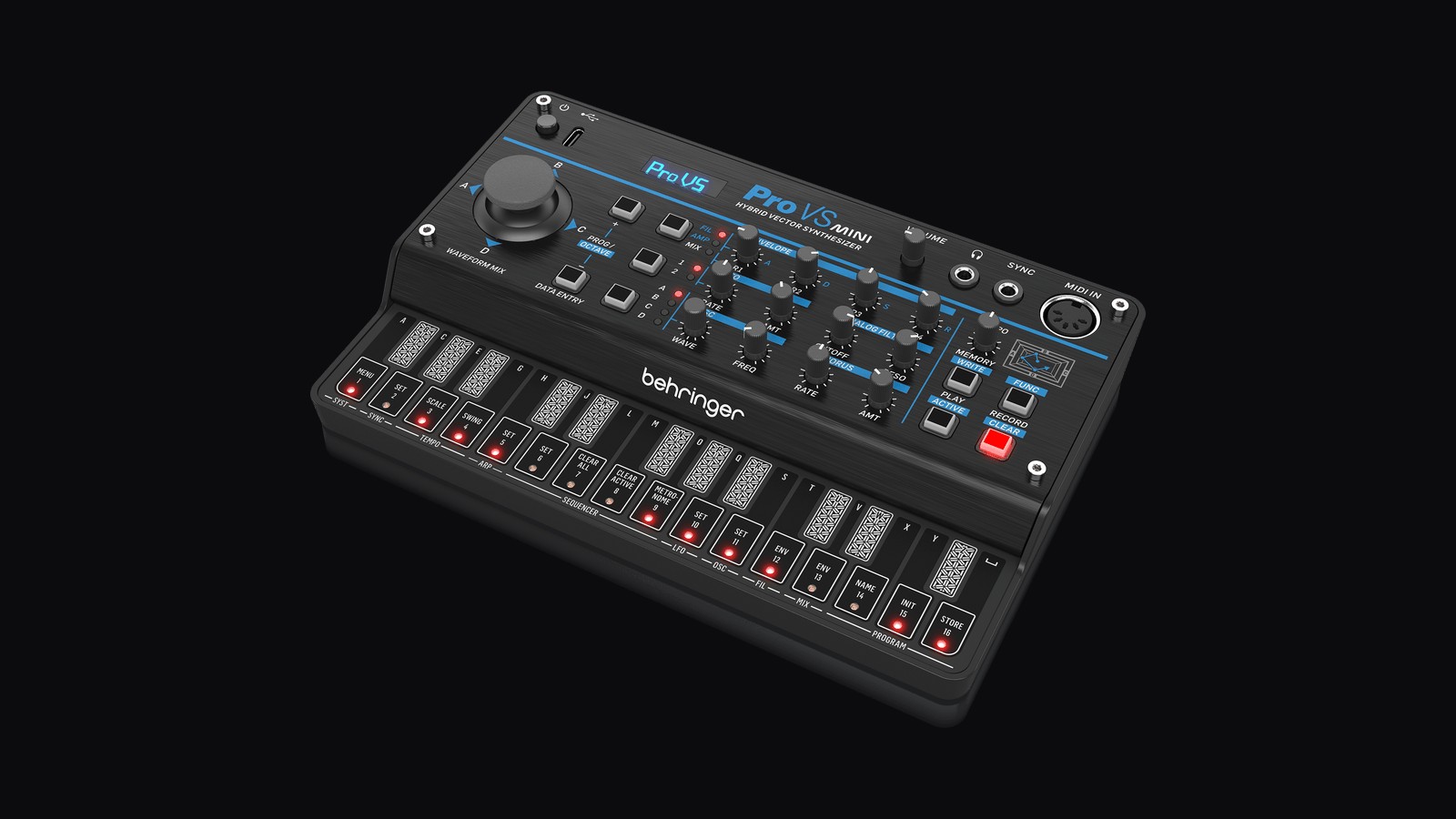
Vector synthesis is one of those ideas that never quite went mainstream, and that is exactly why it still sounds fresh. Instead of picking one waveform and filtering it, you set up four sound sources and then move between them with a joystick, recording that movement as part of the patch. Sequential built the Prophet VS around this in 1986, Yamaha and Korg carried the idea forward, and then the whole approach mostly disappeared into software.
The Behringer Pro VS Mini (opens in a new tab) drags it back onto the desk in a chassis roughly the size of a paperback.
What it actually is
The Pro VS Mini (opens in a new tab) is a five-voice hybrid synth. Each voice runs four digital oscillators drawing from a bank of 128 waveforms, mixed and morphed with the joystick, then pushed through an analog 24 dB low-pass filter. Digital front end, analog back end — the "hybrid" in the name is literal, and it is the reason the thing does not sound like a plugin in a box.
The rest of the spec sheet, briefly:
- 27 touch-sensitive keys along the bottom edge
- 16-step sequencer, plus an arpeggiator with Hold and Chord modes
- Separate envelopes for filter, amplifier and oscillator mixer
- Two LFOs, routable to filter and oscillator tuning
- Chorus, Ensemble and Reverb effect engines
- OLED display for parameter editing
- USB-C power (phone, power bank or computer), MIDI In, sync in
Worth knowing: it (opens in a new tab) shipped as a four-voice and became a five-voice through firmware 2.0, which also added portamento, the Ensemble and Reverb engines, the arpeggiator modes and a refreshed preset bank. If you buy a used unit, check the firmware before you judge it.
The joystick is the instrument
Everything else on the panel is normal synth furniture. The joystick is not.
Four oscillators sit at the corners — A, B, C, D. The stick position decides how much of each you hear. Park it dead centre and you get an even blend; push toward B and the patch takes on that oscillator's character. Because the 128 waveforms include a lot of short, spiky digital shapes rather than just saws and squares, moving between two of them is not a crossfade so much as a change of instrument mid-note.
Then you record the movement. The vector envelope stores a path with its own timings, so a single held key can start as a glassy bell, drift into something reedy, and settle on a hollow pulse. That is the sound people associate with late-eighties records, and it is genuinely hard to fake with a subtractive synth.
Two practical notes. First, small joystick movements matter more than large ones; the corners are less interesting than the space between them. Second, the vector path is stored per patch, so build the movement after the sound is roughly right, not before.
The filter saves it
Four digital oscillators stacked up can get brittle fast. The analog low-pass is what stops that. It is a proper 24 dB response with resonance, and rolling the cutoff back to around two-thirds tames the top end into something that sits in a mix instead of scraping across it.
Some quick starting points:
| You want | Set the filter | Set the vector |
|---|---|---|
| Warm pad | Cutoff ~50%, low resonance | Slow four-point path, long attack |
| Plucked bell | Cutoff high, envelope with fast decay | Snap from one corner to another |
| Bass | Cutoff low, resonance ~30% | Hold two adjacent corners, no motion |
| Texture bed | Cutoff mid, LFO to cutoff | Slow loop through all four corners |
Where it frustrates
Be honest about the trade-offs before you buy.
The keys are not really keys. Twenty-seven touch-sensitive keys printed on the front edge are fine for auditioning a patch and awkward for playing a part. Plug a controller into the MIDI In and treat the built-in strip as a backup.
Five voices runs out. A four-note chord with a long release will steal voices from itself. For pads, either play three-note voicings or track twice.
Menu diving is real. There are knobs for the headline parameters and an OLED for everything else. The panel is well laid out for its size, but you will hold a function button and turn an encoder more than you would on a full-size synth.
No audio input, no battery. It is USB-C powered — a power bank handles the portability claim, but there is no cell inside.
Who it is for
It makes sense if you already have a subtractive synth and want something that does not overlap with it. Against a Juno-style pad machine or a Minimoog-style mono, the Pro VS Mini (opens in a new tab) covers different ground entirely: metallic, glassy, unstable-in-a-good-way sounds that a saw-through-a-filter architecture cannot reach.
It is also a very good sampling source. Record thirty seconds of vector movement into your DAW, chop the interesting three, and you have a texture nobody else has.
It makes less sense as a first synth. If you have never programmed an envelope, learning on a machine with four oscillators and a morph path is the hard route — start with something subtractive and come back to this one.
Getting the most out of the first hour
- Update the firmware first. Version 2.0 is a different instrument, and it is a free download.
- Run through the factory presets with your hand on the joystick, not the keys. It teaches you the range faster than the manual does.
- Turn every effect off and find a sound you like dry. The Ensemble engine flatters everything, which makes it easy to build patches that collapse in a mix.
- Set an LFO to the filter, sync it, and leave it. Slow motion on cutoff plus vector motion on timbre is most of what makes these patches feel alive.
- Record the joystick performance to MIDI from your DAW as well as into the patch. You keep the option to edit it later.
At the price it sits at, the question is not whether it is the best vector synth ever built — it obviously is not, and an original Prophet VS costs several thousand dollars more. The question is whether a genuinely different synthesis method, with a real analog filter under it, is worth roughly the price of a decent set of headphones. For most people making electronic music, it is — check the current price here (opens in a new tab).
This article contains an affiliate link. If you buy through it, Sampled may earn a commission at no extra cost to you.