 SAMPLED
Semi-modular for people who hate patch cables
Semi-modular gear works out of the box and only asks for cables when you want more. A gentle way in.
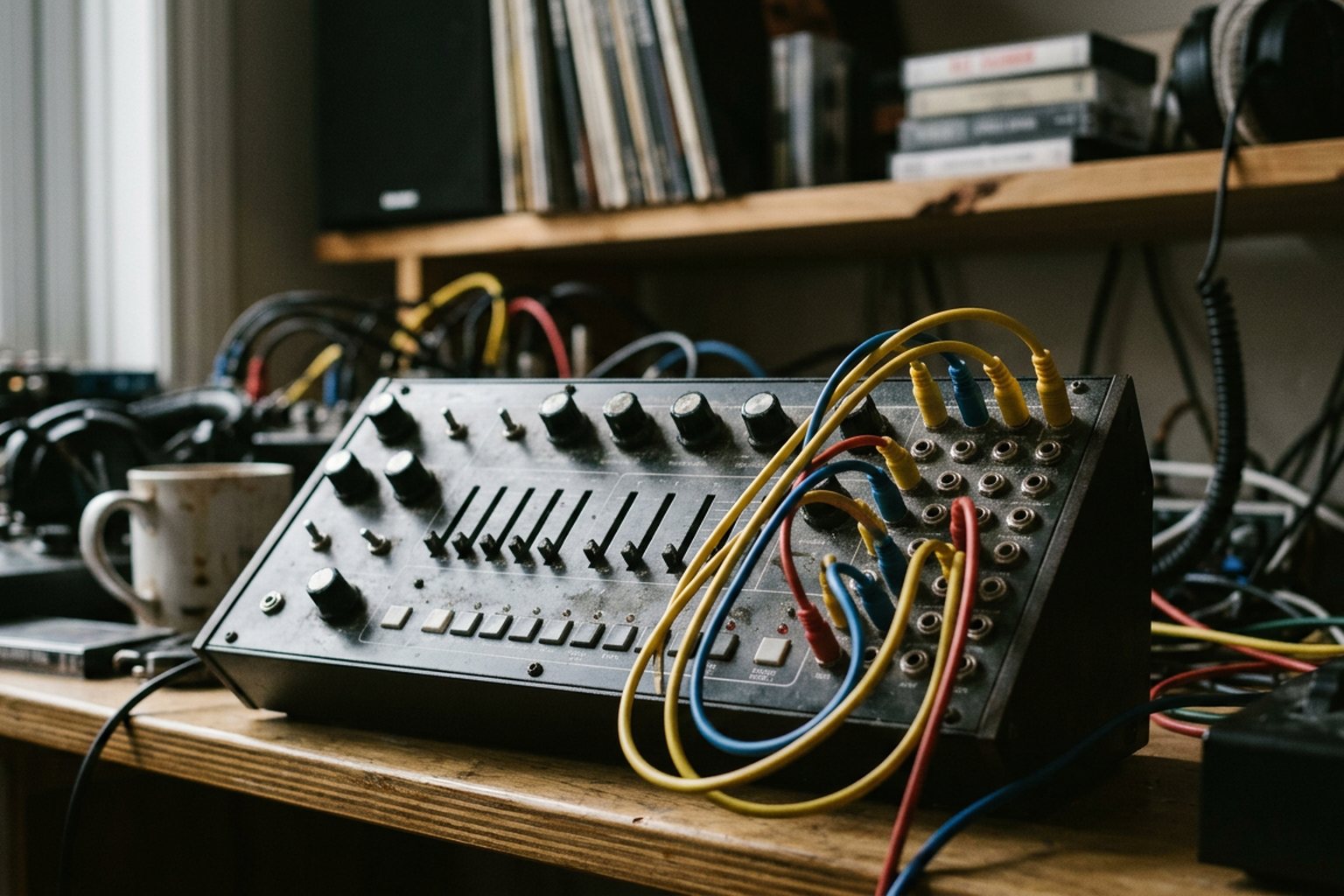
Modular synth culture often looks like a cable management nightmare, with tangled patch bays obscuring controls and requiring twenty minutes of setup just to produce a basic bass tone. Semi-modular synths eliminate that friction entirely by hardwiring a standard subtractive signal path inside the chassis before you ever open a bag of cables. You turn the unit on, hit a key, and hear sound immediately, reserving the patch bay for moments when you explicitly want to break the default rules.
The Mechanics of Normalled Architecture
The defining feature of a semi-modular synth is internal routing, technically known as "normalled" connections. In a fully modular Eurorack system, an oscillator output sits inert until you manually run a physical cable into a filter input, then another cable from the filter into a voltage-controlled amplifier (VCA), and yet another cable from an envelope generator to trigger that VCA. If a single cable slips out, the entire instrument goes silent.
Semi-modular instruments bypass this requirement using switched jacks. Inside the synth, printed circuit board traces route Oscillator 1 into Oscillator 2, through the voltage-controlled filter (VCF), into the VCA, and out to the main audio jack. Envelopes and low-frequency oscillators (LFOs) are already hardwired to standard targets like filter cutoff and oscillator pitch.
When you insert a patch cable into a semi-modular jack, a physical switch inside the jack breaks that internal trace. Inserting a cable overrides the factory routing and substitutes your custom signal instead. If you remove every cable, the internal switches close again, returning the synthesizer to its default factory architecture. You gain the open-ended routing of a modular synth without giving up the turn-key immediacy of a fixed-architecture monosynth.
Hardware That Works Straight Out of the Box
Several prominent semi-modular synths demonstrate how effective this design is for musicians who prefer turning knobs over tracing wiring diagrams.
Moog Grandmother
The Moog Grandmother is built around a classic two-oscillator subtractive layout, a ladder filter, an analog spring reverb tank, and an onboard sequencer. Without a single patch cable inserted, it functions as a thick, dual-oscillator analog monosynth. Its panel layout follows a left-to-right signal path, making it intuitive to dial in lead, bass, or sequence sounds instantly.
The top-mounted patch jacks sit directly above their respective modules. If you want to run the spring reverb before the filter instead of after it, or use the mod wheel to control filter resonance rather than pitch, you plug in a single cable. If you prefer to leave it unpatched, it remains one of the most immediate performance synths on the market.
Default Path:  [VCO 1/2] --> [Mixer] --> [VCF] --> [VCA] --> [Spring Reverb] --> [Output]
Patched Path:  [VCO 1/2] --> [Mixer] --> [Spring Reverb] --> [VCF] --> [VCA] --> [Output]
Korg MS-20 Mini
First released in the late 1970s and modernized in various reissues, the MS-20 design relies on a dual filter topology (high-pass and low-pass in series) capable of aggressive self-oscillation. The left two-thirds of the front panel house a complete subtractive synth with dedicated knobs for every function.
The patch panel on the right side of the unit does not alter the main signal path unless you explicitly tell it to. Instead, it offers access to auxiliary tools like a sample-and-hold circuit, an external signal processor for tracking incoming guitar or vocal audio, and flexible control voltage (CV) attenuators. You can play complex synth lines without touching the patch section, then use two cables to set up envelope-driven pitch bends or external audio filtering when tracking in the studio.
Arturia MiniBrute 2
The MiniBrute 2 pairs a discrete analog oscillator and Steiner-Parker filter with a prominent 48-point matrix patch bay on the right side of the control panel. Despite the intimidating grid of jacks, the synthesizer generates audio instantly upon keypress using internal connections.
Its primary strength for patch cable skeptics is its clear layout. The main control surface isolates tone-shaping controls, oscillator mixing, and filter sweeps. The patch matrix acts as a separate expansion panel. You can play the instrument for months using only the panel controls, treating the patch bay as an optional modulation bank when standard LFO-to-cutoff assignments no longer satisfy your production needs.
Comparing Cable-Optional Instruments
| Model | Standard Signal Routing | Patch Bay Layout | Primary Use Without Cables |
|---|---|---|---|
| Moog Grandmother | Dual VCO -> Ladder Filter -> VCA -> Spring Reverb | Distributed across individual module tops | Classic warm analog leads, bass, and live performance |
| Korg MS-20 Mini | Dual VCO -> High-Pass Filter -> Low-Pass Filter -> VCA | Consolidated on the right side of the chassis | Aggressive, resonant bass, screaming leads, and external processing |
| Arturia MiniBrute 2 | Multi-wave VCO -> Steiner-Parker Filter -> VCA | 48-point matrix grid on the top right panel | Snappy sequences, complex wave-folding, and metallic textures |
| Behringer Neutron | Dual VCO -> Multi-mode Filter -> VCA -> Delay | 56-point consolidated matrix on the right panel | Thick dual-oscillator drone, distorted bass, and bucket-brigade delay FX |
Surgical Patching: The Minimalist Approach
If you dislike patch cables, the trick is using them surgically rather than systemically. You do not need to re-patch the whole instrument to create distinctive sounds; one or two targeted connections are often enough to reach textures fixed-architecture synths cannot generate.
Filter Frequency Modulation
Run a raw audio output from Oscillator 2 directly into the VCF cutoff modulation input. This bypasses the LFO entirely, modulating the filter at audio frequencies. The result is a metallic, sideband-rich timbre that works exceptionally well for industrial basslines or percussion hits, executed with a single patch cable.
Envelope Inversion for Ducking Effects
Take an auxiliary envelope output, pass it through an attenuverter or inverter module if available on your panel, and route it to the VCA or filter cutoff. Instead of opening the filter when you hit a key, the sound instantly dips and blooms as the note decays, creating a natural pumping effect without an external compressor.
Sample-and-Hold Pitch Drift
Route the white noise output into a sample-and-hold clock input, then send the sample-and-hold output to Oscillator 2 pitch with low attenuation. Every time a note triggers, Oscillator 2 assumes a slightly different random pitch, adding organic instability to classic dual-oscillator patches without manual knob tweaking.
Integrating With Non-Modular Gear
Semi-modular synths bridge the gap between modular flexibilities and standard studio environments. Virtually all modern semi-modular hardware includes standard 5-pin DIN MIDI or USB-MIDI inputs. You do not need convertors, pitch-to-CV interfaces, or dedicated hardware sequencers to control them. Plug a standard USB cable from your Digital Audio Workstation (DAW) into the back of the synth, send MIDI note data, and the internal architecture handles pitch tracking and gate triggering automatically.
Furthermore, expression pedal inputs and line-level audio inputs expand functionality without requiring a wall of modular utilities. Route an external drum machine into the audio input of a semi-modular synth, and the drum track passes directly through the analog filter and envelope sections.
Quick Answers
Can I play a semi-modular synth using a standard MIDI controller?
Yes. Nearly all modern semi-modular synthesizers feature MIDI or USB-MIDI connections. The synth automatically converts incoming MIDI note signals into internal control voltages, allowing you to play the instrument from any standard keyboard controller or DAW track without using patch cables.
What happens if I never plug a patch cable into a semi-modular synth?
The synthesizer functions identically to a fixed-architecture analog synthesizer. The internal normalled signal path handles all routing from oscillators to filters, envelopes, amplifiers, and outputs automatically.
Do semi-modular synths require tuning before every session?
Because most semi-modular synths use real analog voltage-controlled oscillators (VCOs), they can drift slightly as internal components warm up. Allowing the synth to sit powered on for 10 to 15 minutes brings the circuits to thermal equilibrium, after which they hold pitch stably. Some models feature digitally-controlled analog oscillators (DCOs) which remain in pitch instantly upon startup.
Can I damage a semi-modular synth by plugging cables into the wrong jacks?
Standard semi-modular input and output jacks are engineered to tolerate cross-patching without circuit failure. Connecting an output to another output or sending high control voltages to signal inputs will generally yield silence or unexpected audio behavior, but it will not damage the synthesizer hardware.
Getting Started
If patch cables make you anxious, pick up a semi-modular synth with a clear panel layout and leave the cable bag inside the shipping box for the first month. Learn how the hardwired knobs affect the filter, envelopes, and oscillator blend. Once you find yourself wishing the filter would react differently or wanting an extra modulation source on a bass patch, pull out a single cable, make that specific connection, and leave the rest of the panel untouched.