 SAMPLED
Oscillator drift is the sound: tuning stability explained
The instability people pay extra for, the instability that ruins takes, and how to tell them apart.
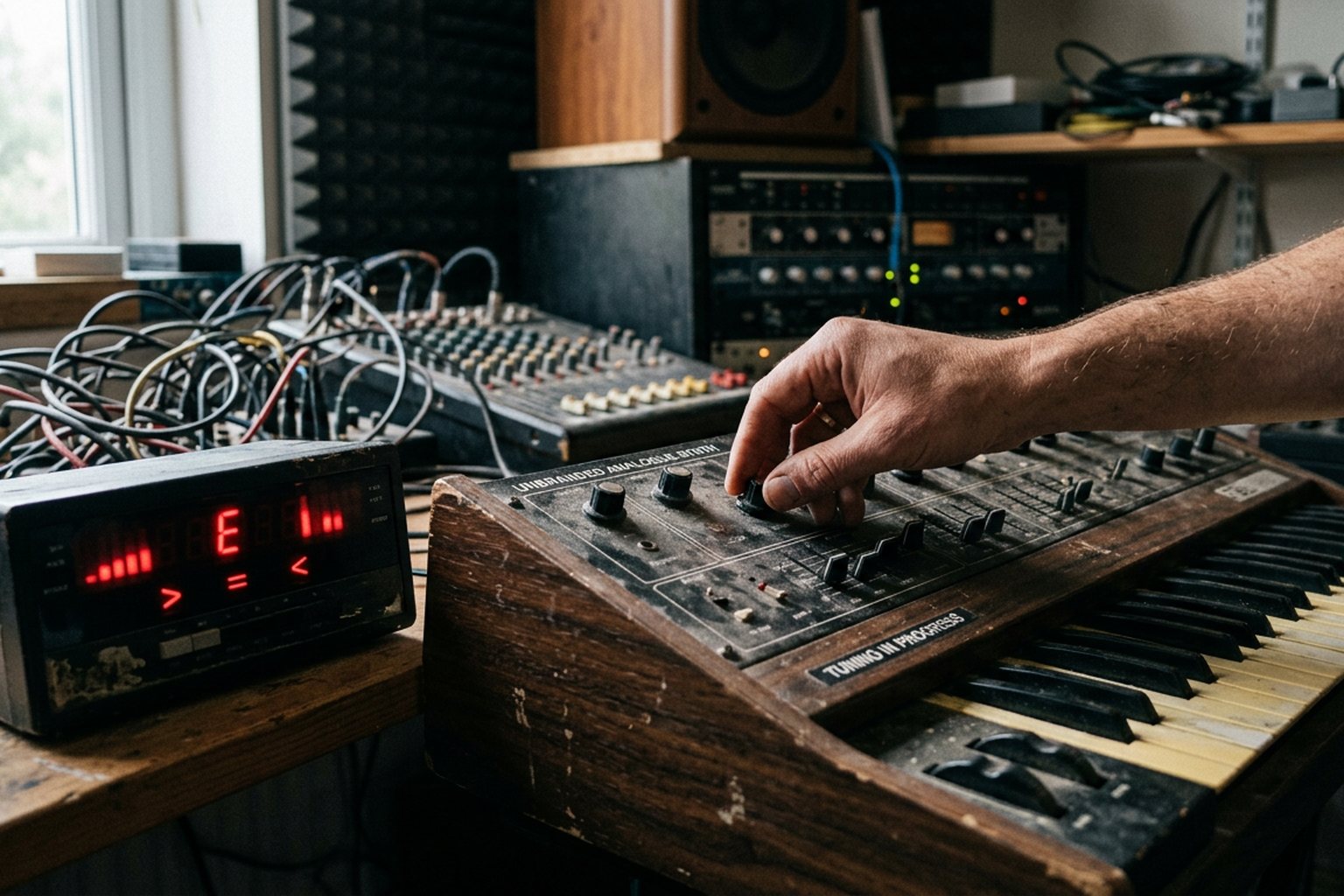
Synthesizer designers spent the 1970s locked in an relentless battle against physics, trying to stop analog oscillators from drifting out of tune as chassis temperatures rose. Decades later, musicians pay premium prices for hardware and software that deliberately reintroduces those exact pitch micro-fluctuations. Understanding why pitch drift happens, how different synth architectures handle it, and where the line sits between organic character and hardware failure is essential for getting the best out of analog gear.
The Physics of Thermal Instability
At the center of a traditional Voltage Controlled Oscillator (VCO) sits an analog core—typically an integrator capacitor that charges and discharges to create a raw sawtooth wave. To translate standard keyboard control voltages into musical pitches, the circuit uses an exponential converter based on bipolar junction transistors. The physics of these silicon transistors are inherently sensitive to temperature. Without compensation, a shift of just one degree Celsius in ambient temperature can alter an uncompensated oscillator's pitch by several cents across the keyboard range.
Early polysynths and modular systems suffered from thermal runaway because their internal circuits took hours to reach equilibrium. Designers tried several methods to stabilize pitch:
- Heated Transistor Pairs: Integrated circuits like the uA726 held silicon chips at a constant, elevated internal temperature. When these components failed or went out of production, synths lost their main line of defense against pitch drift.
- Tempco Resistors: Custom temperature-compensating resistors were physically glued to transistor pairs so their resistance would change in opposition to the silicon's thermal drift.
- Auto-Tuning Microprocessors: Polyphonic synths like the Sequential Circuits Prophet-5 and Oberheim OB-8 added microprocessors that temporarily muted audio and measured voice pitches against a stable reference clock, adjusting control voltages to pull the voices back into line.
When a synth warms up, these components settle into a working balance. Until that thermal equilibrium is reached, pitch will wander continuously.
VCOs, DCOs, and the War on Pitch Precision
The industry took two distinct paths to solve pitch instability: perfecting the VCO or replacing its pitch-generation mechanism entirely.
A classic VCO relies entirely on continuous analog voltages to determine both pitch and waveform shape. Every voice card in a polyphonic VCO synth uses unique physical components with distinct manufacturing tolerances. Voice one's capacitor might charge a fraction of a millisecond faster than voice two's, creating subtle pitch and phase discrepancies across the keybed. This continuous micro-variation gives VCO synths their reputation for weight and movement.
Digitally Controlled Oscillators (DCOs), featured heavily in synths like the Roland Juno-106 and Oberheim Matrix-1000, addressed instability directly. A DCO is not a digital synthesizer engine; it uses a genuine analog wave-shaping circuit. However, instead of relying on a free-running analog voltage core to control pitch, a master digital clock triggers the capacitor reset. The pitch remains absolute and phase-locked to a quartz crystal, completely eliminating thermal pitch drift while keeping the signal path analog.
The trade-off of early DCO designs was a perceived stiffness. Because all voices shared the same rock-solid timing reference, playing a three-note chord on a basic DCO synth yielded none of the natural phase cancellations and pitch beat frequencies of a multi-oscillator VCO machine. Modern synth designers bridge this gap in digital and digitally-controlled hardware using dedicated offset parameters, often labeled Slop, Vintage, or Voice Spread, which reintroduce subtle per-voice pitch and envelope timing offsets based on calibrated tables.
Why the Ear Prefers Imperfections
The human auditory system is exceptionally good at identifying perfectly static sounds, often categorizing them as harsh or artificial. When two analog oscillators play the same nominal pitch slightly out of tune with each other, their waveforms shift in and out of phase. This creates beat frequencies—a periodic cancellation and reinforcement of specific harmonics that sounds like natural chorusing or movement.
In polyphonic playing, oscillator drift manifests in three ways:
- Inter-Oscillator Detune: The pitch offset between Oscillator A and Oscillator B within a single voice architecture, creating immediate timbral movement.
- Voice-to-Voice Variance: Small pitch offsets between individual voice cards across the keybed. Hitting a C major chord triggers three distinct voices, each sitting a fraction of a cent away from true pitch center, widening the stereo image and adding depth.
- Low-Frequency Drift: A slow, continuous movement of global pitch over time, mimicking the natural physical shifts found in acoustic instruments like piano soundboards or string sections responding to humidity.
Without these micro-variations, stacking multiple synth tracks in a dense mix can lead to phase cancellation issues, where identical digital waveforms align perfectly and cancel out key frequencies.
Analog Architecture and Tuning Behavior
Different hardware generations handle pitch stability through vastly different electronic approaches. The table below outlines how these architectures behave in practical studio environments.
| Architecture | Core Mechanics | Tuning Stability | Sonic Signature |
|---|---|---|---|
| Early Discrete VCO (e.g., Minimoog, early Prophet-5) | Fully discrete transistors, minimal thermal compensation | Poor; requires frequent manual recalibration and long warm-ups | High voice movement, heavy phase interaction, organic detuning |
| Late-Era IC VCO (e.g., Prophet-6, Moog Subsequent 37) | Integrated circuit cores with modern tempco circuits and autotune routines | Excellent; holds scale pitch reliably after a short warm-up | Stable pitch center with controlled, musically predictable drift |
| Classic DCO (e.g., Roland Juno series, Alpha Juno) | Analog wave-shapers clocked by a master digital reference | Perfect pitch lock; immune to thermal drift | Precise, uniform pitch; can sound static without external modulation |
| Modern VA / Hybrid with Slop (e.g., Novation Peak, Sequential Rev2) | DSP or digitally clocked cores running voice-modeling algorithms | Absolute hardware stability with variable algorithmic drift | Tunable vintage movement; user controls the exact degree of voice variation |
Distinguishing Character from Broken Gear
There is a clear line between desirable analog warmth and hardware that requires service. Musicians often misdiagnose component failure or out-of-spec calibration as vintage charm.
Desirable drift occurs within a narrow window—typically within two to five cents of absolute pitch center. It moves continuously and smoothly across all notes on the keybed. The synth remains in tune relative to itself; an octave played at the bottom of the keyboard sounds like a clean octave at the top.
Unhealthy drift or failing hardware presents specific symptoms:
- Keyboard Tracking Failures: The synth is tuned at Middle C, but playing two octaves up sounds noticeably flat or sharp. This indicates that the exponential converter scale trimpots need physical recalibration, not that the synth has good drift.
- Voice Dropping: In a polyphonic synth, if five voices are in tune but voice six consistently triggers 30 cents flat, a component on that specific voice card—often a failing capacitor, leaking diode, or bad sample-and-hold IC—is breaking down.
- Sudden Pitch Jumps: If pitch steps abruptly rather than drifting smoothly, dirty pitch-bend potentiometers, noisy power supply rails, or failing digital-to-analog converters (DACs) are introducing voltage spikes into the control path.
Quick answers
How long should I let an analog synth warm up before recording?
Discrete VCO synths generally require 15 to 30 minutes to reach thermal equilibrium inside the chassis. Modern IC-based analog synths usually stabilize in 5 to 10 minutes, while DCO and digital synths are stable immediately upon power-up.
Does tuning an analog synth wear out its internal components?
No. Modern autotune routines run firmware routines that recalibrate internal DAC voltages or digitally trim pitch offsets. On vintage gear, manual calibration involves physically turning sealed trim potentiometers inside the chassis, which causes no wear under normal operating conditions.
Can I make a DCO synth sound like a drifting VCO synth?
Yes, by using subtle modulation routes. Assigning a slow, unsynced LFO with a very low depth setting to modulate the master pitch—or applying light random pitch modulation per-voice via a mod matrix—simulates the free-running behavior of classic VCO cores.
Managing analog tuning in the modern studio comes down to intent. If a line needs to lock precisely with digital basslines or sample libraries, run modern autotune routines after letting the synth warm up, or lean on DCO architectures. If the production calls for wide, atmospheric pads or lead lines that stand out in a busy mix, embrace the warm-up period, disable aggressive background tuning routines, and let the physics of the circuit do the work.