 SAMPLED
MIDI, CV, and gate: making old and new gear talk
Volts per octave, Hz per volt, S-trig, and the converters that stop a hybrid setup from fighting itself.
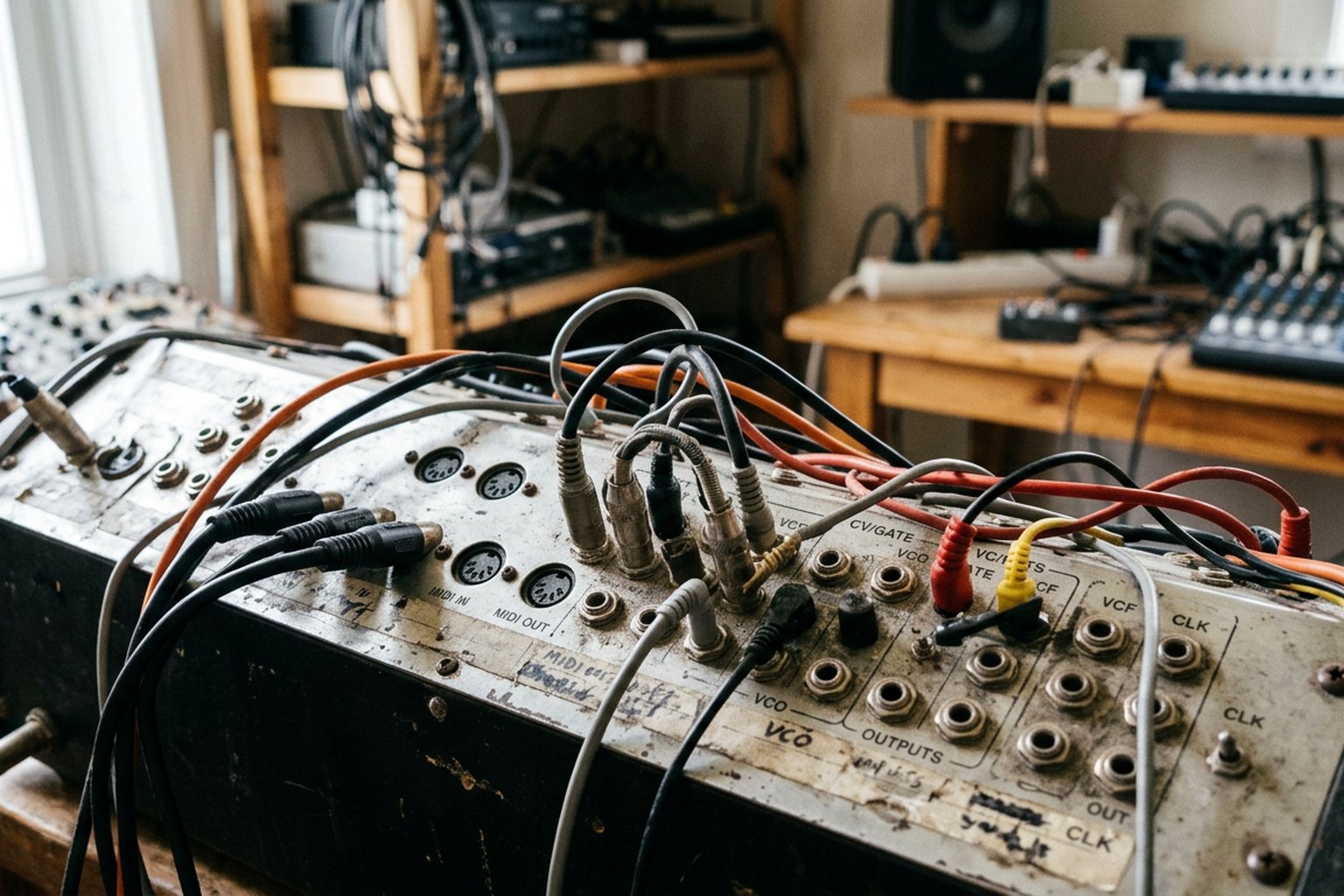
Synth rigs rarely speak a single language. Combine a modern software DAW or hardware MIDI sequencer with instruments designed before 1983, and you instantly run into the physical limits of control protocols. Bridging the gap between digital data and analog circuitry requires matching electrical pitch scaling, trigger polarities, and signal levels so your gear stays in tune and in time.
Pitch Standards: Volts Per Octave vs. Hertz Per Volt
Digital audio workstations and MIDI sequencers process musical notes as discrete binary numbers. MIDI Note 60 represents middle C, Note 61 represents C#, and every step is mathematically identical. Analog synthesizers do not read numbers; they require variable direct current (DC) voltages to alter the pitch of a voltage-controlled oscillator (VCO).
In the late 1960s and 1970s, synth manufacturers split into two competing camps regarding how voltage translates to perceived pitch:
Volts per Octave (1V/Oct)
Adopted early by Moog and popularized by Roland, Sequential Circuits, ARP, Oberheim, and modern Eurorack modular formats, 1V/Oct is an exponential voltage standard. The synth hardware handles the exponential math internally via a logging transistor circuit.
In a 1V/Oct system, raising the control voltage by exactly one volt raises the oscillator's pitch by one octave. Increasing the voltage by 1/12th of a volt (roughly 0.0833 volts) moves the pitch up by one chromatic semitone. Because the exponential conversion occurs inside the instrument's oscillator circuit, sending a linear increase in voltage from a sequencer yields equal-tempered pitch intervals.
Hertz per Volt (Hz/V)
Korg (in vintage units like the MS-10, MS-20, and VC-10) and Yamaha (in the CS series) took a linear approach. Pitch frequency in Hertz doubles with every octave. To raise a note by an octave in a Hz/V system, you must double the absolute voltage sent to the input.
If middle C requires 1 volt to produce 261 Hz, the C an octave above requires 2 volts (523 Hz). The next octave up requires 4 volts (1046 Hz), and the octave above that requires 8 volts. Because the voltage curve is linear rather than logarithmic, a standard 1V/Oct sequencer output plugged directly into a Hz/V synth oscillator results in wildly off-pitch playback. Notes compress drastically at higher registers or stretch out beyond recognition at lower registers.
Gate and Triggering: V-Trig vs. S-Trig
Pitch voltage tells an oscillator what note to play, but it does not tell the envelope generators when to start or stop. That requires a gate or trigger signal. While pitch uses continuous variable voltage, timing signals are binary states: note on, or note off.
Voltage Trigger (V-Trig)
V-Trig (active high) is the standard used by Roland, ARP, Sequential, and modern Eurorack setups. In a V-Trig system, the trigger jack sits at 0 volts when no key is held. Pressing a key sends a positive voltage pulse—typically between +5 volts and +10 volts—into the jack. The envelope generator holds its attack/sustain stage as long as that positive voltage remains high. Releasing the key drops the voltage back to 0 volts, prompting the envelope release phase.
Switched Trigger (S-Trig)
S-Trig ( active low, or shorting trigger) operates on the opposite electrical logic. Developed by Moog for classic instruments like the Minimoog Model D and modular systems, S-Trig connections hold an open circuit voltage (around +5 volts) when idle.
Pressing a key shorts the signal connection directly to ground, dropping the voltage down to 0 volts. The synth interprets this drop to ground as the note-on command. If you send a positive V-Trig signal into a native S-Trig input without converting it, the envelope will either ignore the signal completely or behave in reverse: sustaining continuously when no note is played and shutting off when you press a key.
The Conversion Bridge: Standalone Hardware and DC-Coupled Audio
Getting a hybrid setup running smoothly means introducing hardware or software that converts MIDI data or digital audio streams into the exact voltage types your target synthesizer expects.
+-------------------+      MIDI / USB      +-------------------------+
| Modern Sequencer  | -------------------> | Standalone Converter    |
| or DAW Interface  |                      | (e.g., Kenton Pro Solo) |
+-------------------+                      +-------------------------+
                                                       |
                                    +------------------+------------------+
                                    | Pitch CV                            | Gate / Trigger
                                    v                                     v
                           +------------------+                  +------------------+
                           | Pitch CV Input   |                  | Gate / Trig In   |
                           | (1V/Oct or Hz/V) |                  | (V-Trig / S-Trig)|
                           +------------------+                  +------------------+
                                    |                                     |
                                    +------------------+------------------+
                                                       v
                                           +-----------------------+
                                           | Vintage Synthesizer   |
                                           +-----------------------+
Dedicated Hardware Converters
Standalone MIDI-to-CV units (such as the Kenton Pro Solo series or Doepfer MCV4) accept standard 5-pin DIN MIDI or USB-MIDI data and output precision DC voltages. High-end converters allow users to change the CV output profile via onboard menus. You can switch the pitch output between 1V/Oct and Hz/V modes, adjust the gate output level (+5V to +12V), and toggle gate logic between V-Trig and S-Trig modes.
Audio Interface DC Coupling
Standard audio interfaces use AC-coupled outputs equipped with physical capacitors that filter out direct current (DC) signals below 10 Hz. This design protects studio monitors from low-frequency pops and driver damage. However, pitch CV and gate signals are steady DC voltages. Passing pitch CV through a standard AC-coupled audio interface causes the voltage to drift quickly back to zero, destroying pitch stability.
Interfaces designed with DC-coupled outputs allow static, continuous DC voltages to pass out of the line jacks. Software environments like Ableton Live (via CV Tools) or Bitwig Studio generate control voltages inside the DAW and send them directly through a DC-coupled interface to hardware synths. This setup eliminates the need for a separate MIDI-to-CV box, provided the interface outputs sufficient voltage swing (typically -5V to +5V) to cover the synthesizer's desired pitch range.
| Protocol / Standard | Signal Type | Electrical Characteristic | Typical Hardware Examples |
|---|---|---|---|
| 1V/Octave | Pitch CV | Logarithmic curve; +1.0V per octave increase | Roland SH-101, Sequential Pro-One, Moog Sub 37, Eurorack |
| Hertz/Volt | Pitch CV | Linear curve; voltage doubles per octave increase | Korg MS-10/MS-20, Yamaha CS-5/CS-10 |
| V-Trig | Gate/Trigger | Active high pulse (+5V to +10V signal) | Roland System-100, ARP Odyssey, Modern Eurorack |
| S-Trig | Gate/Trigger | Active low pulse (Shorts circuit connection to 0V ground) | Vintage Moog Minimoog Model D, Moog Modular |
Calibration, Grounding, and Practical Setup
Connecting physical control paths between computer gear and high-impedance analog circuits introduces real-world variables that digital setups avoid.
Eliminating Ground Loops
Connecting a computer via USB to a MIDI-to-CV converter while simultaneously routing audio outputs from a vintage synth back into an audio interface creates a closed loop of ground wires. Digital switching noise, hard drive activity, and power supply hum leak directly into the synth's audio signal path or corrupt the pitch control voltage.
To prevent ground hum from ruining pitch accuracy:
- Powered MIDI isolators or optical isolation on 5-pin DIN cables break ground paths cleanly.
- Audio isolation transformers or dedicated balanced-to-unbalanced passive DI boxes keep ground currents off the audio shield.
- Running power for the entire synth stack and computer setup from a single grounded distribution point eliminates ground potential differences.
Trimming Pitch Drift and DAC Resolution
Analog circuits drift as component temperatures rise. Before calibrating a MIDI-to-CV converter, turn on all hardware synthesizers and let them warm up for 15 to 30 minutes until internal temperatures stabilize.
Digital-to-analog converters (DACs) inside MIDI-to-CV units translate 128 discrete MIDI note numbers into voltage steps. Low-resolution DACs can result in audible stepping or poor microtonal tracking across multiple octaves. Ensure your converter uses high-resolution DACs (16-bit or better) to guarantee smooth pitch bends and precise octave tracking across five or more octaves.
When calibrating:
- Set the synthesizer's master tune knob to center.
- Send middle C (MIDI Note 60) from your sequencer.
- Adjust the converter’s "Offset" parameter until the synth outputs a precise C on an electronic tuner.
- Send a note three octaves higher (MIDI Note 96).
- Adjust the converter’s "Scale" or "Gain" parameter until the higher note sits perfectly in tune.
- Repeat the process between low and high octaves until the scale tracks evenly across the board.
Quick Answers
Can I damage vintage gear by sending the wrong gate signal?
Sending a standard +5V V-Trig signal into a passive S-Trig jack will generally not destroy vintage components, but it will cause erroneous behavior like reversed gate sustain or muted envelopes. However, sending unbuffered high-voltage CV (over +12V) into sensitive low-voltage microprocessors on early digitally controlled synths can damage input circuitry. Always check voltage tolerance limits in the synthesizer's manual before patching active voltage sources.
Why does my Korg MS-20 play out of tune when sequenced via MIDI?
The original Korg MS-20 uses Hz/V pitch scaling and S-Trig gating. If your MIDI-to-CV interface is configured to output standard 1V/Oct pitch voltages, the pitch tracking will compress wildly as you play higher up the keyboard. You must reconfigure your converter's output channel to Hz/V mode and set its gate logic to S-Trig or active-low.
Do I need a specific audio interface to send CV from a DAW?
Yes. Standard audio interfaces use AC-coupling capacitors that filter out low-frequency and DC signals, causing continuous control voltages to fade back to zero volts immediately. You must use an audio interface equipped with DC-coupled outputs, or use a dedicated USB/MIDI-to-CV conversion hardware box.
What is the difference between pitch CV and modulation CV?
Pitch CV requires continuous, precise voltage tracking calibrated tightly to musical scales (such as 1V/Oct or Hz/V). Modulation CV carries dynamic voltage shapes used to move parameters like filter cutoff frequency, pulse width, or amplifier volume. While pitch CV demands strict voltage stability and exact DAC precision, modulation CV can use arbitrary voltage ranges (such as -5V to +5V bipolar or 0V to +10V unipolar) to sweep parameters organically.
When integrating analog and digital gear, build your control path step by step. Confirm your synthesizer’s required pitch curve and gate type before plugging in any cables, and establish stable tuning across three octaves before attempting complex modulation routings. Once physical signal polarities match up, your hybrid rig will respond with the same immediacy and predictability as a single integrated instrument.