 SAMPLED
How Do You Turn a Reference Recording Into First-Pass MIDI Without Mistaking It for a Finished Part?
A contributor workflow for turning a hummed hook or recorded phrase into editable MIDI, then cleaning it up before it reaches the arrangement.
Posted by Sampled · Written by the NotaGen team
Contributor disclosure: The writers are part of the team behind NotaGen and submitted this article to Sampled. This is a contributed piece, not an independent review.
A surprising amount of production still begins as audio when the part you actually need is MIDI. A vocalist hums the hook because the session is moving. A keyboard player records a pass instead of clicking it in. You isolate eight bars from a reference and want the contour, not a time-stretched clone, so you can put it on a different sound and change the notes.
As long as the idea lives only as a clip, you can pitch it and chop it, but you cannot really rewrite it. MIDI is the form that lets you do that. The unglamorous work is getting there without copying a bad conversion straight into the arrangement.
This is a small workflow, not a manifesto. Keep your ears in charge. Let a first pass write the obvious pitches and rhythms. Then edit that pass the way you would edit any rushed take you played yourself.
The converter writes a grid, not an arrangement
A part you can stand behind has been decided: which notes are the idea, which are accidents, how the rhythm sits against the grid, what to leave out. A converter follows the audio as literally as it can. It will include the breath, the smear of the pedal, the ghost of a second voice, and the octave it guessed wrong. If you drop that file onto a favourite piano and keep writing, you will spend the next hour deleting notes that were never part of the hook.
That is not a scandal. It is the same cleanup you already do when a MIDI take was played with too much coffee. The only change is that you start from a file instead of from an empty piano roll.
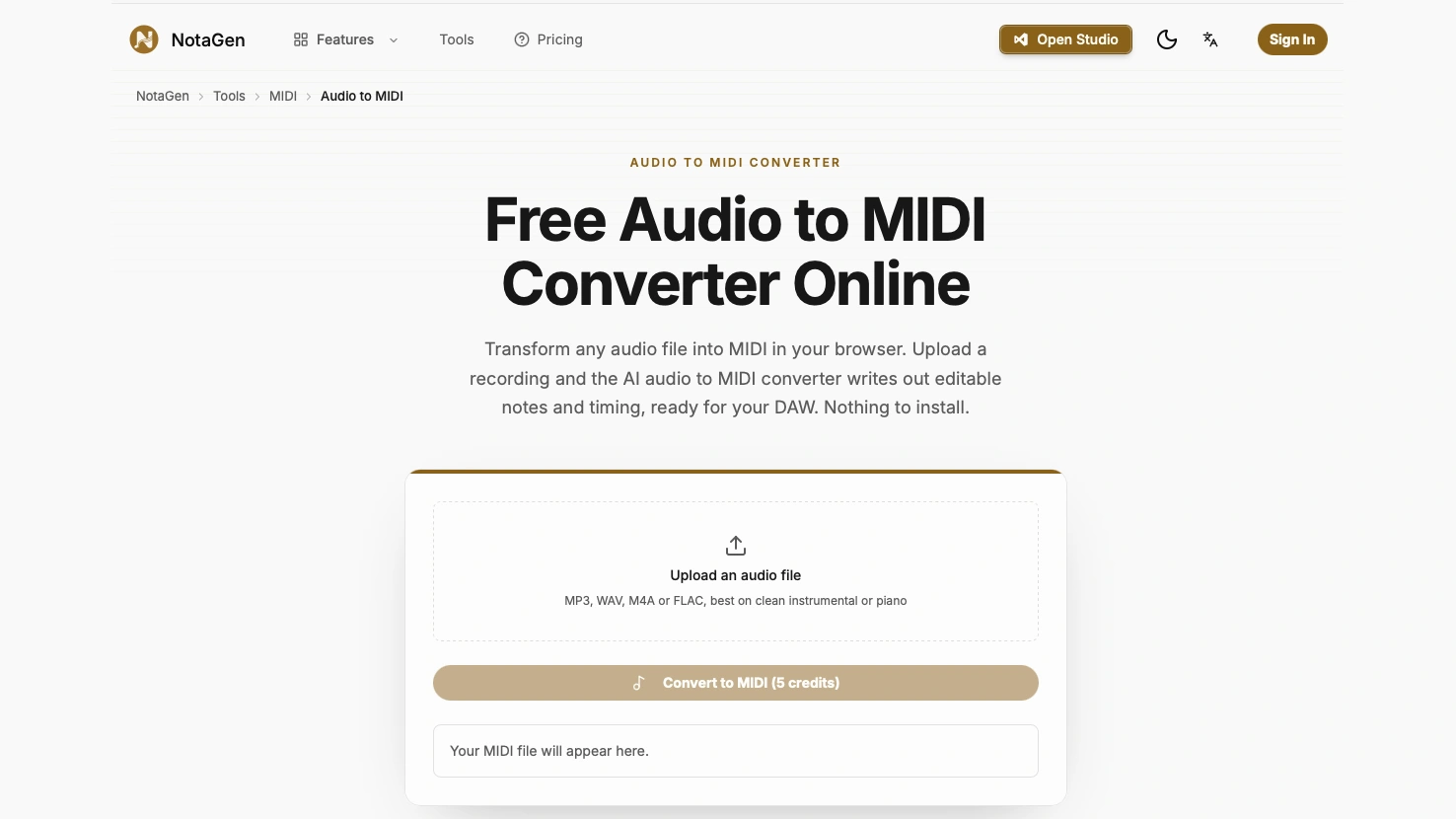
I work with NotaGen (opens in a new tab), a browser tool that turns a recording into MIDI and has an editor (opens in a new tab) if you want to do the first cleanup before the file reaches the DAW. I am using that workflow here because it is the one I know. The same habits apply if you bounce a clip out of the session, run another transcriber, or play the line in again after listening once. The tool is the first pass. The producer still edits.
Start with a clip a human could transcribe
Most bad conversions are bad sources. Before you convert anything, spend two minutes on the clip:
- One line is better than a full mix. If the hook is buried, truncate to the phrase or bounce a dryer version.
- Eight to sixteen bars is enough. A whole section is a long cleanup for a first experiment.
- A reasonably steady tempo helps. You can put the swing back after the notes exist.
- A hummed memo is fine if it was hummed in pitch. If it was not, you will be editing anyway — which is the point of having MIDI.
If the source is a dense break or a heavily processed chop, do not ask the converter to solve the arrangement. Ask it only for the contour you intend to rewrite.
Edit before the part sees the song
Listen once with the original clip and the piano roll together. Then look at the roll on its own.
- Is the metre the metre you know, or did a pickup get swallowed into a full bar?
- Did the pass land an octave out? It happens.
- Which notes followed the idea, and which followed the noise?
- What length and velocity will this hook want once it sits on a pluck, a pad, or a bass patch, rather than on the original sound?
Delete first. Transpose second. Quantize only as much as the part needs. The point of going to MIDI is not to clone the memo. It is to be able to change it: a new key for the next section, a hole for the kick, an answer phrase, a doubled rhythm.
A routine you can reuse in a session
- Isolate one phrase.
- Convert it and check it against the clip for one minute, not ten.
- Delete anything that is not the part, and fix the obvious pitch and metre mistakes.
- Move it onto the sound it is actually for, and write the next change by hand.
- Listen in context the next day before you build a whole section on it.
The last step is the one people skip. A MIDI file you never play in the song is just another bounce in the session folder.
What this does not replace
It does not replace choosing the notes. It does not produce a finished, releasable replay of someone else's record. Use it for your own ideas, your own takes, and your own rewriting, and treat other people's recordings with the same care you already would when you replay or interpolate a phrase.
The useful claim is a small one. A first-pass MIDI file is a way to reach the part of production that is actually writing, while you still have ears left for it.
About the contributor
The NotaGen team builds a browser tool for audio-to-MIDI and editable notation.