 SAMPLED
Eurorack on a budget: your first 84HP
A sane starter rack, the modules that earn their space, and the ones that quietly waste it.
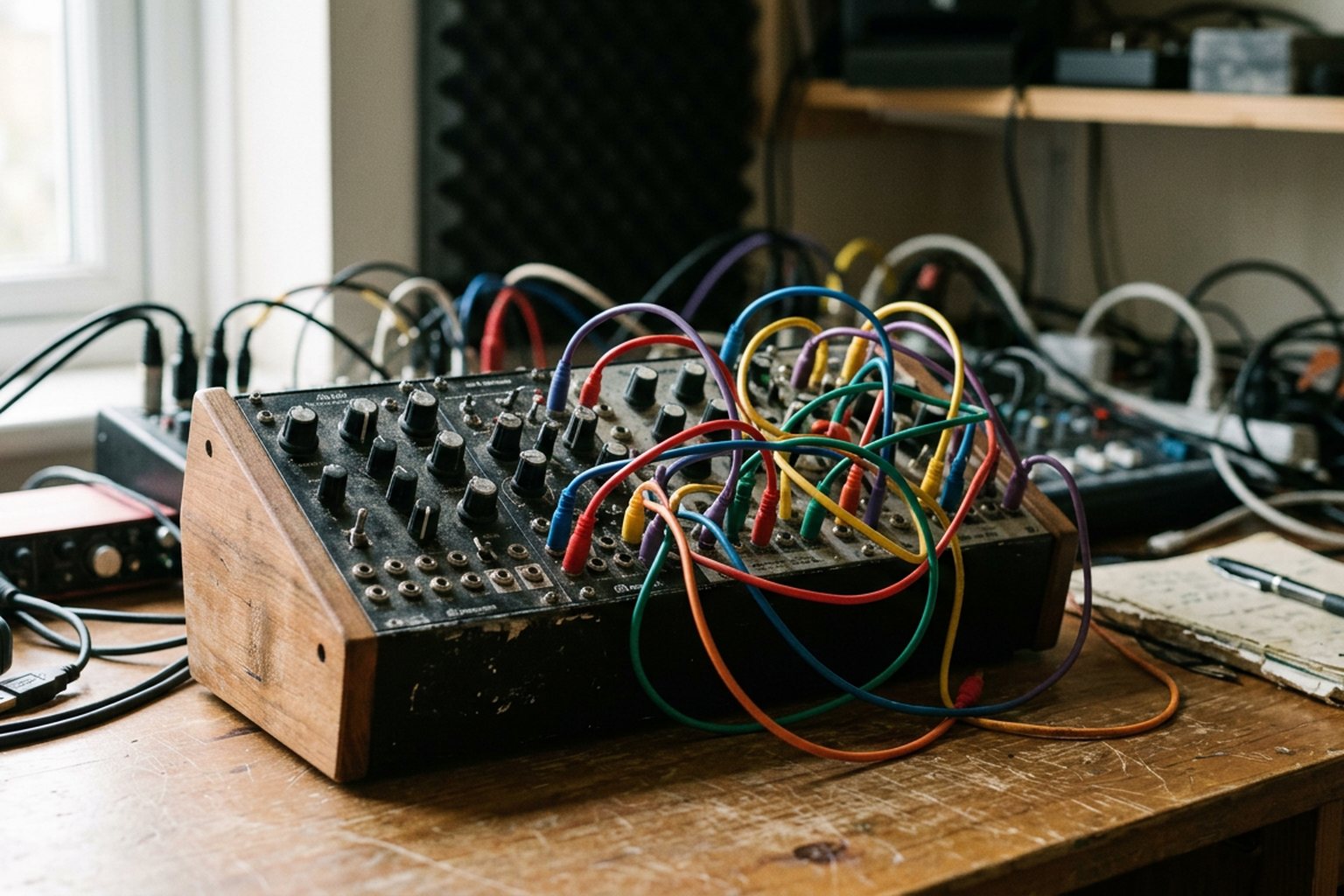
Eurorack has earned a reputation as a sinkhole for disposable income. Beginners often buy massive dual-row cases, fill them with screen-heavy digital modules, and end up with an unplayable mess that costs thousands of dollars. A single 84HP row—the standard width of a 19-inch rack mount—is enough space to construct a rich, flexible, fully patchable synthesizer if you plan with cold discipline.
Case and Power: The Boring Foundation
The most common beginner mistake is spending half the budget on an overbuilt enclosure or buying a cheap, unpowered frame with a dodgy power supply. Unstable power introduces ground hum, pitch drift in analog oscillators, and digital cross-talk into your audio path.
An unpowered 84HP desktop enclosure or a basic metal rail kit paired with a proven power solution gets the job done. The TipTop Audio uZeus or a Doepfer low-cost power kit provides clean +12V, -12V, and +5V rails without consuming unnecessary budget. Aim for a simple wooden or aluminum chassis with standard threaded strip rails rather than sliding nuts, which make rearranging modules tedious. Spending money on exotic hardwood end-cheeks yields zero sonic return.
Sound Generation: VCOs and VCFs
In an 84HP footprint, every millimeter counts. Buying a massive dual-complex oscillator takes up nearly a third of your rail. You want compact, fully featured analog oscillators with dedicated fine-tuning, pulse-width modulation, and multiple simultaneous waveform outputs.
The Doepfer A-110-2 Micro VCO is a workhorse that occupies only 8HP while delivering triangle, sawtooth, and square waves along with hard sync. Alternatively, simple core analog oscillators from manufacturers like Dreadbox or Ladik give you rock-solid pitch tracking in tiny physical profiles.
When choosing a Voltage Controlled Filter (VCF), pass on overly clean multi-mode filters that sound sterile. Modular synth patches benefit from filters with distinct analog character and self-oscillating resonance. The Doepfer A-124 Wasp Filter uses digital inverter chips operated in an analog mode to produce a gritty, nonlinear tone that cuts through a mix. It occupies just 8HP and provides low-pass, high-pass, band-pass, and notch outputs. If you prefer a smooth, creamy ladder filter, compact transistor ladder modules from various builders sit in the 6HP to 8HP range without eating up your rack.
Utilities: VCAs, Envelopes, and Mixers
Utilities are not exciting to look at, but they are the actual engine of modular synthesis. Without Voltage Controlled Amplifiers (VCAs), attenuators, and envelopes, your synthesizer is just an unguided noise generator.
The classic advice holds true: you can never have too many VCAs. Instead of buying single VCAs, buy a dense quad VCA module. Clones or compact variants of the Intellijel Quad VCA or Mutable Instruments Veils pack four VCAs into 10HP to 12HP. Crucially, look for VCAs that feature continuously variable response curves from linear to exponential, along with cascading outputs so the module can double as an audio or control voltage (CV) mixer.
For modulation, skip massive dual-function generators like Make Noise Maths if you are strictly limited to 84HP. At 20HP, Maths eats up nearly a quarter of your total real estate. Instead, look for dedicated compact function generators or envelope generators. An ALM Busy Circuits Pip Slope provides a flexible attack-decay envelope in just 4HP. Pair that with a compact dual LFO module, like the Ladik Dual LFO or an Erica Synths Pico LFO, to keep modulation flowing without running out of rail space.
Keep Control Outside the Case
A major space-waster in small Eurorack systems is internal sequencing and keybeds. Mechanical buttons, sliders, and keyboards require physical surface area that belongs on an external desktop controller, not on expensive modular rack space.
Offload your performance control to external hardware. An Arturia KeyStep or a Korg SQ-1 provides MIDI and direct CV/Gate outputs for a fraction of the cost of an equivalent Eurorack sequencer module. To interface external hardware with your rack, all you need is a basic MIDI-to-CV converter (like the ALM mmMidi) or direct 1/8-inch patch cables from an external CV sequencer. This strategy saves anywhere from 16HP to 30HP, which can then be dedicated to signal routing and sound shaping.
An 84HP Allocation Blueprint
To see how an 84HP row balances out in practice, consider this template layout. It creates a complete mono-synth voice with dual modulation sources, flexible filtering, built-in effects, and full utility support.
| Function | Module Example | Width (HP) | Core Purpose |
|---|---|---|---|
| Power / MIDI Input | TipTop uZeus / ALM mmMidi | 4HP | Clean power distribution & external clock/note conversion |
| Primary Oscillator | Doepfer A-110-2 Micro VCO | 8HP | Core analog tone generation with PWM and Sync |
| Filter | Doepfer A-124 Wasp VCF | 8HP | Character filter with multiple simultaneous modes |
| Amplification / Mixing | Quad VCA (Veils Clone) | 10HP | Dynamic level control for audio signals and CV |
| Envelope Generator | Doepfer A-140-2 Dual ADSR | 8HP | Dedicated shape generation for filter and amplitude |
| LFO / Modulation | Ladik Dual LFO / Pip Slope | 8HP | Cyclic modulation for pitch, cutoff, and pulse width |
| CV Utility / Attenuator | Dreadbox / Ladik Attenuator | 6HP | Scaling control voltages and mixing mod sources |
| Signal Processing / FX | Happy Nerding FX AID | 6HP | Compact stereo reverb, delay, and modulation FX |
| Output Utility | ALM HPO / Output Module | 4HP | Level matching and dedicated headphone driving |
| Unassigned / Buffer | Blank Panel | 28HP | Room for a second VCO, sample-and-hold, or sub-oscillator |
Leaving nearly 20 to 30 percent of your case empty at first is not a failure; it is insurance. It allows you to play the initial setup, identify genuine bottlenecks in your workflow, and buy specific solutions rather than guessing upfront.
Modules That Quietly Waste Your Space
When building on a budget, certain module categories actively work against you:
- Large Screen Visualizers: Oscilloscopes look impressive in videos, but a standalone hardware scope taking up 6HP to 10HP adds zero functionality to your signal chain. Use a free software scope on your computer via an audio interface instead.
- Deep-Menu Multi-FX: Modules with tiny screens and nested sub-menus ruin the tactile, immediate feedback loop that makes hardware hardware. Pick modules with dedicated physical knobs for every key parameter.
- Dedicated Single-Function Jacks: A 4HP module that only attenuates a single signal or only inverts a phase is inefficient. Look for utility modules that combine attenuating, inverting, offset-generating, and mixing into one panel.
Quick Answers
How much power headroom do I need for 84HP?
Aim for a power supply that provides at least 30 to 50 percent more milliamps on both the +12V and -12V rails than your modules consume on paper. Modular power supplies run hotter and less reliably when pushed to their maximum limit, which can cause subtle pitch drift and unexpected digital reboots.
Is it cheaper to build modules from DIY kits?
If you already own a temperature-controlled soldering iron, solder wick, and basic electronics tools, DIY kits from brands like Befaco, AI Synthesis, or Sound Study Modular can cut your hardware costs by roughly half. However, if you have to buy tools and learn to solder from scratch, the entry cost balances out, and a single cold solder joint can burn hours of troubleshooting time.
Why not just buy a semi-modular desktop synth instead?
Semi-modular units like the Moog Mother-32, Dreadbox Erebus, or Behringer Neutron offer exceptional value per feature. However, a true Eurorack system allows you to swap individual components, choose non-standard filter topologies, and configure custom utility chains that pre-wired semi-modular synths cannot replicate.
Start with the absolute minimum functional signal path: one oscillator, one filter, one dual envelope, one quad VCA, and a way to get control voltages into the rack. Patch those handful of connections until you hit a hard wall in your sound design process. Only buy your next module when you can explicitly articulate what signal routing problem it solves.