 SAMPLED
Analog drum machines vs sample-based boxes
Voice synthesis versus playback, and why most producers end up running both.
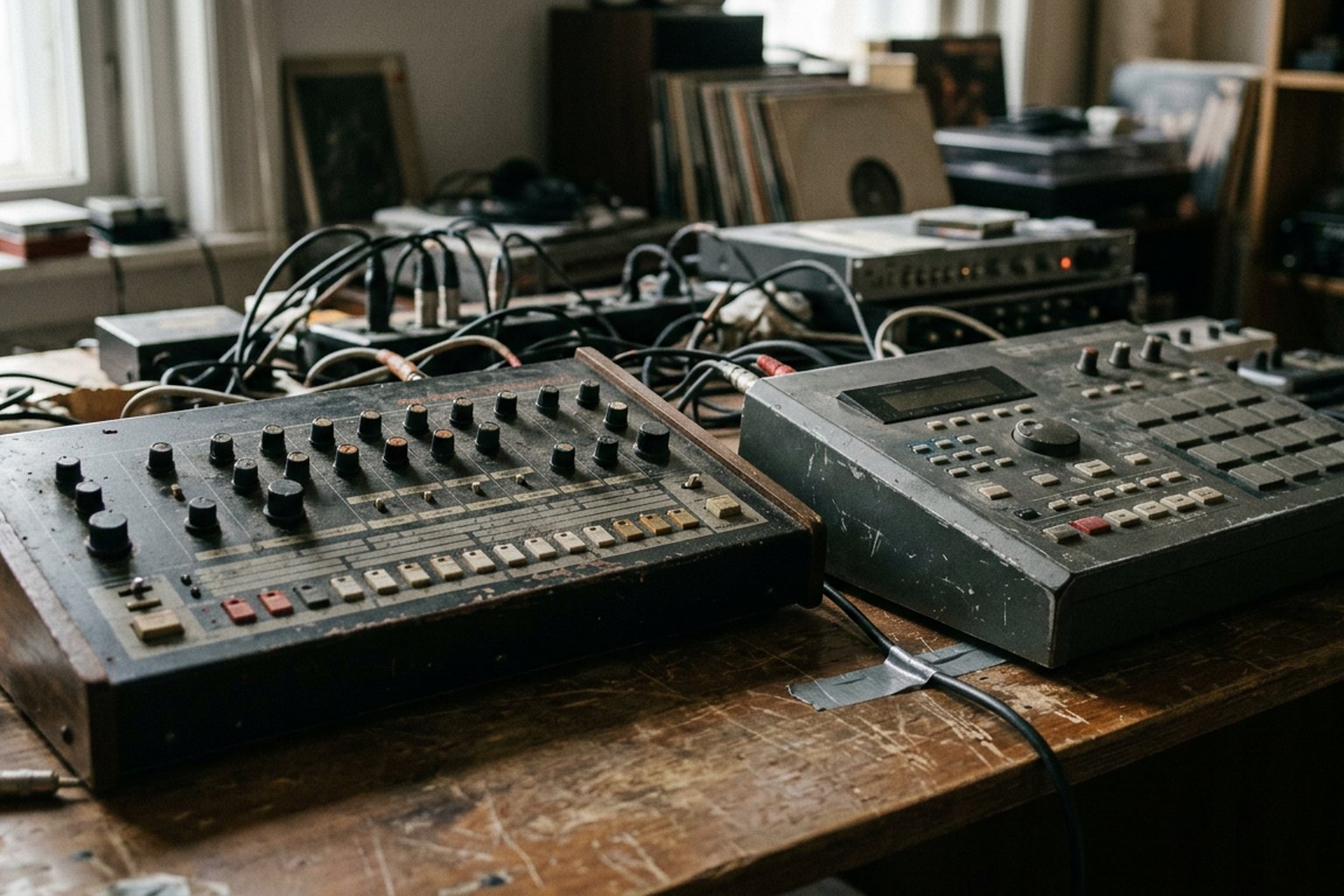
The divide between analog drum machines and sample-based hardware isn't a battle over which technology sounds objectively better. It is a structural difference between real-time voice synthesis and digital audio playback. Analog circuits synthesize voice architectures using discrete components, noise generators, and filters, while samplers reproduce recorded digital audio stored in memory.
Voice Generation: Oscillators, Noise, and Bridged-T Circuits
Analog drum machines do not play back recorded audio files. When a trigger pulse hits an analog voice circuit, it excites an electrical network that synthesizes an acoustic approximation from scratch. The low-end thump of a Roland TR-808 kick, for example, relies on a damped sine wave generated by a bridged-T network oscillator. Varying the decay control alters how long the circuit oscillates before its energy dissipates, while a dedicated pitch envelope controls the initial transient attack.
Snares, hi-hats, and cymbals operate on different analog topologies: combinations of filtered noise generators, voltage-controlled amplifiers, and fast envelope generators. A TR-909 snare uses two tuned analog oscillators for the fundamental tonal body, layered with a band-pass filtered white noise burst for the snare wire rattle.
Because these voices are raw electrical signals running through physical components, they exhibit natural non-linearities. Temperature shifts, component tolerances, and minor power rail fluctuations mean two consecutive triggers rarely yield identical waveforms. The low end breathes, and the transient distortion shifts slightly with velocity.
The compromise is flexible functionality. An analog kick circuit will only ever sound like an analog kick circuit. You can tweak its decay, pitch, and transient snap, but you cannot force a transistor network to suddenly output an authentic recorded floor tom or an orchestral chime.
       +-------------------------------------------------+
       |               ANALOG TRIGGER PATH               |
       |                                                 |
Trigger|  +-----------+    +---------------+    +------+ | Audio
------>|->| Envelope  |--->| Sine/Bridged-T|--->| VCA  | |------->
Pulse  |  | Generator |    | Oscillator    |    +------+ | Out
       |  +-----------+    +---------------+             |
       +-------------------------------------------------+
Sample Playback: Fidelity, Pitching, and Textural Freedom
Sample-based drum machines bypass physical synthesis circuits entirely, replacing them with digital memory and a playback engine. Whether using classic 12-bit units like the E-mu SP-1200 and Oberheim DMX or modern hardware like the Elektron Digitakt and Akai MPC series, the concept remains identical: a recorded audio file is recalled from memory and routed through digital or analog filters and converter stages.
The primary advantage of sample engines is limitless palette diversity. A single sample-based unit can trigger an acoustic drum kit, an orchestral percussion section, field recordings, or multi-layered analog synth hits within the same pattern.
Processing samples inside dedicated hardware introduces distinct coloration. Early sampling drum machines relied on low sample rates and limited bit depths to conserve expensive RAM. When pitch-shifting a sample down on an SP-1200 or an Akai MPC60, the underlying math produces aliasing artifacts and high-frequency clock ring that became defining textures in hip-hop and house production. Modern samplers offer pristine high-resolution playback, but they retain the core ability to alter audio through time-stretching, pitch modulation, and non-destructive layering.
The inherent trade-off of sample playback lies in static waveform reproduction. Unless a sampler utilizes multi-sampling, velocity switching, or round-robin modulation, retriggering the exact same sample sixteen times in a bar creates a rigid, mechanical feel. The audio file does not react dynamically to voltage continuous changes; it plays back the exact same array of digital numbers on every trigger.
Feature Matrix: Analog vs. Sample Engine
| Feature | Analog Voice Engine | Sample Playback Engine |
|---|---|---|
| Sound Generation | Real-time voltage synthesis | Digital audio file playback |
| Sonic Palette | Limited to specific circuit design | Virtually unlimited |
| Low-End Behavior | Continuous, dynamic, non-phase-locked | Static phase unless modulated |
| High-Frequency Realism | Synthetic noise approximations | High-fidelity acoustic reproduction |
| Sound Manipulation | Direct knob-per-parameter control | Pitching, trimming, filtering, stretching |
| Hardware Real Estate | High (requires physical components) | Low (chips and flash memory) |
The Hybrid Approach: Combining Punch and Precision
The realization most studio engineers reach after working with both formats is that analog synthesis and sample engines excel at entirely different frequency ranges and musical roles. Rather than choosing one format exclusively, modern rhythm production relies heavily on running both in tandem.
Low-frequency content is where analog drum machines maintain a clear physical advantage. Sub-bass frequencies require smooth, continuous voltage to push speaker cones predictably. When stacking repeated digital kick samples, static phase relationships can lead to unexpected frequency cancellation or unwanted peak voltage spikes when overlaid with a bassline. An analog sine-based kick oscillator moves continuously, providing a round low end that fills space without cluttering the master bus.
Mid-range detail, transient snap, and complex high-frequency textures are vastly easier to manage using samples. Achieving the metallic complexity of acoustic cymbals or the specific wood-block click of an acoustic rimshot requires dense frequency spectra that simple analog noise generators struggle to mimic.
In a combined workflow, a producer might rely on an analog synthesizer or dedicated analog drum box for the weight and decay tail of a kick drum, while triggering a high-pass filtered acoustic snare sample from an Akai MPC for the initial transient attack.
Hardware designers recognized this synergy decades ago. The Roland TR-909 famously used analog circuits for its kick, snare, toms, and rimshot, but implemented 6-bit digital samples for its hi-hats and cymbals to achieve realistic high-frequency bite. Modern hybrid instruments like the Elektron Analog Rytm expand on this architecture, allowing users to layer a sample engine directly over an analog synth circuit per voice channel, routing both through a shared analog state-variable filter and analog overdrive circuit.
                  HYBRID VOICE ARCHITECTURE

+------------------+     +------------------+
| Analog Synth     |     | Digital Sample   |
| Engine (Kick)    |     | Engine (Attack)  |
+--------+---------+     +--------+---------+
         |                        |
         +-----------+------------+
                     |
                     v
          +--------------------+
          | Analog Filter &    |
          | Drive Circuit      |
          +----------+---------+
                     |
                     v
               Main Output
Quick Answers
Which format is better for heavy sub-bass and low-end punch?
Analog drum machines excel at sub-bass synthesis because their sine and triangle wave oscillators generate smooth electrical signals without digital quantization or fixed phase states. This produces a warm, continuous low end that sits reliably in a mix.
Do sample-based drum machines sound colder than analog units?
Modern high-resolution samplers reproduce audio with complete linear accuracy, which can feel static if single samples are retriggered without velocity or filter modulation. Older samplers with lower bit depths and analog output stages often sound noticeably warm or gritty due to hardware coloration.
Why do analog drum machines have a limited selection of sounds?
Analog drum engines rely on hardwired circuits tuned to produce specific acoustic approximations. While you can adjust parameters like decay, pitch, envelope depth, and filter cutoff, you cannot fundamentally alter the physical circuit topology without modifying the internal hardware.
What is a hybrid drum machine?
A hybrid drum machine combines analog voice circuits and digital sample playback within a single unit. These instruments typically allow you to layer a digital sample over an analog oscillator, sending both signals through shared analog filters and drive circuits.
Practical Integration
When building a hardware drum setup, start by evaluating where your mixes lack impact. If your tracks feel thin in the lower octaves or suffer from phase cancellations when layered, adding a dedicated analog kick generator or analog drum synthesizer will resolve low-end issues far faster than auditioning thousands of digital sample packs. If your music requires intricate high-frequency textures, recorded real-world percussion, or specific genre-focused hits, a modern hardware sampler offers the versatility you need. The most effective rhythm tracks aren't built on rigid technological loyalty—they are built by letting analog circuits handle the low-end weight while digital samples deliver the mid-range detail.