 SAMPLED
What Are 100 Business Terms Everyone Should Know, From GTM to Cash Flow?
Understand 100 business terms with plain-English definitions, documented company examples, worked calculations and freely accessible references.
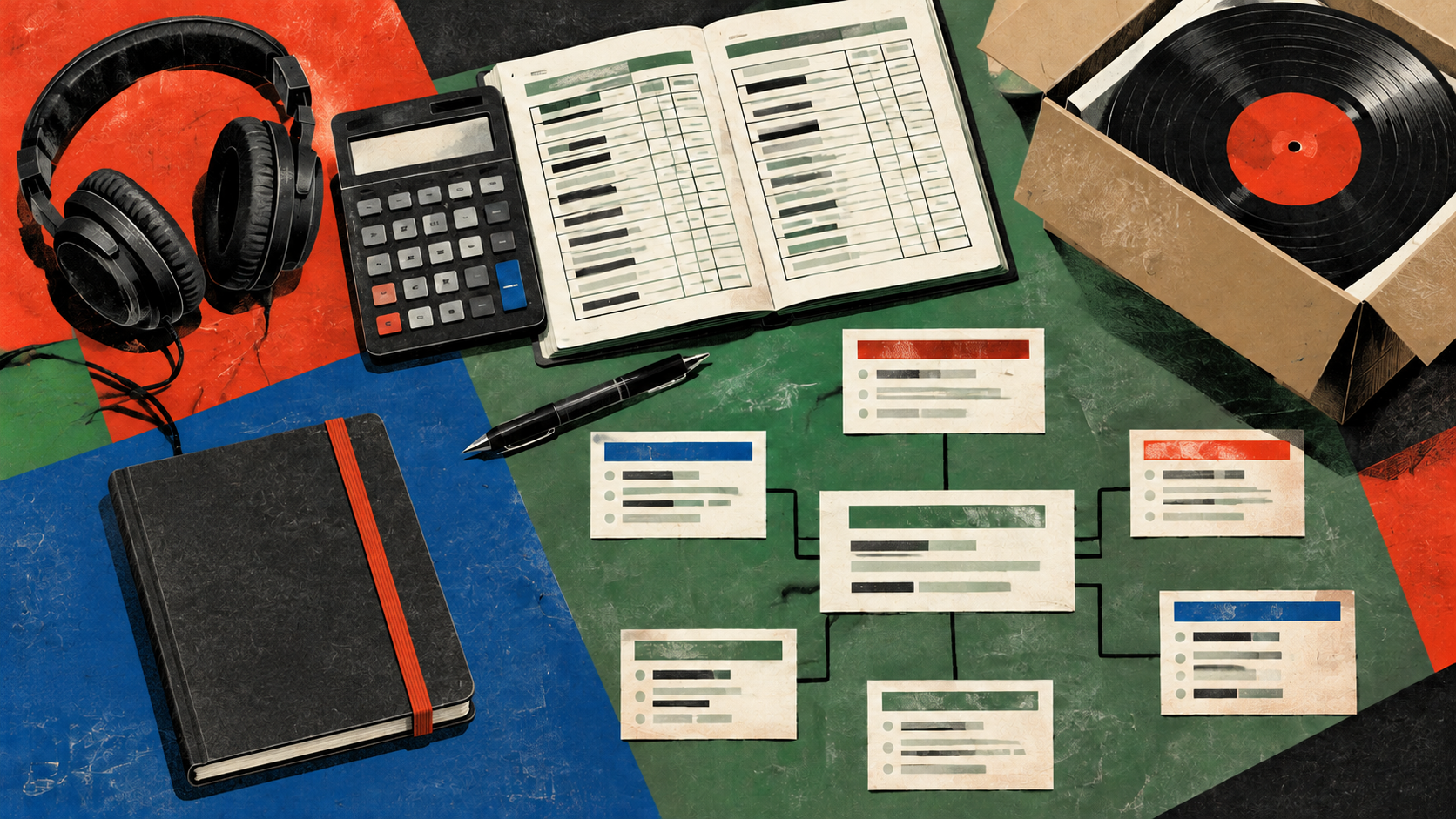
A producer can negotiate a great-sounding deal and still lose money because they confuse revenue with profit, a license with ownership, or an audience with paying customers. Business vocabulary is useful when it helps you see those differences—not when it makes a meeting sound expensive.
Here are 100 business terms everyone should know, grouped by the decisions they help you make. GTM means go-to-market: the coordinated plan for reaching the right buyers and turning an offer into sales. It is where we begin, because making something and selling something are different jobs.
The named-company examples below describe publicly documented products, practices or historical results. The smaller-business examples and calculations are explicitly illustrative, not reported earnings or promised outcomes. Dollar amounts are USD. Accounting, tax and contract examples use general principles; legal details depend on your location and agreement.
1–10: Strategy—what are you selling, and to whom?
Start with the offer before choosing the logo. A great microphone does not fix a bad recording room; a polished brand does not fix a product nobody needs. OpenStax explains business models as the way a venture creates, delivers and captures value; the SBA provides free market-research questions and planning resources. 1 (opens in a new tab) 2 (opens in a new tab)
1. GTM — Go-to-market
The plan connecting target customers, positioning, pricing, sales channels, launch activity and delivery. Real example: GitLab's public GTM resources bring sales, marketing and customer-success work together; its sales-operations documentation covers account routing and territories. GTM is not just a launch post. Apply it: write who buys, why they buy, where you reach them, how they pay and what happens after checkout. 3 (opens in a new tab) 4 (opens in a new tab)
2. Business model
How an organization creates value, delivers it and earns enough to keep operating. Real example: Bandcamp connects artists and fans and earns a share of sales; Patreon supports paid creator memberships and digital shops. Those are different business models, even when the same musician uses both. 5 (opens in a new tab) 6 (opens in a new tab)
3. Value proposition
The practical reason someone should choose your offer. Illustrative example: “Mixes delivered with instrumental versions and two revision rounds” is more useful to a buyer than “premium audio solutions.” Make the promised result specific and deliverable.
4. Target market
The broader group you intend to serve. Illustrative example: independent artists releasing their first EP is a target market; “everyone who likes music” is too broad to guide a service offer.
5. Market segmentation
Dividing a market into groups with different needs or buying behavior. Illustrative example: touring artists need merch that travels well, while online-first creators may prioritize on-demand fulfillment. The same shirt can require two different sales plans.
6. ICP — Ideal customer profile
The characteristics of a best-fit customer, especially a company account in B2B sales. Illustrative example: a mixing service might target small labels releasing two or more projects a quarter with organized stems and an approved budget. An ICP describes fit, not a fictional person's hobbies.
7. Buyer persona
A research-based picture of a person involved in a purchase: their responsibilities, problems and decision criteria. Illustrative example: the label manager cares about deadlines and rights, while the artist cares about vocal tone. Neither persona should be invented and treated as customer evidence.
8. Positioning
The place you want your offer to occupy in the buyer's mind compared with alternatives. Real example: Bandcamp describes itself as an online record store and music community centered on direct artist support. That frames the service differently from simply calling it an audio player. 5 (opens in a new tab)
9. Competitive advantage
A meaningful edge that helps you win or serve customers better than alternatives. Illustrative example: a bilingual engineer with reliable next-day vocal edits may offer an advantage to a specific local scene. “We care more” is not much of an advantage unless customers can see the difference.
10. SWOT — Strengths, weaknesses, opportunities and threats
A framework separating internal strengths and weaknesses from external opportunities and threats. Illustrative example: a studio's experienced engineer is a strength; limited parking is a weakness; a new local festival is an opportunity; rising commercial rent is a threat. Use it to choose actions, not just fill four boxes. 7 (opens in a new tab)
11–20: Markets and products—how big is the opportunity?
Market sizing is not a prediction that you will sell to everyone. Treat each estimate as a stack of assumptions that someone else should be able to inspect. OpenStax's entrepreneurship resources cover business models, startup resources and funding; GitLab's public engineering handbook provides a real example of incremental delivery. 1 (opens in a new tab) 8 (opens in a new tab) 9 (opens in a new tab)
11. TAM — Total addressable market
The total potential demand for a clearly defined product or service, often expressed as annual revenue. Illustrative example: 10,000 eligible studios spending $200 annually would imply a $2 million TAM, if both assumptions are sound. Do not use the entire music industry's revenue for a narrow studio tool.
12. SAM — Serviceable available market
The part of TAM your current offer and operating model can actually serve. Illustrative example: software that only supports Windows excludes otherwise interested Mac-only customers from its present SAM.
13. SOM — Serviceable obtainable market
The portion of SAM you can realistically capture within a stated period and resource limit. Illustrative example: a solo engineer with capacity for 60 projects a year cannot honestly plan to fulfill 600 without changing operations. SOM is an estimate, not a guaranteed share.
14. Market share
Your sales divided by total sales in the defined market, over the same period. Illustrative example: 100 of 2,000 comparable projects sold locally equals 5% by project count. A revenue-based share may differ when prices vary.
15. Product-market fit
Evidence that a defined market genuinely wants the product enough to adopt, pay for or keep using it. Illustrative example: repeated paid orders and unsolicited referrals are stronger evidence than launch-day compliments. There is no universal single score that proves fit for every business.
16. MVP — Minimum viable product
The smallest usable product that lets you test a critical assumption with real users. Illustrative example: sell one carefully documented original drum kit before building a 200-pack storefront. “Minimum” is not permission to distribute broken files or unclear licenses.
17. Iteration
Making successive improvements based on evidence and feedback. Real example: GitLab's engineering handbook advocates smaller merge requests and incremental changes. Illustrative application: fix confusing installer instructions before adding another 30 presets. 9 (opens in a new tab)
18. Pivot
A substantial change to an important part of the business strategy after learning something new. Illustrative example: a producer moves from low-priced custom beats to a niche sample library because repeat buyers consistently want sounds, not commissions. Changing the thumbnail alone is not a pivot.
19. B2B — Business-to-business
Selling to another business. Illustrative example: supplying original music to an advertising agency is B2B, even if the finished ad reaches consumers.
20. B2C — Business-to-consumer
Selling to individuals for personal use or consumption. Real example: fans buying an album from an artist's Bandcamp page illustrate consumer sales; the platform also serves artists and labels, so its whole business is not only B2C. 5 (opens in a new tab)
21–30: Sales—how does interest become a purchase?
A funnel describes progression toward purchase; a pipeline helps manage specific potential deals. Salesforce explicitly distinguishes the two, while GitLab publishes the terminology its teams use for inquiries, accounts and qualified leads. 10 (opens in a new tab) 3 (opens in a new tab)
21. DTC — Direct-to-consumer
A brand selling to end customers rather than relying on a traditional wholesale-to-retailer chain. It can still use payment and storefront platforms. Real example: Bandcamp gives artists direct-to-fan stores, but remains an intermediary with its own fees. “Direct” does not mean “no platform.” 11 (opens in a new tab)
22. Sales funnel
A model of the stages people pass through from awareness to purchase. Illustrative example: 1,000 tutorial viewers become 100 product-page visitors and 10 buyers. Diagnose the weak stage instead of assuming every stage needs more traffic.
23. Sales pipeline
A system for tracking individual potential deals through stages. Illustrative example: a studio tracks one film brief as “qualified,” another as “proposal sent” and a third as “contract agreed.” Pipeline value is not money already earned. 10 (opens in a new tab)
24. Lead
A person or organization that might become a customer and has entered your sales process. Illustrative example: someone requesting a mixing quote is a lead; an anonymous video view usually is not a usable sales contact.
25. MQL — Marketing-qualified lead
A lead meeting your marketing team's agreed criteria for further attention. Real example: GitLab defines MQL using systematic qualification, including demographic, firmographic or behavioral scoring. Downloading one free file need not make someone ready to buy. 3 (opens in a new tab)
26. SQL — Sales-qualified lead
A lead assessed as sufficiently suitable and ready for a sales conversation under your process. Illustrative example: an artist confirms a budget, delivery date and track count for a mixing job. In this business context SQL is not the database query language.
27. CRM — Customer relationship management
The processes and tools used to organize customer interactions, contacts and follow-ups. Real example: Salesforce describes managing opportunities through a sales pipeline. Illustrative application: track the last conversation and next action so a warm inquiry does not disappear into your inbox. 10 (opens in a new tab)
28. Conversion rate
The percentage of eligible people or events completing a defined action. Illustrative example: 20 purchases from 1,000 product-page sessions is a 2% session-to-purchase rate. Specify the denominator; email opens and page visits are not interchangeable. 12 (opens in a new tab)
29. Sales cycle
The time between a defined starting point in the sales process and closing the deal. Illustrative example: a studio takes 21 days from first qualified inquiry to signed agreement. Choose one starting point and use it consistently when comparing projects.
30. CTA — Call to action
The next action you ask someone to take. Illustrative example: “Hear the unprocessed vocal and book a mix consultation” is a clearer CTA than “Learn more” on a service page. The action should match the reader's stage, not rush every visitor into payment.
31–40: Marketing—what is attention worth?
Clicks are useful signals, not a salary. Google's public documentation explains CTR, campaign conversion measures and SEO without promising first-place rankings; Stripe explains the fuller costs involved in acquiring customers. 13 (opens in a new tab) 12 (opens in a new tab) 14 (opens in a new tab) 15 (opens in a new tab)
31. CAC — Customer acquisition cost
The relevant sales and marketing costs spent to acquire customers, divided by new customers acquired over a matching period. Illustrative example: $500 of acquisition costs for 25 new buyers gives $20 CAC. Include relevant labor and tools; ad spend alone is a narrower measure.
32. LTV / CLV — Customer lifetime value
An estimate of value generated by a customer over the relationship. Definitions vary: revenue-based LTV and gross-profit-based LTV are not the same. Illustrative example: $20 a month for 10 months is $200 revenue LTV; at 70% gross margin it is $140 gross-profit LTV before acquisition costs. State your method. 16 (opens in a new tab)
33. LTV-to-CAC ratio
Estimated lifetime value divided by customer acquisition cost. Illustrative example: $140 gross-profit LTV divided by $20 CAC equals 7:1. A ratio based on uncertain retention is uncertain too; there is no magic ratio that guarantees a viable business.
34. ROAS — Return on ad spend
Attributed revenue divided by advertising spend. Illustrative example: $800 in attributed sales from $200 of ads is 4× ROAS. It does not subtract production costs, shipping, refunds or your labor, and attribution can over-credit an ad. 12 (opens in a new tab)
35. ROI — Return on investment
Net gain attributable to an investment divided by its cost, expressed as a percentage. Illustrative example: a $200 campaign producing $300 of contribution before its own cost leaves $100 net gain: 50% ROI. Use the full relevant costs, not just sales revenue.
36. CTR — Click-through rate
Clicks divided by impressions, usually expressed as a percentage. Illustrative example: 50 clicks from 2,000 ad impressions is 2.5% CTR. That says people clicked—not that they bought. 13 (opens in a new tab)
37. CPC — Cost per click
Advertising spend divided by paid clicks. Illustrative example: $100 for 200 clicks gives a $0.50 average CPC. Cheap clicks are expensive if none of them need your offer.
38. CPM — Cost per thousand impressions
The cost to deliver 1,000 ad impressions. Illustrative example: $60 for 10,000 impressions gives a $6 CPM. Ten thousand impressions can include repeat exposure to the same people; it is not automatically 10,000 unique viewers.
39. SEO — Search engine optimization
Improving content and technical accessibility so search engines can understand pages and people can find useful answers. Real example: Google's SEO Starter Guide recommends practices that help discovery and explicitly rejects guaranteed first-place rankings. A helpful licensing answer is a better foundation than stuffing “best beats” into every paragraph. 14 (opens in a new tab)
40. A/B testing
Comparing two versions using a controlled split to learn which performs better on a chosen outcome. Illustrative example: randomly show two product headlines to comparable visitors and measure purchases, not just clicks. A tiny result from two different holiday weeks is not a clean test.
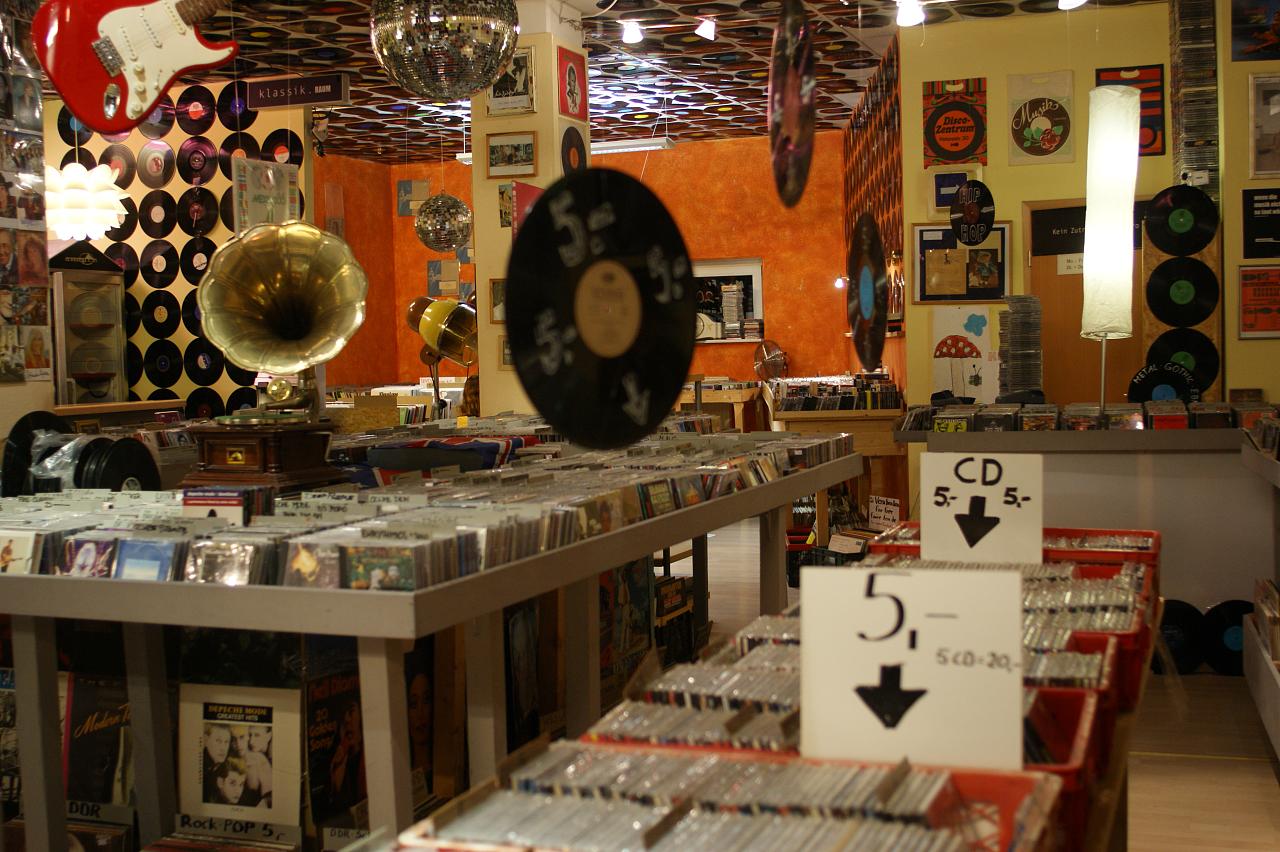 Photo: Hans Dinkelberg / Wikimedia Commons, CC BY 2.0 (opens in a new tab). Klang.KOMBINAT record shop, Leipzig (opens in a new tab). Illustrative retail photograph; the calculations below are not this shop's results.
41–50: Revenue and pricing—what do you keep from each sale?
Treat a sale like a cable with several connections: a problem anywhere along the chain changes what comes out. Accounting separates revenue, direct costs and operating expenses; economics helps explain how prices affect demand. 17 (opens in a new tab) 18 (opens in a new tab)
41. Revenue
Income earned from sales and services before subtracting expenses. Real example: Apple reported approximately $102.5 billion in revenue for its fiscal fourth quarter ended September 27, 2025. That is a dated historical result, not its profit or today's quarterly figure. 19 (opens in a new tab)
42. COGS — Cost of goods sold
Costs attributed to producing or acquiring what was sold; service businesses may use “cost of revenue” or “cost of services.” Illustrative example: the manufacturing cost of sold CDs belongs here, not automatically every CD still in storage. Classification depends on the business and accounting policy.
43. Gross profit
Revenue minus cost of goods sold or cost of revenue. Illustrative example: $1,000 in merch sales less $400 of product costs gives $600 gross profit, before operating expenses. Apple's published statements show net sales, cost of sales and gross margin as distinct lines. 20 (opens in a new tab)
44. Gross margin
Gross profit divided by revenue, expressed as a percentage. Illustrative example: $600 gross profit on $1,000 revenue is 60% gross margin. Some financial statements use “gross margin” for the dollar subtotal; check whether a report means dollars or a percentage.
45. Markup
The amount added above cost, often expressed as a percentage of cost. Illustrative example: a shirt costing $10 and selling for $25 has 150% markup but 60% gross margin. Different denominators produce different percentages; they are not synonyms.
46. Contribution margin
Revenue minus variable costs; per unit, selling price minus variable cost per unit. Illustrative example: a $25 shirt with $10 production and $3 variable selling costs contributes $12 toward fixed costs and profit. Gross margin may classify costs differently.
47. Net profit
What remains after all recognized expenses, including relevant interest and taxes, are deducted from income. Illustrative example: $1,000 revenue less $400 product cost, $250 operating expense, $20 interest and $30 tax leaves $300 net profit. Profit still is not necessarily cash received.
48. AOV — Average order value
Order revenue divided by the number of orders for a defined period. Illustrative example: $900 across 30 orders gives $30 AOV. Specify how you treat refunds, discounts, taxes and shipping before comparing reports.
49. Price elasticity of demand
How sensitive quantity demanded is to a price change, measured as percentage change in quantity divided by percentage change in price. Illustrative example: using the same simple baseline method, a 10% price increase alongside a 20% quantity decrease gives elasticity of −2. Other factors may explain the decline; the observation alone does not establish causation. 18 (opens in a new tab)
50. Unit economics
The revenue and costs attached to a meaningful unit, such as one order, member or project. Illustrative example: a $100 editing job with $10 variable expenses and three hours of work leaves $90 before fixed costs and tax—$30 per working hour at that stage. Counting your time stops “high-margin” services from becoming unpaid overtime.
51–60: Cash and costs—can the business pay its bills?
Profit is a score for a period; cash is what can settle a bill. The SEC explains that difference, and the SBA offers a free break-even calculator. The economics reference explains why opportunity costs matter and unrecoverable sunk costs should not drive the next decision. 17 (opens in a new tab) 21 (opens in a new tab) 22 (opens in a new tab)
51. Cash flow
Cash moving into and out of a business over time. Illustrative example: a studio may have earned $4,000 of invoiced revenue but received only $1,000 before rent is due. A signed contract cannot pay the landlord until cash arrives.
52. Working capital
Current assets minus current liabilities. Illustrative example: $12,000 of current assets minus $8,000 of current liabilities gives $4,000 working capital. Inventory and unpaid invoices are not as immediately spendable as cash.
53. Burn rate
The rate at which a business uses cash. Gross burn measures spending; net burn measures cash depletion after inflows. Illustrative example: $8,000 monthly outflows and $5,000 inflows produce $3,000 monthly net burn. Label which version you mean.
54. Runway
The estimated time before available cash runs out at an assumed net burn rate. Illustrative example: $18,000 of available cash at $3,000 monthly net burn gives six months. Revenue changes and upcoming bills can shorten that; it is a scenario, not a countdown guaranteed by the calendar.
55. Fixed costs
Costs that do not change with output within a relevant range and period. Illustrative example: a $600 monthly studio lease stays the same whether you complete four mixes or eight. Expanding into a second room can change the fixed-cost base.
56. Variable costs
Costs that change as activity or output changes. Illustrative example: packaging and per-order processing costs rise when more merch orders ship. A cost can include both fixed and variable components.
57. Break-even point
The sales level where total revenue equals total costs under stated assumptions. Illustrative example: $600 monthly fixed costs divided by $12 contribution per shirt means 50 shirts to break even. Include all relevant variable costs and revisit the model if prices or product mix change. 21 (opens in a new tab)
58. Opportunity cost
The value of the next-best alternative you give up. Illustrative example: spending Saturday on unpaid custom revisions may mean declining a $200 session. The lost alternative matters even when no invoice records it. 22 (opens in a new tab)
59. Sunk cost
A past cost that cannot be recovered. Illustrative example: money already spent on an unsuccessful logo is not a reason to keep a confusing name. Decide using future costs and benefits, not the desire to justify yesterday's bill. 22 (opens in a new tab)
60. Budget
A plan for income, spending and resource allocation over a defined period. Real example: Kickstarter's creator handbook tells creators to list expenses, including fulfillment materials, when setting a funding goal. Illustrative application: budget for mailers and replacement shipments, not just vinyl pressing. 23 (opens in a new tab)
61–70: Accounting—what do the reports actually say?
These are the terms that turn a pile of receipts into a picture of the business. The SEC's financial-statements guide covers the major reports; IRS publications explain bookkeeping and cash versus accrual accounting in a US tax context. 17 (opens in a new tab) 24 (opens in a new tab) 25 (opens in a new tab)
61. Forecast
An estimate of likely future results based on assumptions and available evidence. Illustrative example: a label forecasts 80 orders using preorders and past conversion rates, while budgeting money for only 60. A forecast describes expectation; a budget sets a plan. GitLab publicly describes a rolling-forecast process in its finance handbook. 26 (opens in a new tab)
62. Accounts receivable — AR
Money customers owe for goods or services already provided or invoiced under the relevant accounting treatment. Illustrative example: a completed $500 mix with payment due next month creates a receivable, not $500 of bank cash.
63. Accounts payable — AP
Amounts owed to suppliers for goods or services purchased on credit. Illustrative example: the printer's unpaid $700 invoice sits in accounts payable. Keep its due date visible even if the merch has not sold yet.
64. Accrual accounting
Recording revenue when earned and expenses when incurred, rather than only when cash moves. Illustrative example: a December job paid in January may belong in December revenue if the revenue-recognition conditions are met. Tax rules and exceptions need separate checking. 25 (opens in a new tab)
65. Cash-basis accounting
Generally recording income when received and expenses when paid. Illustrative example: under a straightforward cash-method scenario, the January payment appears in January income. Not every business or transaction can use that simplified treatment for tax. 25 (opens in a new tab)
66. Balance sheet
A snapshot of assets, liabilities and equity at a specific date. Illustrative example: on December 31, list cash and equipment, amounts owed and the residual ownership interest. It is a photograph, not a movie of the whole year.
67. P&L — Profit and loss statement
Also called an income statement: a report of revenue, expenses and profit or loss over a period. Real example: Apple's fiscal 2025 statements of operations separate sales, cost of sales, operating expenses and net income. Read the period label before comparing numbers. 20 (opens in a new tab)
68. Cash flow statement
A report grouping cash flows into operating, investing and financing activities. Illustrative example: customer receipts, an equipment purchase and a business loan are different types of cash movement. A loan brings in cash but is not sales revenue.
69. CapEx — Capital expenditure
Spending on assets expected to provide benefits beyond the current period, subject to capitalization rules. Illustrative example: a qualifying purchase of a long-lived studio console may be capitalized. Not every gear purchase receives the same accounting or tax treatment.
70. OpEx — Operating expenditure
Spending associated with running the business, generally recognized as operating expenses rather than capital assets. Illustrative example: ordinary monthly software subscriptions and office utilities are operating costs. A subscription and an owned long-lived asset can affect reports differently.
71–80: Ownership and funding—whose money, whose risk?
Funding is not free money. Debt creates repayment obligations; equity changes ownership. The SEC covers the accounting equation, OpenStax describes funding sources, and Y Combinator publishes its SAFE materials. The IRS describes US business structures. 17 (opens in a new tab) 8 (opens in a new tab) 27 (opens in a new tab) 24 (opens in a new tab)
71. Depreciation
Allocating the depreciable cost of a tangible asset over its useful life for accounting purposes. Illustrative example: a $3,000 asset with no residual value depreciated straight-line over five years creates $600 annual depreciation. Tax depreciation may use different rules; this allocation is not a fresh $600 cash payment each year.
72. Equity
The residual interest after liabilities are deducted from assets; it also refers to ownership interests. Illustrative example: a business with $50,000 assets and $20,000 liabilities has $30,000 book equity. Book equity is not automatically the price an investor will pay.
73. Liability
A present obligation the business owes. Illustrative example: an outstanding loan is a liability. A customer advance can also create an obligation to deliver; receiving cash does not always mean you have earned it all.
74. Bootstrapping
Funding a business mainly through founders' resources and operating income rather than outside equity investment. Illustrative example: a producer uses mixing revenue to develop a sample library. Bootstrapping preserves ownership but does not remove financial risk or the need to pay yourself.
75. Debt financing
Raising money that must be repaid under agreed terms, commonly with interest. Illustrative example: a studio borrows for acoustic treatment. Compare payment timing, collateral, guarantees and total cost—not only the headline rate.
76. Equity financing
Raising money in exchange for an ownership interest. Illustrative example: an investor buys newly issued shares in a music-software company. You may avoid scheduled loan repayments, but you give up ownership and may share control.
77. Valuation
An estimate or negotiated measure of what a business or ownership interest is worth. Illustrative example: a startup's pre-money valuation is the agreed value before new investment; post-money adds the new investment in a simple priced round. Different methods and security terms can produce different values.
78. Dilution
A reduction in an existing owner's percentage ownership, usually when new equity is issued. Illustrative example: founders holding 100 shares own 100%; after 25 new shares are issued to an investor, they own 100/125, or 80%. A lower percentage does not necessarily mean a lower dollar value.
79. SAFE — Simple Agreement for Future Equity
An agreement giving an investor rights to future equity under specified events and terms. Real example: Y Combinator publishes the SAFE it created for startup fundraising. A standard YC SAFE is not an ordinary interest-bearing loan; conversion and ownership depend on the document. Use qualified advice before signing. 27 (opens in a new tab)
80. Crowdfunding
Raising money from many contributors, through models that may involve rewards, donations, debt or equity. Real example: Kickstarter uses all-or-nothing project funding: funds are not collected if the goal is not reached. Backing a reward project is not the same as buying shares, and creators still need to fulfill their promises. 23 (opens in a new tab)
81–90: Recurring income—will people stay?
A membership business is a garden, not a vending machine: recurring billing still needs recurring value. Stripe's metrics guide explains subscription measures, and Patreon documents monthly and annual creator memberships. Define the same period and customer cohort before comparing retention numbers. 16 (opens in a new tab) 28 (opens in a new tab)
81. MRR — Monthly recurring revenue
Recurring subscription revenue normalized to a month, excluding one-off sales under your stated method. Illustrative example: 40 members at $5 and 12 at $25 produce $500 gross MRR before fees, refunds and expenses. A one-time $100 kit sale does not add $100 of MRR.
82. ARR — Annual recurring revenue
Recurring revenue expressed on an annual basis. Illustrative example: $500 MRR annualizes to $6,000 ARR. That is a run-rate measure, not proof you have received $6,000 or will retain every member for a year.
83. Churn rate
The rate at which customers or revenue are lost over a period; label which one. Illustrative example: five departures from 50 starting members equals 10% monthly customer churn. Losing five $25 members has a different revenue impact from losing five $5 members.
84. Retention rate
The share of a starting customer group remaining after a defined period. Illustrative example: 45 of 50 starting members remain, so retention is 90%. New signups are not part of that original cohort; do not use them to hide departures.
85. NRR — Net revenue retention
Recurring revenue retained from existing customers, including expansion and subtracting contraction and churn, divided by their starting recurring revenue. Illustrative example: $1,000 starting revenue plus $200 expansion minus $50 contraction and $100 churn gives 105% NRR. Exclude revenue from brand-new customers.
86. Upselling
Offering a higher-priced or more capable version of what the customer is considering or already uses. Illustrative example: a member moves from a $5 supporter tier to a $25 group-feedback tier. The added value and workload should justify the difference.
87. Cross-selling
Offering a related, different product or service. Illustrative example: a mixing client adds mastering or instrumental edits. Unlike upselling, you are adding an adjacent offer, not merely a higher tier of the same one.
88. Freemium
A model with an ongoing free version and paid upgrades. Real example: Patreon describes free memberships alongside paid memberships; creators can have both. Ableton's time-limited Live trial is different from an indefinitely free software tier. Do not confuse “free trial” and “freemium.” 6 (opens in a new tab) 29 (opens in a new tab)
89. Onboarding
Helping a new customer get set up and reach useful value. Real example: Ableton's trial page walks users through installation, creating an account and authorization. Illustrative application: new community members need their download link, access instructions and first-session date—not just a payment receipt. 29 (opens in a new tab)
90. NPS — Net Promoter Score
A recommendation measure: the percentage of promoters scoring 9–10 minus the percentage of detractors scoring 0–6 on a 0–10 recommendation question; 7–8 are passives. Illustrative example: 60% promoters minus 20% detractors gives NPS +40, not 40% customer retention. Survey response bias still matters. 16 (opens in a new tab)
91–100: Execution and agreements—how do you protect the work?
Set measurable goals, document delivery and know which rights you are granting. OpenStax explains KPIs; GitLab publishes an OKR process; the Copyright Office distinguishes copyright, trademark, patent and trade-secret protection. US structure and tax examples below are not universal legal advice. 30 (opens in a new tab) 31 (opens in a new tab) 32 (opens in a new tab) 24 (opens in a new tab)
91. KPI — Key performance indicator
A chosen measure of progress toward an important objective. Illustrative example: on-time project delivery rate is a useful KPI for a mixing service; follower count may be less useful for that objective. A metric becomes “key” because it informs an important decision, not because it looks good on a dashboard.
92. OKR — Objectives and key results
A goal-setting framework pairing a qualitative objective with measurable results. Real example: GitLab publishes a quarterly OKR process with scoring and review. Illustrative application: “Make delivery dependable” could pair with “deliver 95% of this quarter's projects by the agreed date.” Tasks support the objective but are not automatically outcomes. 31 (opens in a new tab)
93. SOP — Standard operating procedure
A documented, repeatable way to perform a task. Illustrative example: a studio's SOP covers intake, file naming, backups, export settings and final delivery checks. It should reduce preventable mistakes without pretending every creative decision can be standardized.
94. SOW — Statement of work
A document describing a project's scope, deliverables, responsibilities, timetable and often acceptance criteria. Illustrative example: specify six mixes, two revision rounds, file formats and a delivery date. Agree on how extra work is approved and priced before revisions become an endless loop.
95. SLA — Service-level agreement
An agreement setting service commitments and how performance is measured, sometimes including remedies. Illustrative example: a business promises a response to support requests within two business days. “Response” does not mean “resolution,” and the agreement should specify business hours and exclusions.
96. Intellectual property — IP
Legal rights relating to creations and certain commercially valuable information, including copyright, trademarks, patents and trade secrets. Illustrative example: a song, a label logo and a confidential manufacturing process involve different forms of protection. Not every idea is automatically protected in every way. 32 (opens in a new tab)
97. Copyright
Protection for original works of authorship, such as songs, recordings, photographs and software, under applicable law. In the US, qualifying work is protected when fixed; registration has additional legal benefits. Illustrative example: the musical composition and its sound recording can have different owners. Credit is not a substitute for permission. 32 (opens in a new tab) 33 (opens in a new tab)
98. Licensing
Granting permission to use something under specified terms without necessarily transferring ownership. Illustrative example: a nonexclusive beat license allows defined uses while the producer may license the same beat to others. State territory, duration, permitted uses, restrictions, payment and rights clearly; “royalty-free” does not mean copyright-free.
99. Sole proprietorship
A business owned by an individual without a separate corporate entity in the usual US sense. Illustrative example: a freelance producer operating personally may be a sole proprietor even without forming a company. Required registrations and taxes still apply, and personal liability is an important consideration. 24 (opens in a new tab)
100. LLC — Limited liability company
A US state-law business entity that generally separates business obligations from its owners, subject to exceptions. Illustrative example: an engineer forms an LLC for a studio, but a personal guarantee can still create personal exposure. An LLC is not itself one universal tax treatment; classification and elections matter. 24 (opens in a new tab) 34 (opens in a new tab)
Put the vocabulary to work: a one-page business check
You do not need to memorize all 100 terms before taking your next step. Use the ones that reveal a decision you have been avoiding.
- Define the offer: write your value proposition, target customer and GTM in five sentences. If you cannot explain the outcome, pause the ad campaign.
- Check one sale: list price, product costs, selling costs and your time. Calculate contribution margin before celebrating revenue.
- Check the month: record fixed costs, payment due dates, cash available and expected collections. Estimate break-even and runway only with stated assumptions.
- Choose one acquisition measure: track qualified inquiries, conversion rate and full CAC. Avoid treating cheap impressions as evidence of profitable demand.
- Check recurring value: if you sell memberships, track MRR, cohort retention and the work needed to keep the promise. Annualized revenue is not cash in the bank.
- Protect the delivery: agree scope and licensing in writing. Choose a business structure and accounting method with appropriate local advice.
- Review and adjust: compare the forecast with what happened, choose one KPI to improve and make one useful iteration.
For a worked music-business application, read our guides to building a paid producer community, selling music locally and online, selling beat leases and selling merch without upfront inventory.
Where can you learn more for free?
Openly available is not always openly licensed. The references in this article can be read without buying a course. Some are open educational resources, government publications or public company documentation; others are free-to-read commercial explainers. A public webpage does not automatically grant permission to republish it.
- Open educational references: OpenStax's Entrepreneurship (opens in a new tab), Principles of Marketing (opens in a new tab) and Principles of Economics (opens in a new tab). Check the particular book's attribution and reuse terms; they are not identical across titles.
- A real company's public operating manual: The GitLab Handbook (opens in a new tab) lets you examine sales terminology, finance planning and engineering iteration. Learn from the practice without assuming every company's definitions match GitLab's.
- Government starting points: the SBA's business planning resources (opens in a new tab), break-even calculator (opens in a new tab), SEC financial-statements guide (opens in a new tab), IRS recordkeeping guide (opens in a new tab) and Copyright Office IP toolkits (opens in a new tab).
- Free operational explainers: Stripe's subscription metrics guide (opens in a new tab), Google's SEO Starter Guide (opens in a new tab) and Salesforce's pipeline guide (opens in a new tab). These are useful vendor sources, not independent promises about your results.
- Fundraising documents: Y Combinator's SAFE resources (opens in a new tab). Reading a template is not a substitute for advice on the ownership and obligations it creates.
Common questions
Is GTM the same as marketing?
No. Marketing is part of GTM, but a go-to-market plan also connects pricing, channels, selling, delivery and customer support. A great launch with an unusable checkout is an incomplete GTM.
Which business terms should a beginner learn first?
Start with value proposition, revenue, gross margin, cash flow, fixed costs, contribution margin, break-even, conversion rate, CAC and licensing. They help answer whether someone wants the offer, whether a sale works financially and whether you can deliver it safely.
Are profit and cash flow the same?
No. Unpaid invoices, equipment purchases, loan repayments and the timing of expenses can make profit and cash movement differ. Look at both instead of assuming a good-looking P&L means the bank balance is healthy.
Can I use this glossary outside the United States?
Most strategy, marketing and measurement concepts travel well. Business entities, taxes, copyright enforcement and contract rules vary by jurisdiction. LLC and IRS examples here are specifically US-oriented; use local official guidance before acting.
References reviewed November 19, 2026. Historical company results remain labeled with their original reporting period; illustrative prices and calculations are teaching examples, not current platform quotes or income forecasts.