 SAMPLED
Why Should Artists Check Their Music Royalties Before 2027?
Before planning your next release, check whether your existing music is getting paid correctly. Here is a practical royalty audit, plus a useful tool Mogul brought to Sampled’s attention.
Your next music-business win might not be another release. It might be collecting money from the music you have already made.
Heading into 2027, artists and songwriters have plenty to plan: studio time, new singles, shows, content and the bills that make all of it possible. But a bigger audience does not automatically fix an incomplete song registration. If the paperwork behind your catalog is wrong, more activity can mean more earnings that are difficult to match to the right person.
Think of your catalog as a shop with several cash registers. Checking the distributor dashboard is checking one drawer—not necessarily the whole business. The recording, the composition and your role in each can lead to different payment routes.
This guide focuses on the U.S. royalty system, with international considerations where relevant. 2027 is a planning milestone here, not a newly announced universal royalty deadline. You do not need to wait for January to start.
Why does collecting royalties matter before chasing more streams?
A royalty audit is not a promise of a windfall. It is a way to check whether the income you are entitled to is reaching you, rather than assuming a release appearing on Spotify means every registration is complete.
The Mechanical Licensing Collective—The MLC (opens in a new tab)—says that tracking unpaid royalties starts with correctly registered musical works and their associated sound-recording metadata. Its tools let eligible members review unmatched uses and pursue claims. That is a practical reason to inspect your back catalog: the problem may be an unfinished connection between an existing recording and the composition behind it.
For an independent artist, money already earned can help fund the next mix, rehearsal or campaign. Even when an audit reveals no missing payment, knowing which organization handles each income stream makes your budget more dependable. Treat royalties as business records, not a mystery number that occasionally appears in your bank account.
Which royalty routes should you check?
Start with two assets: the composition—the underlying music and lyrics—and the sound recording—a particular recorded performance. You may own or earn from both, one, or only a contractual share. Writing a song does not automatically mean you own its master; performing on a record does not automatically mean you wrote its composition.
| Payment route | What it relates to | Where to check |
|---|---|---|
| Recording income from on-demand streams, downloads and other licensed uses | The sound recording and your agreed entitlement | Your distributor, label or other recording-rights administrator and the relevant contract |
| Composition public-performance royalties | Public performances of the underlying song, including eligible broadcast, live and streaming uses | Your performing rights organization, such as ASCAP, BMI or SESAC, or your home-country society |
| U.S. digital mechanical royalties | Eligible digital reproductions of the composition under The MLC’s blanket license | The MLC, or the publisher, administrator or collective already representing the relevant shares |
| U.S. statutory digital sound-recording performance royalties | Eligible non-interactive digital uses, such as satellite radio and internet radio | SoundExchange for featured artists and sound-recording copyright owners |
These are payment routes, not four guaranteed payments for every play. A Spotify on-demand stream is not the same use as a non-interactive radio play. Sync fees, physical-copy mechanical royalties and international neighboring rights can involve additional arrangements.
For the distinctions, see BMI’s performing-rights introduction (opens in a new tab), The MLC’s membership guidance (opens in a new tab) and SoundExchange’s artist and rights-owner guidance (opens in a new tab). If you want the longer foundation, read our guide to collecting music royalties as an independent artist.
Step 1: Make a catalog sheet you can actually use
Do not start by opening six accounts and hoping the totals agree. Start with a single source of truth for your music.
For each release, record:
- Song title, alternate titles and the exact released recording version.
- Release date, artist name, distributor and label, if any.
- Recording ISRC and release UPC where available.
- Each writer’s legal name, performing-rights affiliation and IPI identifier where available.
- Agreed composition ownership splits, publisher or administrator, and the territories they control.
- Master owner, featured artists and any producer payment agreement.
- Registration status, confirmation references and the person responsible for unresolved issues.
An ISRC identifies a recording; an ISWC identifies a musical work. An IPI identifies an interested party such as a songwriter or publisher. Keep them in separate columns rather than treating them as interchangeable codes. A remix or alternate recording can need a different recording entry even when it uses the same underlying song.
Start with your ten most active tracks, then work through the rest. That is a manageable audit strategy, not a rule imposed by a collection society.
Step 2: Check the registrations—not just the memberships
Joining an organization and registering your catalog are separate jobs. A membership confirmation does not establish that every song has the right title, writers and shares attached.
Compare your catalog sheet with the records held by your PRO and relevant mechanical collector. Check aliases, missing co-writers, duplicate entries, publisher details and territory coverage. Ask collaborators to compare their registrations with the same agreed information.
Do not copy percentages blindly between systems. Organizations can display writer and publisher shares differently. Use their instructions, and confirm what each percentage represents. BMI’s work-registration instructions (opens in a new tab), for example, distinguish writer and publisher information and direct changes to existing registrations through an update process rather than another new-work submission.
If your music has a publisher or administrator, ask who registers what, in which territories, and how corrections are handled. Avoid creating competing claims for shares somebody else already administers. If you are outside the U.S., check your home society’s collection arrangements rather than assuming you need a second PRO membership.
Step 3: Look beyond your distributor
Your distributor statement is useful, but it is not a universal receipt for everything your song can earn.
If you self-administer composition shares entitled to U.S. digital mechanical royalties, check The MLC’s membership requirements (opens in a new tab). Membership is free. If a publisher, administrator or collective manages those shares, establish whether it already collects them; do not assume the same share needs another independent claim.
Then check SoundExchange (opens in a new tab) if you are an eligible featured recording artist or sound-recording owner. Registration is free, and SoundExchange Direct supports recording searches, claims and payment review. Someone who owns the master and is also the featured artist should check that both relevant roles are correctly represented—not assume one account entry resolves every entitlement.
For international recording income, ask what your existing representative covers. SoundExchange announced additional international collection agreements in February 2026 (opens in a new tab), a useful reminder that territory coverage deserves a specific question, not an assumption.
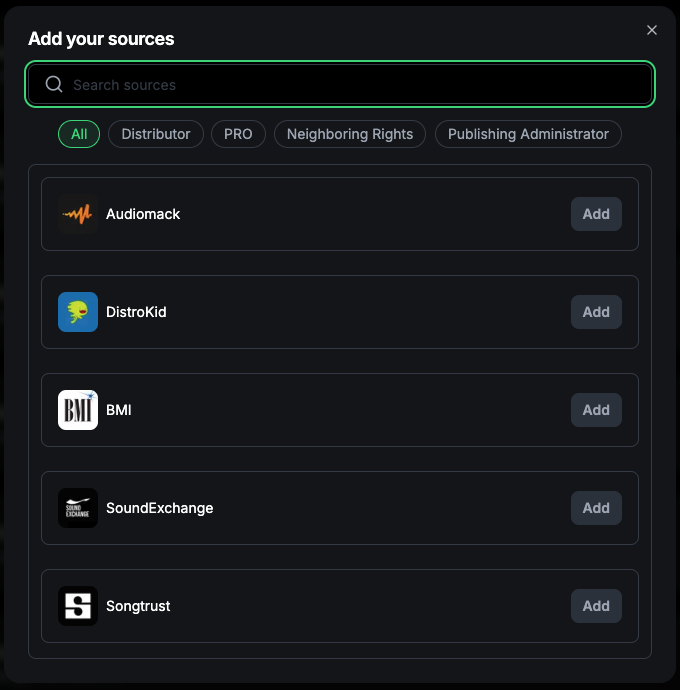
Screenshot: Mogul. Supplied to Sampled; shown with permission. This screen illustrates source connections, not proof that any particular account is missing money.
Where does Mogul fit into a royalty check?
Mogul (opens in a new tab) is a tool Tim Vogel, Growth at Mogul, brought to Sampled’s attention. We think the idea is cool: make registration gaps easier to see, then help fix the paperwork behind them. That is why it belongs in this conversation—not as a replacement for understanding your rights, but as a possible way to make a catalog audit less scattered.
In the information supplied to Sampled, Mogul says it scans ASCAP, BMI, SESAC, SoundExchange and The MLC for missing or incorrect registrations, then helps correct them so money reaches the artist. Its official website (opens in a new tab) describes a workflow of connecting royalty sources, identifying issues and submitting registration fixes.
Vogel put it this way:
"Most artists don't realize that a song can be earning money in four places at once, and a single missing registration can leave that money sitting uncollected. Our job is to find those gaps and close them."
— Tim Vogel, Growth at Mogul, in a quote supplied to Sampled
The useful takeaway is that one catalog can have multiple collection routes. The exact routes depend on the use, territory, rights and agreements; the quote should not be read as a guarantee that every song earns four separate checks.
Start with the free Royalty Finder
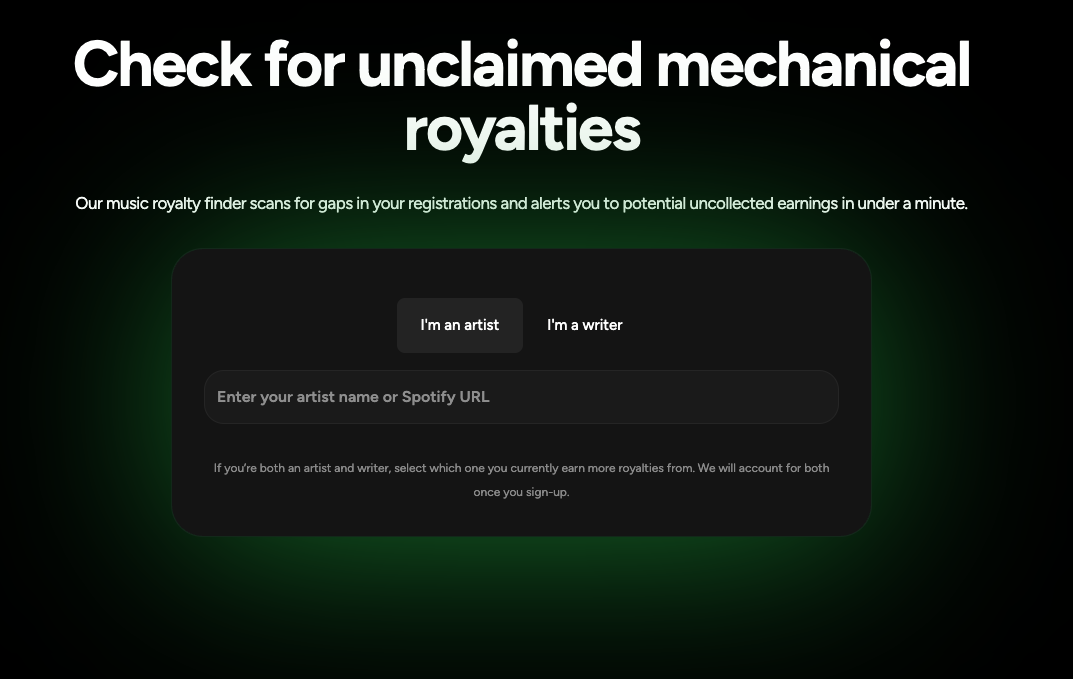
Mogul points readers to its free Royalty Finder (opens in a new tab), which it says checks for potential unclaimed royalties in under a minute. The page currently leads with unclaimed mechanical royalties and offers artist and writer starting points.
Separate that first check from the full service. Mogul’s help-center explanation (opens in a new tab) describes the free finder as a U.S. publishing audit, while its broader service connects royalty accounts and works on registrations across additional sources. A quick result is not the same thing as a completed claim or cash arriving in your account.
We tried it: five minutes and a potential $222
After Mogul brought the tool to our attention, Sampled’s Robert Anthony tried Mogul’s free Royalty Finder (opens in a new tab). It took him about five minutes, and Mogul displayed: “Hey Robert, we found up to $222 waiting for you at the MLC alone.” That is our first-hand experience with the check—not the under-a-minute timing advertised for the finder.

Screenshot: Robert Anthony / Sampled, using Mogul. The result displays “up to $222”; this is a potential amount identified by the service, not money we have received.
The screen asks us to finish setting up so Mogul can find and fix more royalty issues, and says payments can take 4–6 months depending on which partners collect the royalties. That is Mogul’s stated timing, not a guaranteed payout date.
We plan to upgrade with Mogul (opens in a new tab) and report back in a follow-up article on how it goes, including the registration process and any royalties actually collected. We have tried the initial check, but have not yet verified a recovery or completed that upgraded-service follow-up.
The other screenshots supplied for this article illustrate Mogul’s interface and estimates; they are not audited earnings or a typical customer outcome. Before authorizing ongoing work, check current fees, account permissions, the collection mandate, cancellation terms and whether the service overlaps with your existing administrator.
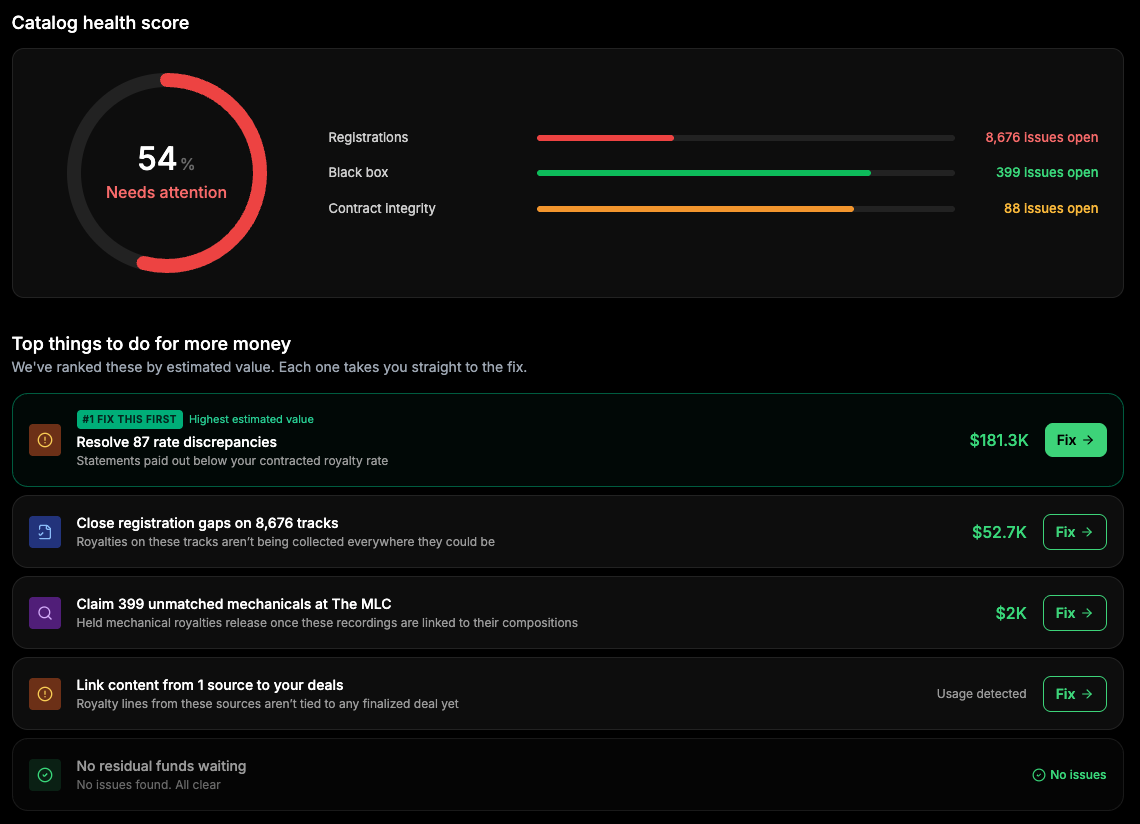
Screenshot: Mogul. Supplied to Sampled; shown with permission. Displayed amounts and issue counts are company-provided interface examples, not verified recoveries or earnings forecasts.
Step 4: Turn a possible gap into a documented correction
A flagged issue is a lead, not a finished payment. Work through it like an unpaid invoice:
- Identify the work and recording. Check the title, artist, writers and recording identifiers.
- Establish your entitlement. Gather the split sheet, publisher agreement, master-ownership record or other relevant evidence.
- Find the actual mismatch. Is a work absent, a writer missing, a recording unmatched, a share disputed, or an account missing payment information?
- Use the responsible organization’s process. Submit a correction or claim yourself, or authorize your representative to do it within its mandate.
- Save the reference. Record submission date, ticket number, supporting files and the next follow-up date.
- Verify the outcome. Confirm the corrected record and later check the statement and payment—not just the disappearance of a warning.
The MLC provides royalty-income tracking guidance (opens in a new tab) explaining different approaches for historical and more recent uses. Recovery windows and procedures vary, so ask the relevant organization about the specific usage period. Do not assume every old royalty remains claimable forever—or invent a December 31 cutoff that nobody announced.
If ownership is disputed, software cannot replace resolving the agreement. Get qualified advice when a conflicting claim or contract requires it.
Step 5: Build a realistic royalty forecast for 2027
Keep three numbers apart: estimated missing earnings, reported royalties and cash received. They are not interchangeable.
For example, imagine your records show $240 in distributor income received, $90 in PRO royalties received and a tool flags an estimated $60 registration issue. This is an illustrative calculation, not a Mogul customer result: you have received $330, not $390. The flagged $60 stays in an unresolved-claims column until entitlement, collection and payment are confirmed.
Track reporting periods as well as payment dates. Royalties for a use in one month can be reported and paid later; a gap in this month’s bank deposits is not automatically missing income. Compare statements on a like-for-like basis, including currency, territories, deductions and the share you actually control.
For your budget, use confirmed history and conservative assumptions. Potential recoveries can be upside, but they should not be the money you have already promised a mixing engineer.
Your before-2027 royalty checklist
- This week: Build the catalog sheet and audit ten active tracks.
- Next week: Compare registrations, ownership shares and responsible administrators.
- Then: Check official unmatched-royalty tools and, if useful, try Mogul’s free Royalty Finder (opens in a new tab).
- Before your next release: Agree splits, capture identifiers and assign registration responsibilities.
- Each month: Review new releases and open correction tickets.
- Each quarter: Reconcile statements, payments and changes to territory coverage or representation.
A producer selling a beat should settle composition splits and any royalty participation before release; our beat-lease guide covers the business questions to ask. A collaborator uploading the track is not automatically taking care of your publishing.
Common questions
If I am already with ASCAP or BMI, am I collecting everything?
Not necessarily. PROs handle composition public-performance royalties. U.S. digital mechanical royalties and eligible recording-side digital performance royalties have different collection routes. Check the actual catalog registrations as well as your memberships.
Do I have to pay for a royalty-finding tool?
No. The MLC and SoundExchange provide official tools and free registration for eligible users. Mogul also offers its free first check. A paid administrator or monitoring service is a choice to evaluate against its scope, fees and your existing arrangements—not a prerequisite for starting an audit.
Can Mogul guarantee I will recover money?
A scan or estimate is not a payment guarantee. Recovery depends on eligibility, evidence, registrations, disputes and the relevant organization’s rules. The company’s claims and supplied screenshots should be understood in that context.
Is there a special 2027 deadline?
This article does not identify a universal 2027 collection deadline. The point is to enter the year with cleaner records. Specific organizations and claims may have their own time limits; check those directly.
The bottom line
You do not need a viral record to take your royalty income seriously. You need to know what you own, where each payment should come from and whether the records agree.
Going into 2027, make the next release easier by cleaning up the last ones. Start with the official collection routes, use a tool such as Mogul (opens in a new tab) if it helps you see the gaps, and follow every fix through to the statement. Getting paid correctly is part of making music sustainable—not an administrative favor to do for your future self.