 SAMPLED
Are Trail Cameras Good for Studio Security? Moultrie Edge 3 Review
A $100 cellular trail camera that watches your gear when there is no Wi-Fi or power — and quietly builds you a library of original footage while you sleep.
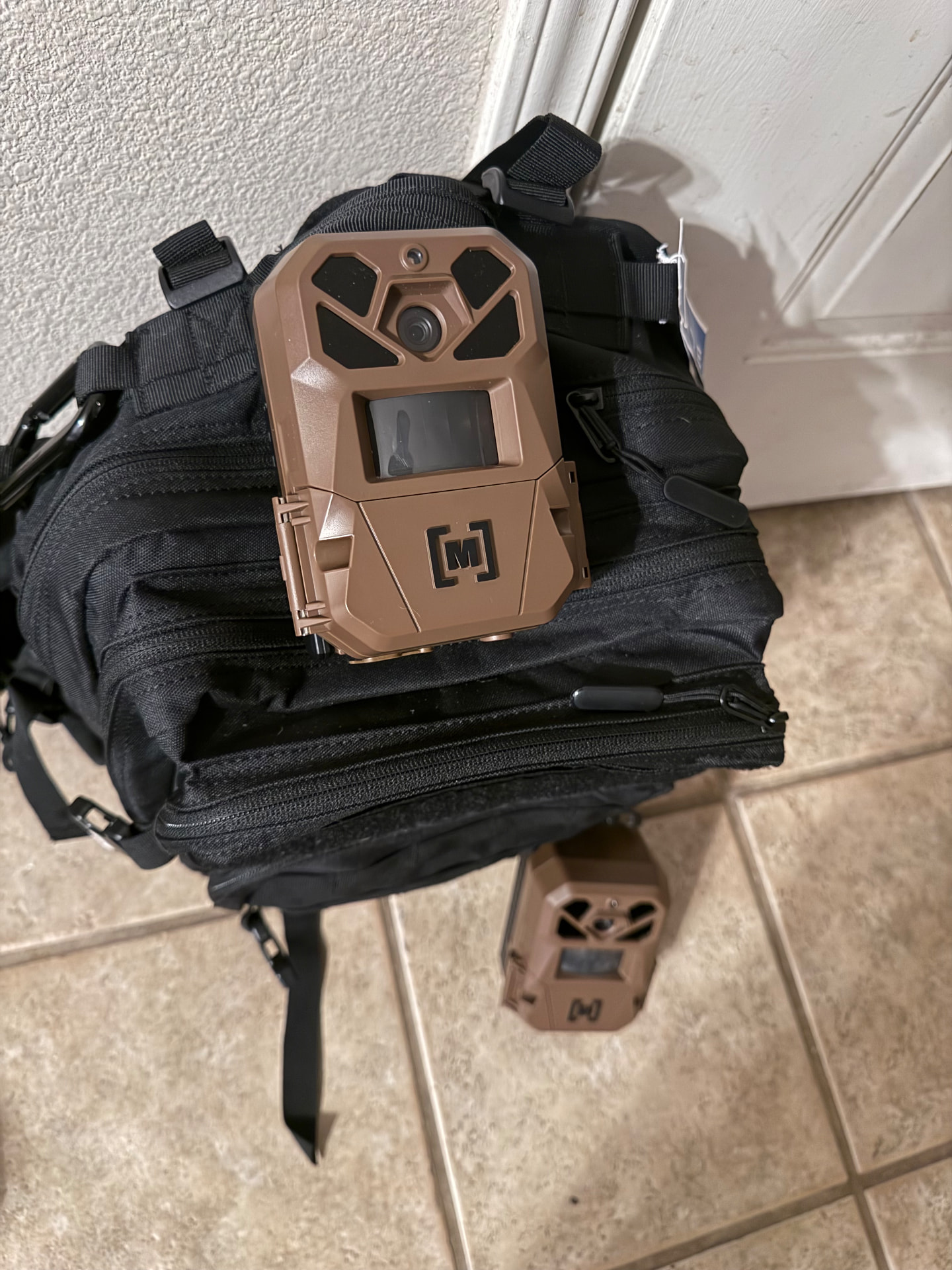
Most gear a creative buys is pointed at themselves — a mic, a light, a lens. This one points away from you, sits outside for months on batteries, and quietly does two jobs at once: it watches your stuff, and it films things you would never be awake or still enough to film yourself.
The Moultrie Edge 3 (opens in a new tab) is a cellular trail camera sold in a two-pack. It shoots 40MP stills and 1080p video, fires on a 0.5-second trigger, and pushes what it sees to your phone over cell service — no Wi-Fi, no SD card runs, no being there.
What it is, in plain terms
It is a weatherproof box with a motion sensor, a camera, and a cell radio. Something moves, it wakes up, takes the shot, and sends it. Moultrie's own listing puts the Edge 3 at $99.99 a unit and it goes on sale below that on Moultrie's own store (opens in a new tab); the two-pack is the version worth having, because one camera is a security tool and two cameras are coverage.
The specs that actually matter here:
| Spec | What it means for you |
|---|---|
| 40MP stills, 1080p video | Big enough to crop hard and still post it |
| 0.5s trigger | It catches the thing, not the empty frame after |
| Multi-carrier auto-connect | Picks the strongest of four US networks, no SIM swapping |
| Low-glow IR flash | Night footage without a bright white flash announcing itself |
| GPS + built-in memory | You can find it if someone walks off with it, and it stores locally too |
| On-demand check-in | Pull a fresh look from your phone whenever you want |
Walmart's listing spells out the multi-carrier and built-in memory side of it on the two-pack listing (opens in a new tab), and Moultrie's page covers the AI false-trigger filtering, Live Aim framing help, and GPS tracking on its product page (opens in a new tab).
The security half
If you run a home studio, you already have a room with more resale value than the car in the driveway. A synth, two mics and an interface is a grab-and-go payday for someone who has watched you load in twice.
A cellular trail camera solves the specific problem regular security cameras don't: it needs no power run and no Wi-Fi. You strap it to a tree, a fence post, the side of a shed, a pole at the end of a driveway — anywhere your router doesn't reach and an outlet doesn't exist. That covers the alley behind the practice space, the storage unit, the trailer with the backline in it, the gate.
Two of them means two angles: one wide on the approach, one tight on the door. Low-glow IR means the night shots don't light up like a camera flash and tip anyone off. And because it uploads immediately, the footage exists somewhere else before anyone finds the box.
A few practical notes from having one out:
- Mount it higher than eye level and angle it down. Harder to spot, harder to reach, better face angles.
- Cellular cameras need a data plan. Budget for it the same way you budget for a domain.
- The GPS tracking is not theoretical — trail cameras get stolen. It matters.
- Point it away from the road unless you enjoy a hundred notifications a day about passing cars.
The half nobody talks about: free footage
Here is the part that makes this a creative purchase and not just an insurance one.
Every visual you make needs B-roll. Lyric videos, loop packs, EPK backgrounds, Reels behind an unreleased snippet, a slow shot under a voice memo. Most people either pay for stock, use the same three Pexels clips everyone else uses, or skip it.
A camera that runs unattended for weeks makes footage while you sleep. Not staged, not licensed, not shared with ten thousand other accounts — yours, shot on your terms, cleared for anything you want to do with it.
This is a clip from mine, in Bristol, Tennessee. A hummingbird, caught by a motion trigger, at a time of day I was definitely not standing outside with a camera.
Fifteen seconds of that, slowed to half speed, is a whole intro. Ten clips like it is a visual library.
Things worth pointing a trail camera at if content is the goal:
- A feeder, a birdbath, a fruit tree — motion all day, no setup
- Weather: a storm rolling in, snow accumulating, fog burning off a field
- A time-lapse of the same frame across a season, cut down to eight seconds
- Night IR footage — the black-and-white infrared look is instantly a mood, and free
- Your own load-in and load-out, from a fixed angle, for a documentary-style cut
The 0.5-second trigger is what makes this usable rather than frustrating. Slower cameras catch the tail of the animal leaving. This one catches it arriving.
Honest limits
It is 1080p, not 4K, and it is a small sensor behind a plastic lens. Blown up on a TV it looks like what it is. On a phone, cut to music, it looks great — which is where your work lives anyway.
Clips are short by design and the framing is fixed, so you are editing found footage, not directing it. Battery and data are ongoing costs. And it is a motion-triggered device, which means you will delete a lot of wind-in-the-grass before you find the shot.
None of that changes the math. It is under a hundred dollars a camera, it protects gear worth many times that, and it hands you original video you didn't have to shoot.
Who should buy it
Anyone with gear stored somewhere a normal camera can't reach, and anyone who keeps running out of visuals for the music. If you are both — and most independent artists are — the two-pack (opens in a new tab) is one of the few purchases that pays into two different columns at once.
Set one on the studio door. Put the other one somewhere beautiful and forget about it for a month. Come back and see what it collected.
Photo and video in this piece were shot by me on the Edge 3. Links to the camera are affiliate links — if you buy through them, Sampled earns a small commission at no extra cost to you.