 SAMPLED
Can You Fit a Whole Production Setup in a Backpack?
Six pieces — interface, sampler, mic, controller, monitors, headphones — that turn any laptop and a backpack into a working studio.
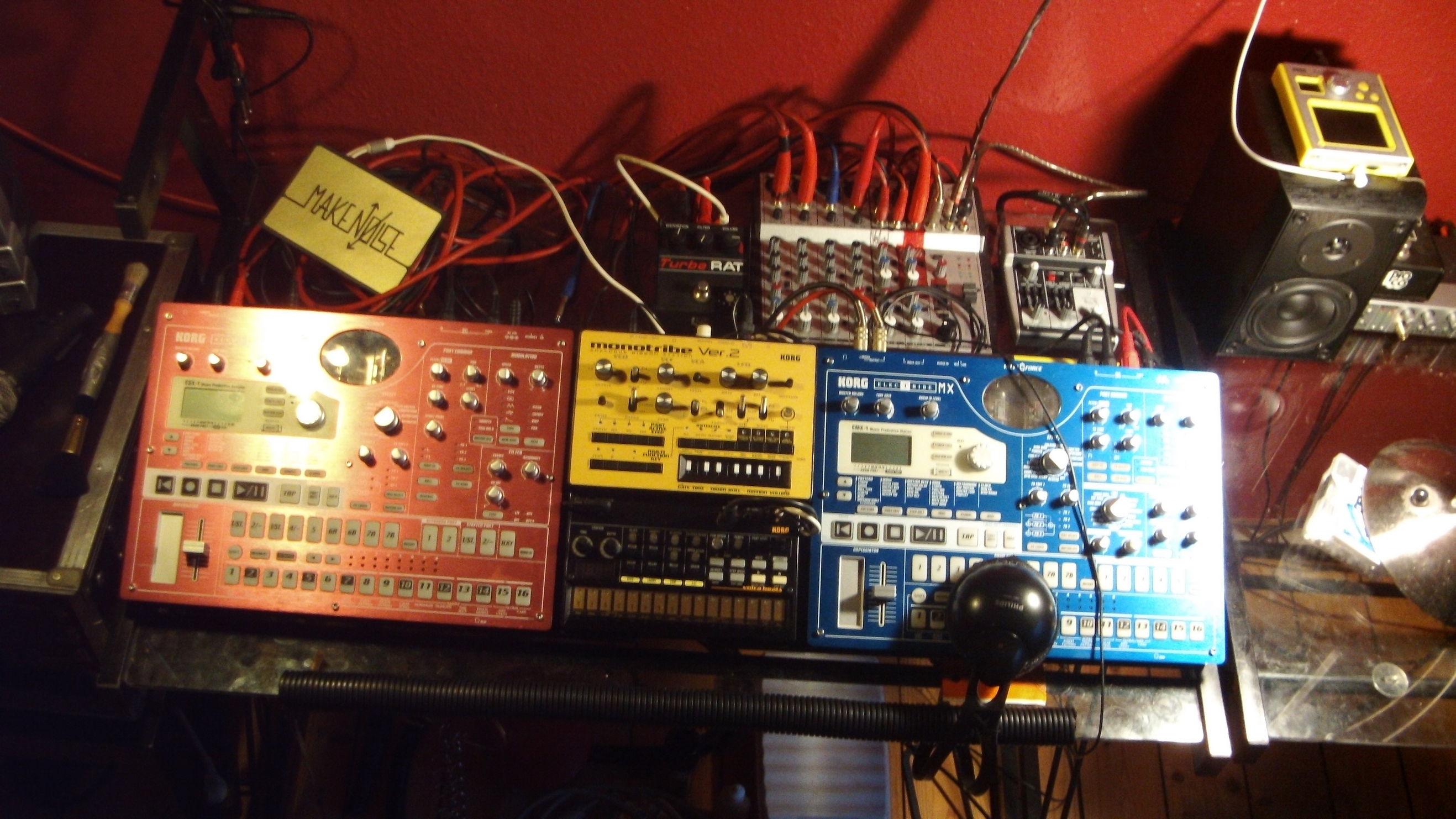
A studio used to mean a room. It meant monitors bolted to the walls, a console the size of a desk, and insulation in every corner. The gear in this article is the opposite of that: six pieces, each small enough to travel, that together do everything a fixed rig does — capture a vocal, sequence a beat, play a part, and reference a mix. Pack them in a backpack with a laptop and the studio moves where the producer moves.
The logic of the kit is that no piece is redundant. The Focusrite Scarlett Solo 3rd Gen (opens in a new tab) gets sound in and out of the computer. The Akai MPC Sample (opens in a new tab) makes beats without one. The Audio-Technica AT2020 bundle (opens in a new tab) captures the vocal. The Nektar Impact LX Mini (opens in a new tab) plays the parts. The PreSonus Eris 3.5 (opens in a new tab) monitors the result. The Sony MDR-7506 (opens in a new tab) checks it when the room is too loud or too quiet to trust the speakers.
Quick comparison
| Role | Connection | Power | Why it travels | |
|---|---|---|---|---|
| Focusrite Scarlett Solo 3rd Gen | Audio interface | USB-C | Bus-powered | One mic, one instrument, 24-bit/192 kHz, no wall plug |
| Akai MPC Sample | Standalone sampler/sequencer | USB-C / standalone | Rechargeable battery | 16 pads, built-in mic and speaker, makes a beat with no laptop |
| Audio-Technica AT2020 bundle | Condenser microphone | XLR (to interface) | 48V phantom | Side-address cardioid with arm, pop filter, and cable in the box |
| Nektar Impact LX Mini | MIDI controller | USB | Bus-powered | 25 mini keys, 8 pads, 8 knobs, arps and transport in a 12-inch frame |
| PreSonus Eris 3.5 | Studio monitors | TRS / RCA / 3.5 mm | Powered (AC) | 3.5-inch nearfield pair, front headphone jack, fits either side of a laptop |
| Sony MDR-7506 | Headphones | 1/4-inch / adapter | Passive | Closed-back, folding, 40 mm driver, the reference for every session |
| Buy | Scarlett Solo (opens in a new tab) | MPC Sample (opens in a new tab) | AT2020 (opens in a new tab) | LX Mini (opens in a new tab) |
The interface: Focusrite Scarlett Solo 3rd Gen
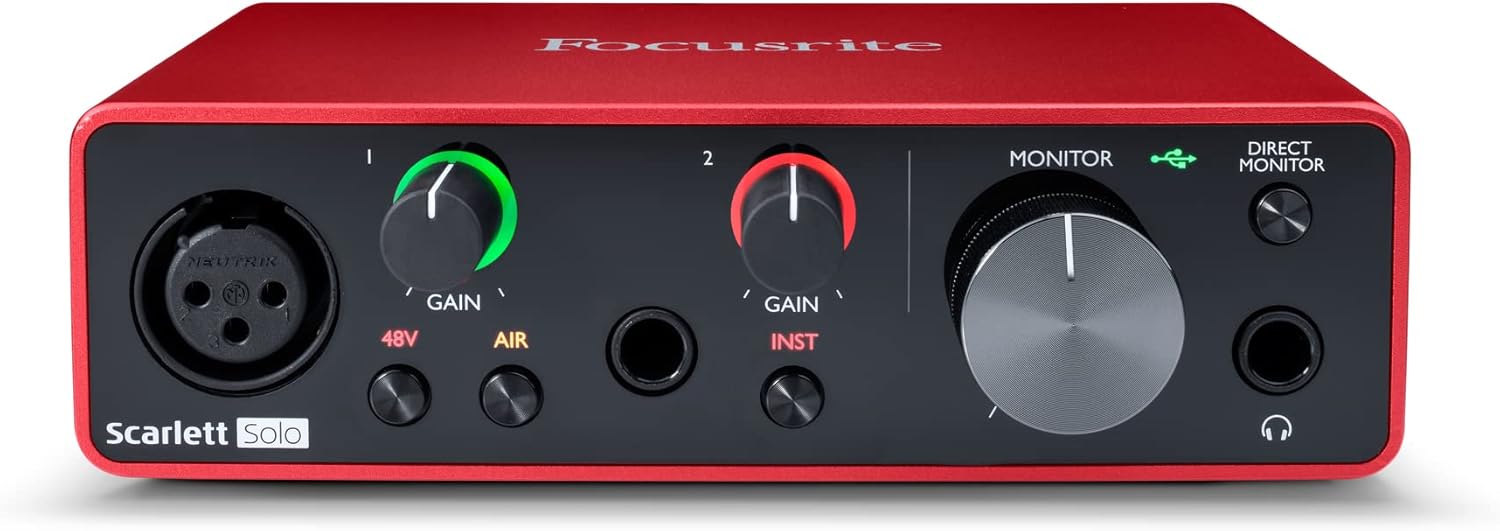
Everything else in the bag is pointless without a way to get sound into the computer at recording quality, and the Scarlett Solo 3rd Gen (opens in a new tab) is the interface that does that with the least friction. One combo XLR input handles a microphone, a separate instrument jack handles a guitar or bass DI, and both can record at once at 24-bit / 192 kHz over USB-C. The whole box is bus-powered, so it draws power from the laptop — no separate supply, no wall outlet to hunt for in a hotel room or a café.
The feature that earns its place in a travel kit is the Air button. Engaging it switches the preamp to a circuit that lifts the top octave the way Focusrite's ISA console preamp does, flattering a condenser on vocals or acoustic guitar. For a producer tracking one take at a time in an untreated room, that single switch is often the difference between a flat demo and a recording that sounds finished. Phantom power is on board for the AT2020, and the bundled Ableton Live Lite and Pro Tools First mean the DAW is ready before anything is installed. At roughly $119 (opens in a new tab), the Solo is the cheapest link in the chain and the one nothing else works without.
The sampler: Akai MPC Sample
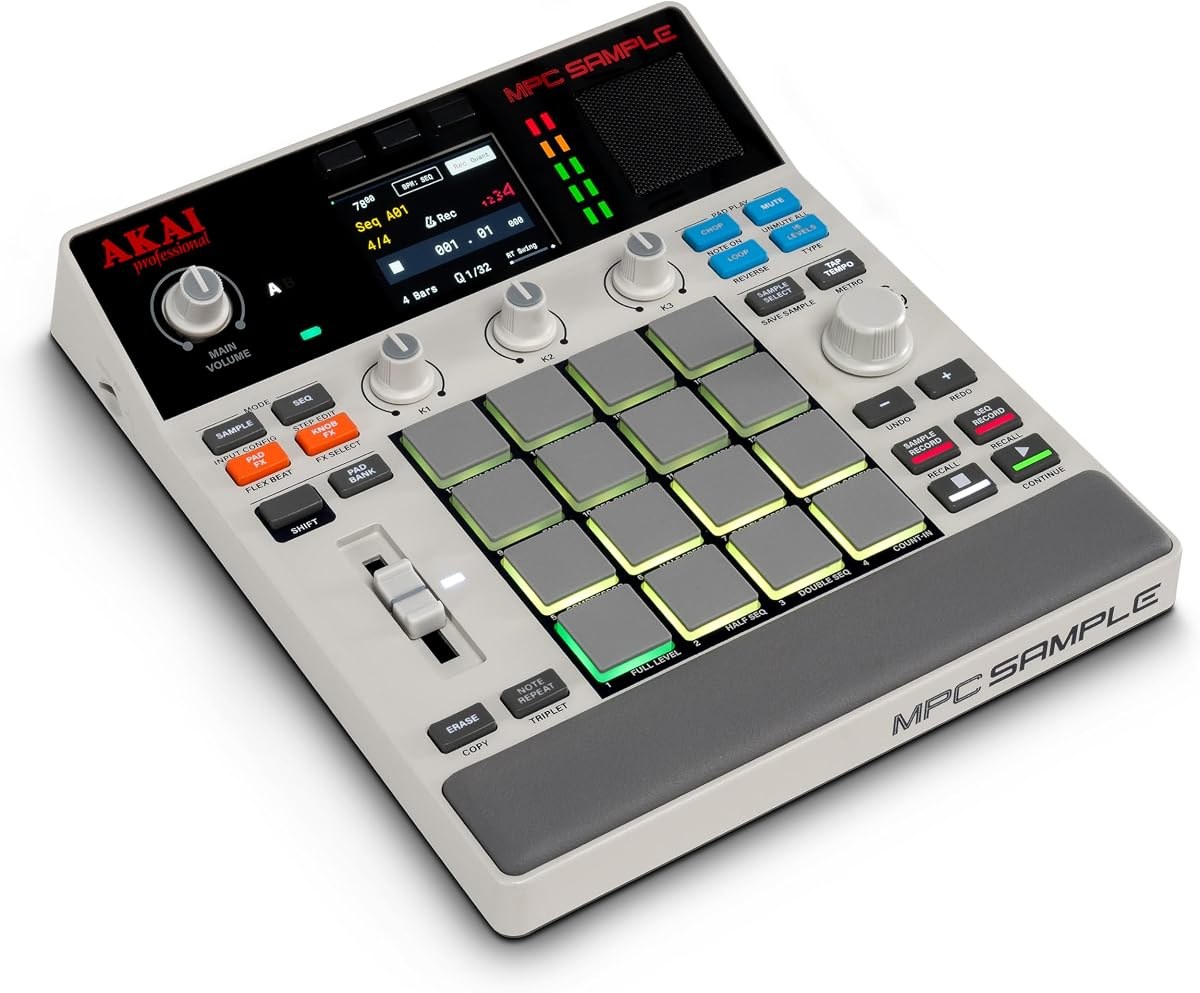
Where the interface handles the computer side, the MPC Sample (opens in a new tab) is the piece that works when the laptop stays closed. Sixteen MPC pads sit under a 2.4-inch color display, and the unit is fully standalone: a rechargeable lithium-ion battery, a built-in speaker, an internal microphone, and microSD storage mean a beat can be sampled, chopped, and finished on a train. Instant Sample Chop mode, real-time timestretch and repitch, and internal resampling take a raw recording to a playable kit without leaving the pads, and four internal FX processors cover 60 effect types.
It is the piece that turns downtime into output — the gap between soundcheck and set, the hour on the bus, the hotel-room evening — because it does not depend on anything else being powered. Over 100 factory kits ship on board, so the first session starts with sound already in the pads. When it does come back to the desk, USB-C carries audio and MIDI to the computer, so the MPC Sample (opens in a new tab) drops into a live rig or a DAW session without becoming an island.
The microphone: Audio-Technica AT2020 bundle
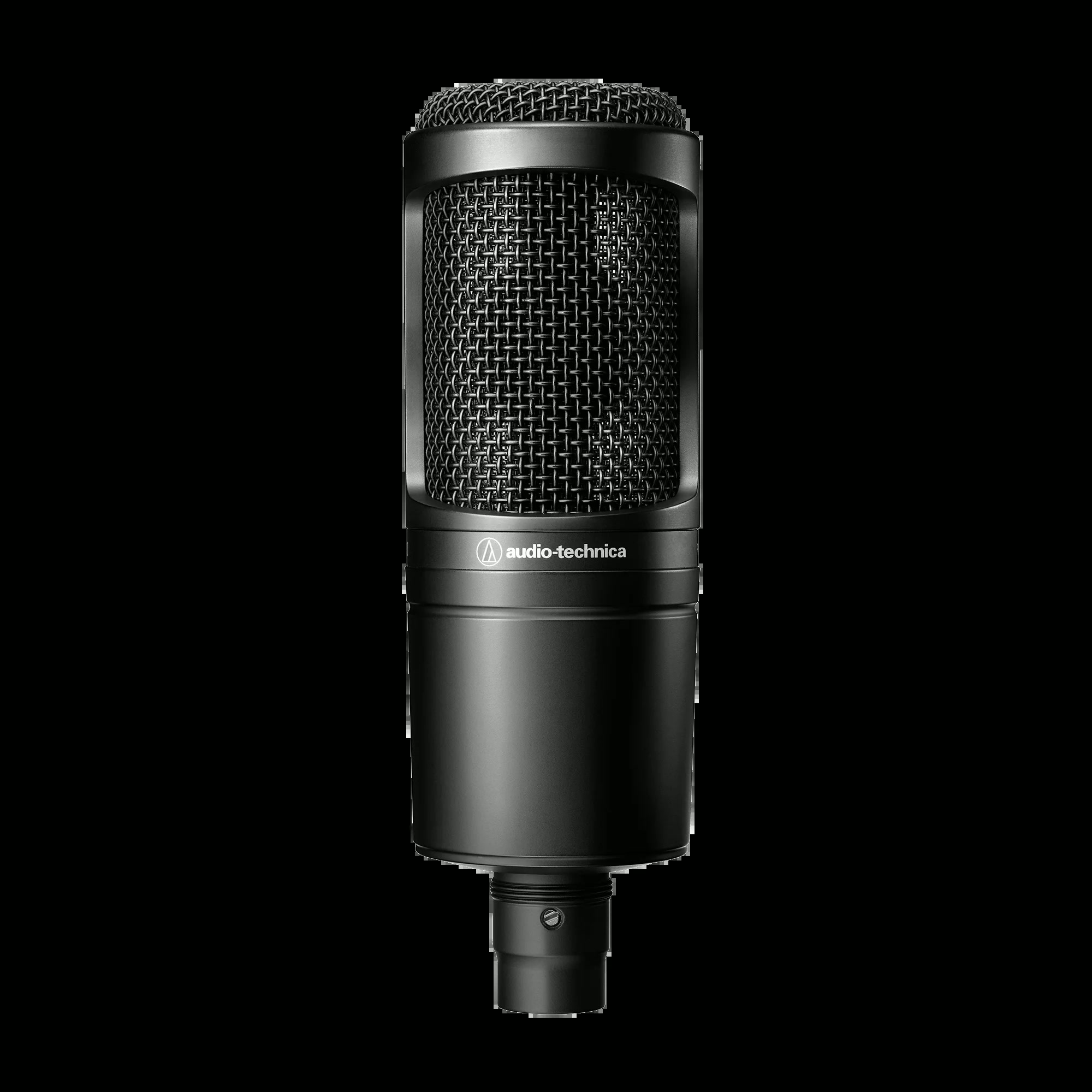
A mobile rig still needs to record a voice, and the AT2020 bundle (opens in a new tab) is the microphone that does it without a separate shopping list. A 15.4 mm low-mass diaphragm with a cardioid pattern covers 20 Hz to 20 kHz, handles 144 dB SPL without distorting, and rejects rear reflections well enough for an untreated bedroom or a borrowed closet. The self-noise of 20 dB(A) disappears the moment there is a voice in front of the capsule.
What makes the bundle the right pick for a travel kit is what comes in the box: a boom arm that gets the capsule off the desk and out of the keyboard's vibration path, a pop filter that catches plosives before they hit the diaphragm, an XLR cable, and a cleaning cloth. A content creator building a signal chain on the road gets the interface-to-mic connection in one purchase, with nothing left to source. The AT2020 is side-address, so it records from the grille, and it sits naturally on the boom arm above the controller. For podcasting, voice-over, and first vocal tracking away from home, the AT2020 bundle (opens in a new tab) is the cheapest mic in the bag that does not sound cheap.
The controller: Nektar Impact LX Mini
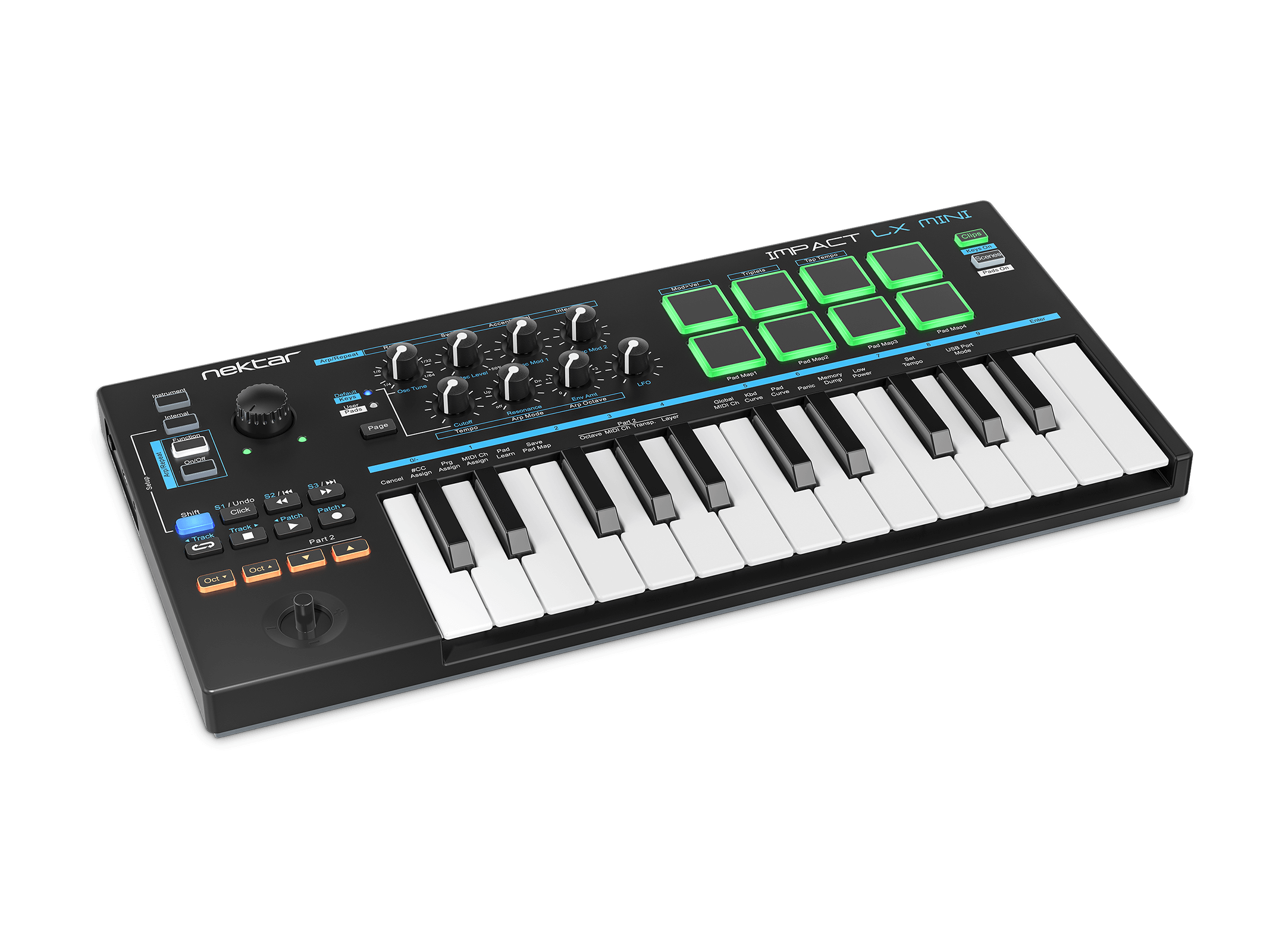
A laptop trackpad is the slowest way to play a part, and the Impact LX Mini (opens in a new tab) is the controller that fixes that in the smallest possible footprint. Twenty-five mini keys with velocity sensitivity, dedicated octave buttons, and four selectable curves sit beside a four-way joystick for pitch, modulation, and pedal control. Eight knobs switch between instrument, internal, and arp pages, and eight velocity-sensitive pads handle finger drumming with four storable maps for 32 note assignments.
The reason this outperforms most mini controllers is the control surface, not the keybed. Two arpeggiators and seven transport buttons — doubled to fourteen with shift, and up to twenty-one under DAW integration — let the producer start, stop, and navigate a session without reaching for the mouse. Nektar's DAW Integration maps transport, track selection, and mixer control across the supported DAWs without manual CC assignment, so the workflow learned at the desk carries to the road. It even keeps a footswitch socket, with an eighth-inch to quarter-inch adapter included and automatic polarity detection at boot. For laptop production and travel, the LX Mini is hard to beat on control-per-inch (opens in a new tab).
The monitors: PreSonus Eris 3.5
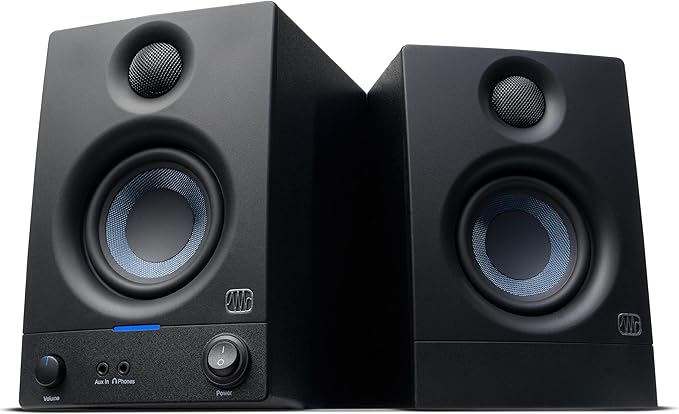
A pair of monitors is the one piece of the kit that does not run on bus power, but the Eris 3.5 (opens in a new tab) keeps the compromise small. A 3.5-inch woven composite woofer and a 1-inch silk dome tweeter run on roughly 50 watts across the pair, and the footprint fits either side of a laptop. The low end tapers off around 80 Hz, which is honest rather than flattering — it will not invent a sub bass line that is not there — but the midrange and top stay smooth for long sessions.
The layout is built for a desk rather than a rack. A front-panel headphone jack and aux input, volume on the front, and rear-panel TRS and RCA connections mean the interface, a phone, or a tablet all plug in without reaching around the back. High-frequency and acoustic-space controls handle wall placement and room brightness, which matters in a room that was never treated for mixing. Plenty of engineers keep a pair of these as a deliberately limited second reference — the modern equivalent of checking a mix on a car stereo. Check the pair on Amazon. (opens in a new tab)
The headphones: Sony MDR-7506
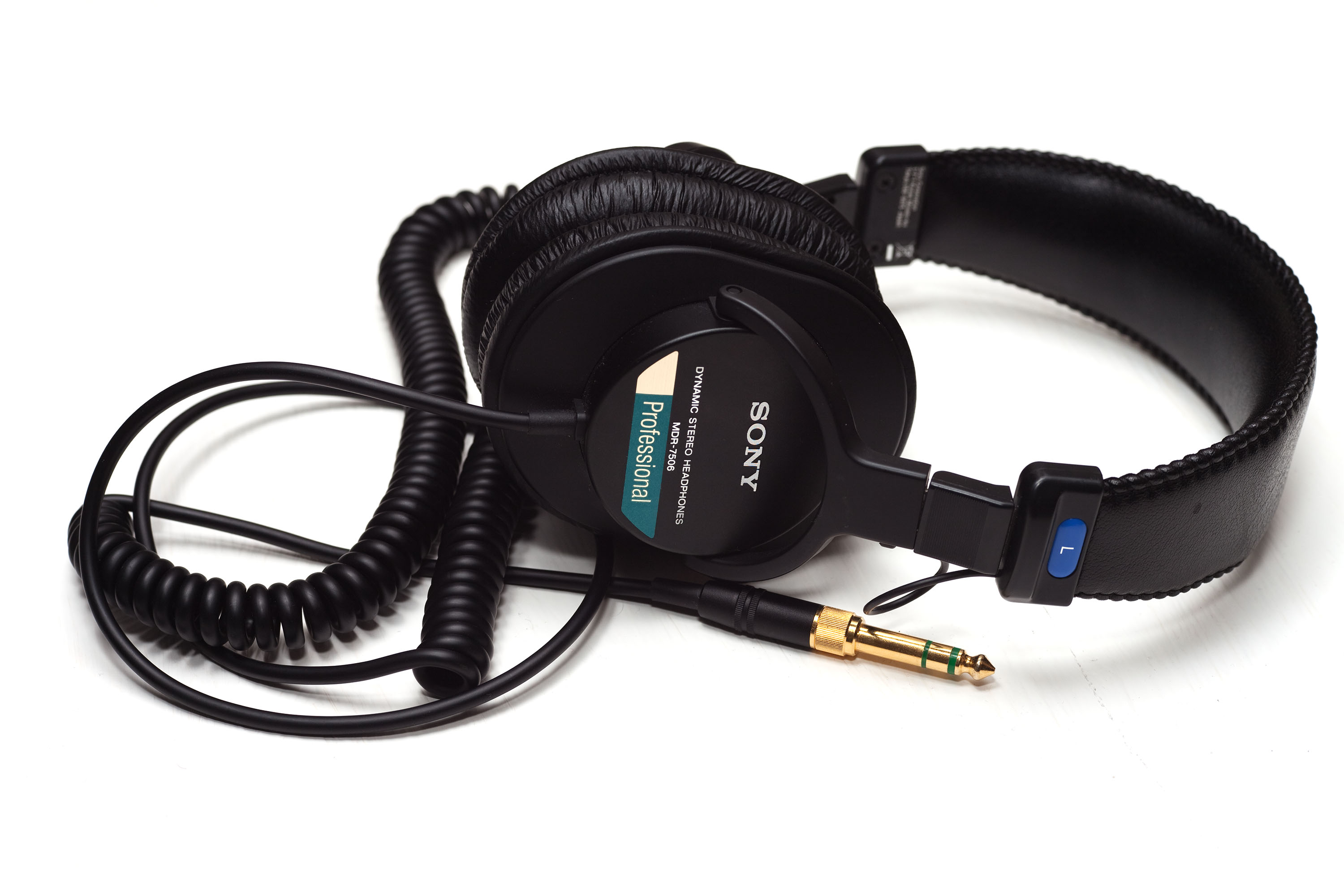
The monitors are useless in a loud room and misleading in a dead one, and that is where the MDR-7506 (opens in a new tab) earns its place. Introduced in 1991, it is the closed-back headphone that studios keep on the mic stand and on every shelf: a 40 mm driver, a 10 Hz to 20 kHz range, 63 ohms of impedance, and 106 dB/mW sensitivity that makes it easy to drive from a laptop or an interface. The folding design and a 1/4-inch adapter mean it packs flat and plugs into anything.
Its reputation is not marketing. Andrew Scheps has mixed records on them, and Dave Rat's decades of live-engineering notes lean on them as a reference. The closed back isolates the ear from the room, so tracking vocals in a noisy space or checking a mix on a bus is possible without bleed into the mic. They are the last thing checked before a session ends, and the one piece in the bag that a professional studio would already own. Get a pair. (opens in a new tab)
How the kit fits together
The signal chain is short and linear. The AT2020 (opens in a new tab) plugs into the boom arm and runs XLR to the Scarlett Solo (opens in a new tab), which supplies 48V phantom power and sends the digital signal to the laptop over USB-C. The LX Mini (opens in a new tab) plugs into a second USB port and plays the parts; the MPC Sample (opens in a new tab) connects when a beat needs to be built on pads rather than keys, or runs standalone on its battery when the laptop is closed. The Solo's monitor output feeds the Eris 3.5 (opens in a new tab) pair over TRS, and the front-panel headphone jack on the Eris — or the Solo's own headphone out — feeds the MDR-7506 (opens in a new tab) when the speakers cannot be trusted.
The only piece that needs wall power is the monitor pair; everything else runs off the laptop or its own battery. That is what makes it a backpack rig rather than a studio shrunk down: the producer is one USB-C cable and an outlet away from a working session, and the MPC Sample keeps working even without that.
What to leave behind
The kit is deliberately built around the workflow, not the spec sheet. A producer who tracks vocals and sequences beats on pads needs the AT2020 and the MPC Sample; one who plays parts needs the LX Mini; one who mixes needs the Eris 3.5 and the MDR-7506. None of the six is a compromise version of a bigger piece — they are the right-sized version of each role for a rig that has to move. The total lands well under the cost of a single mid-tier interface and a pair of full-size monitors, and it fits in a bag that goes on a plane as carry-on.
Disclosure: this article contains Amazon affiliate links. Purchases made through them may earn Sampled a commission at no additional cost to the reader. Product photography courtesy of Focusrite (opens in a new tab), Akai Professional (opens in a new tab), Audio-Technica (opens in a new tab), Nektar Technology (opens in a new tab), PreSonus (opens in a new tab), and Sony (opens in a new tab). Cover photo by Nenad Stojkovic via Wikimedia Commons (opens in a new tab) (CC BY 2.0).