 SAMPLED
How Do You Play Natural Minor Scales on Piano in All 12 Keys?
Learn the natural minor pattern, start with A minor, and use our downloadable 12-key piano chart to practice notes, fingering and musical phrases.

You do not need to memorize twelve unrelated sets of piano keys to learn natural minor scales. Learn one interval pattern, hear where the root note feels like home, and apply that pattern to a different starting note.
Start with A natural minor, which uses only white keys. Then work through the other keys using the chart below. This lesson gives you the notes for all twelve scales, a first fingering exercise, and a way to turn scale practice into melodies—not just faster runs up and down the keyboard.
What is a natural minor scale?
A natural minor scale contains seven different notes, followed by the root again one octave higher. Its scale-degree formula is 1–2–♭3–4–5–♭6–♭7. Those flats describe intervals compared with the major scale on the same root; they do not mean every minor scale has flat note names.
The distance between consecutive notes follows this pattern:
Whole – Half – Whole – Whole – Half – Whole – Whole
On a piano, a half step is the distance to the immediately adjacent key, whether white or black. A whole step is two half steps. E to F and B to C are half steps even though both notes are white keys.
Open Music Theory’s minor-scale chapter (opens in a new tab) explains this pattern and the relationship between natural, harmonic and melodic minor. Here, we are learning natural minor specifically, also called the Aeolian mode.
How do you play A minor first?
Find A: it is the white key between the second and third black keys in a group of three. Play:
A – B – C – D – E – F – G – A
Say each note as you play it. Listen for the half steps between B–C and E–F. Everything else in this ascending scale is a whole step.
For a first one-octave exercise, use the following conventional fingering. Finger numbers are 1 = thumb, 2 = index, 3 = middle, 4 = ring, 5 = little finger on either hand.
| Ascending note | A | B | C | D | E | F | G | A |
|---|---|---|---|---|---|---|---|---|
| Right hand | 1 | 2 | 3 | 1 | 2 | 3 | 4 | 5 |
| Left hand | 5 | 4 | 3 | 2 | 1 | 3 | 2 | 1 |
In the right hand, move the thumb under after C so it plays D. In the left hand, cross the third finger over the thumb after E so it plays F. Reverse those movements coming down.
Keep your wrist comfortable and avoid forcing a stretch. Start with separate hands. This table is for A minor over one octave, not a universal fingering for all twelve keys or continuous multi-octave playing. Other scales need different crossings, especially when they begin on black keys.
How do you read the 12-key natural minor piano chart?
The chart uses dark blue for the root and light blue for other scale notes. Each little keyboard shows a fixed C-to-C window, rather than beginning at that scale’s root. Read the printed note line above each keyboard for the actual ascending scale order.
For example, the G minor keyboard highlights notes on both sides of G. To play a complete ascending G minor scale, start on G and continue into the next octave of your real keyboard: G–A–B♭–C–D–E♭–F–G. Do not simply play the highlighted keys from the chart’s left edge.
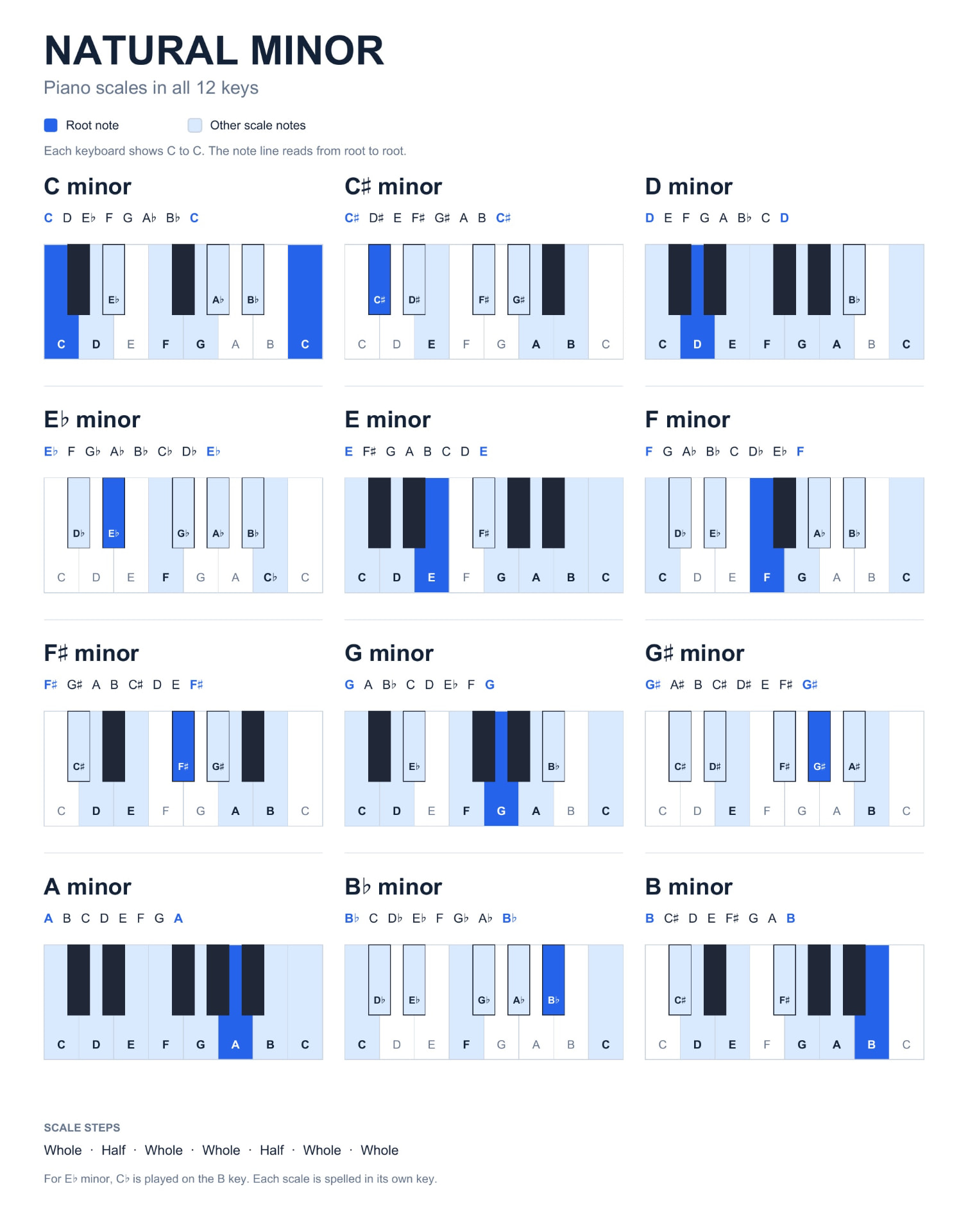
Download the full-size 12-key natural minor piano chart (JPEG)
Chart: Robert Anthony / Sampled. The chart shows which keys belong to each scale, not finger numbers or octave-specific hand positions.
What are the notes in all 12 natural minor scales?
Here are the same scales written from root to root. The final note repeats the first one an octave higher.
| Natural minor scale | Ascending notes | Relative major |
|---|---|---|
| C minor | C – D – E♭ – F – G – A♭ – B♭ – C | E♭ major |
| C♯ minor | C♯ – D♯ – E – F♯ – G♯ – A – B – C♯ | E major |
| D minor | D – E – F – G – A – B♭ – C – D | F major |
| E♭ minor | E♭ – F – G♭ – A♭ – B♭ – C♭ – D♭ – E♭ | G♭ major |
| E minor | E – F♯ – G – A – B – C – D – E | G major |
| F minor | F – G – A♭ – B♭ – C – D♭ – E♭ – F | A♭ major |
| F♯ minor | F♯ – G♯ – A – B – C♯ – D – E – F♯ | A major |
| G minor | G – A – B♭ – C – D – E♭ – F – G | B♭ major |
| G♯ minor | G♯ – A♯ – B – C♯ – D♯ – E – F♯ – G♯ | B major |
| A minor | A – B – C – D – E – F – G – A | C major |
| B♭ minor | B♭ – C – D♭ – E♭ – F – G♭ – A♭ – B♭ | D♭ major |
| B minor | B – C♯ – D – E – F♯ – G – A – B | D major |
Why does E♭ minor contain C♭? On a standard piano, C♭ is played on the same key as B. We spell it C♭ because a seven-note scale uses each letter name once. Writing B instead would give this scale two B notes and no C. The chart correctly labels that white key C♭.
C♯ and D♭ also share a piano key, as do D♯ and E♭. These are enharmonic equivalents: different spellings for the same pitch on the standard equal-tempered keyboard. Follow the spelling of the scale you are learning.
How can you build a minor scale without the chart?
Try D natural minor using the step pattern:
- Start on D.
- Move a whole step to E.
- Move a half step to F.
- Move a whole step to G.
- Move a whole step to A.
- Move a half step to B♭.
- Move a whole step to C.
- Move a whole step back to D, one octave higher.
The result is D–E–F–G–A–B♭–C–D. Check it against the chart, then try E minor. This turns the picture into a reference you understand rather than a pattern you copy blindly.
How does a relative major help you learn minor keys?
A natural minor scale and its relative major contain the same notes and share a key signature. A minor and C major both use the white keys; C minor and E♭ major both use three flats.
Find the relative major by moving three half steps above the minor root. From A, that takes you to C. From E, it takes you to G.
The notes are shared, but the musical center changes. Play the white keys over a sustained A and resolve phrases to A; then play them over a sustained C and resolve to C. You are hearing how context makes the same note collection function differently.
Do not confuse relative major with parallel major: A minor and A major share a root but have different notes. See musictheory.net’s minor-scale lesson (opens in a new tab) for the relationship between the scale forms.
How should you practice without getting overwhelmed?
Use this suggested ten-minute routine, not a speed test:
- Two minutes: find the roots. Choose a key and locate its root in three different octaves. Say the note name.
- Three minutes: one octave, separate hands. Begin at a comfortable tempo, such as 60 BPM with one note per click. Ascend and descend evenly. Slow down if the crossing causes a pause.
- Two minutes: smaller groups. Play degrees 1–2–3, then 2–3–4, then 3–4–5. This helps break the habit of only playing long scale runs.
- Three minutes: make a phrase. Use three or four notes, repeat a rhythm, and finish on the root. Leave space between phrases.
Begin with A minor, then add E minor and D minor, each of which introduces one black key. After that, select another key from the chart. There is no need to rush through all twelve in one sitting.
When you move to a new scale, identify its black keys before playing. Work out a comfortable scale-specific fingering with a teacher or a reliable fingering reference; copying A minor’s numbers into every key will create awkward crossings.
How do you turn natural minor into a melody or chord progression?
In A minor, try a simple left-hand loop:
Am – F – C – G
The chord notes are A–C–E, F–A–C, C–E–G, and G–B–D. Every note belongs to A natural minor. Play each chord slowly, or record the loop, then create a right-hand melody with A, C, D and E before introducing the rest of the scale.
Aim for a chord tone at the beginning or end of a phrase. Hold a note, repeat a short idea, or answer one phrase with another. A recognizable rhythm often does more for a melody than adding extra notes.
To hear the same idea in C minor, transpose the loop to Cm–A♭–E♭–B♭ and use the C minor row of the chart. This is a practical reason to learn more than the all-white-key scale: you can move a musical idea into a register or key that suits a singer or instrument.
How is natural minor different from harmonic and melodic minor?
These names describe different minor-scale forms, not interchangeable note lists.
- A natural minor: A–B–C–D–E–F–G–A.
- A harmonic minor: A–B–C–D–E–F–G♯–A. The seventh degree is raised.
- A melodic minor, classical ascending form: A–B–C–D–E–F♯–G♯–A. The sixth and seventh are raised; the conventional classical descending form returns to natural minor. Jazz usage often keeps the raised form in both directions.
That raised G♯ helps explain why an E major or E7 chord can appear in music centered on A minor even though G♯ is not in the natural minor chart. Minor-key music is not restricted to one unchanged seven-note collection throughout an entire song.
Can guitar players use this piano chart too?
Yes. The note relationships stay the same; only the instrument’s layout changes. A piano makes the half steps visible, while a guitar places each half step one fret away along a string.
Compare this chart with our lessons on A minor on guitar, B minor on guitar, C minor on guitar, and E minor on guitar. Each includes a scale diagram and practice ideas. Our guitar tabs resource guide is useful when you want to follow the notes into songs.
Frequently asked questions
Is A minor the easiest natural minor scale on piano?
It is an accessible starting point because it uses no sharps or flats. The keyboard pattern is easy to see, but smooth playing still requires even timing and comfortable finger crossings.
Are all minor scales played only on black keys?
No. A natural minor uses only white keys, and the other natural minor scales combine white and black keys. A key’s position or color does not by itself determine whether a scale is major or minor.
Does the chart show piano fingering?
No. Dark blue identifies roots and light blue identifies other scale tones. The printed letters identify notes. Use the A minor exercise above for your first one-octave fingering, then learn fingering appropriate to each new scale.
Do you play the same notes coming down?
For natural minor, yes: reverse the ascending note order. The classical melodic-minor ascending/descending distinction does not apply to this chart.
What should you learn after the notes?
Learn the chords built from the scale, play short melodies over a minor chord, and transpose one small phrase into another key. The goal is to recognize and use the sound—not simply recite twelve lists.
Explore major scales next
Compare this lesson with our major scales piano guide and downloadable 12-key chart, with C-major fingering, all twelve note sequences and practice ideas.