 SAMPLED
How Do You Play the C Minor Scale on Guitar? Notes, Tab and Practice Guide
Learn the C natural minor scale on guitar with an eighth-fret tab, the seven notes, practical fingering, and exercises that turn a scale shape into music.

The C natural minor scale gives you seven notes to build melodies, riffs and solos: C, D, E♭, F, G, A♭ and B♭. On a standard-tuned guitar, a useful place to begin is fret 8 on the low E string. That note is C, your starting point and the sound you will return to as you practice.
This lesson walks through the supplied guitar tab, explains the notes underneath the fret numbers, and gives you a manageable practice routine. You do not need to memorize the entire neck first. Learn a short section accurately, connect it to the next string, and then make something musical with it.
What are the notes in the C minor scale?
When a lesson says “C minor scale” without naming a different form, check which version it means. This lesson teaches C natural minor, also called C Aeolian—not C harmonic minor or C melodic minor.
| Scale degree | Note | Interval above C |
|---|---|---|
| 1 | C | Root |
| 2 | D | Major second |
| ♭3 | E♭ | Minor third |
| 4 | F | Perfect fourth |
| 5 | G | Perfect fifth |
| ♭6 | A♭ | Minor sixth |
| ♭7 | B♭ | Minor seventh |
Its interval formula is 1–2–♭3–4–5–♭6–♭7. Compared with C major, the third, sixth and seventh are lowered: E becomes E♭, A becomes A♭, and B becomes B♭.
The step pattern between consecutive notes, including the return to C, is whole–half–whole–whole–half–whole–whole. On one guitar string, a whole step is two frets and a half step is one fret. That is why C to D spans two frets, but D to E♭ spans only one.
E♭ major is the relative major of C minor. Both use the same seven notes; the distinction is which note and chord feel like home. Simply starting a run on C does not establish a key by itself—your phrasing, bass notes and harmony help establish C as the center.
How do you read this guitar tab?
Tune your guitar to E–A–D–G–B–E, from the thickest, lowest-pitched string to the thinnest, highest-pitched string.
Guitar tab has six lines. The bottom line represents the low E string; the top line represents the high E string. A number tells you which fret to press on that string, not which finger to use. Read the example from left to right, playing one note at a time. There are no stacked chord shapes in this ascending run.
Fret 8 means press the string just behind the eighth fret wire, toward the headstock. Use only enough pressure to make the note clear. If it buzzes, check finger placement before squeezing harder.
How do you play the eighth-fret C minor pattern?
The diagram below begins on low E, fret 8, and moves across all six strings. It contains two full octaves from C to C, followed by D and E♭. If you want to finish on the root, stop at high E, fret 8; the final two notes extend the pattern beyond that C.
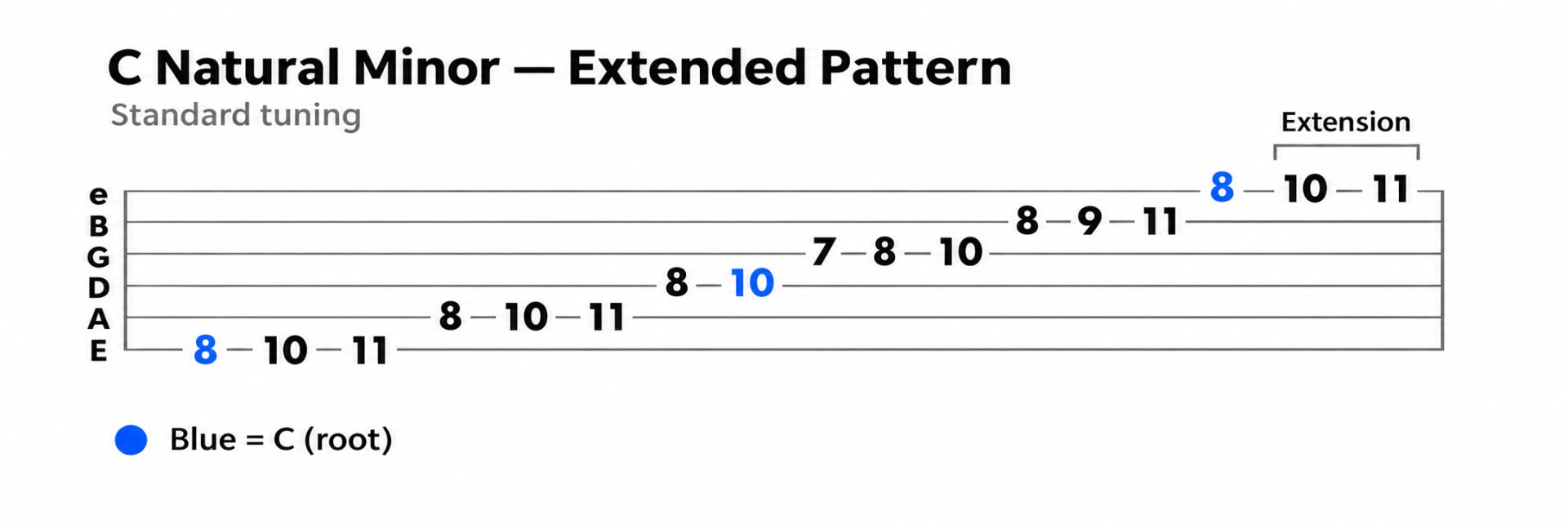
Download the full-size C minor guitar tab (JPEG)
Diagram: Robert Anthony / Sampled. Guitar tab supplied for this lesson.
Which notes do the fret numbers produce?
Play the rows in this order, from the low E string upward. Within each row, play the frets left to right.
| String | Frets | Notes in order |
|---|---|---|
| Low E, sixth string | 8–10–11 | C–D–E♭ |
| A, fifth string | 8–10–11 | F–G–A♭ |
| D, fourth string | 8–10 | B♭–C |
| G, third string | 7–8–10 | D–E♭–F |
| B, second string | 8–9–11 | G–A♭–B♭ |
| High E, first string | 8–10–11 | C–D–E♭ |
Your C notes are low E fret 8, D string fret 10, and high E fret 8. Find these three landmarks before trying to play the whole run quickly. They make it easier to hear the root and recover if you lose your place.
Which fingers should you use?
Use this as a starting suggestion, not a rigid rule. Finger 1 is your index, 2 your middle, 3 your ring, and 4 your little finger.
- Low E, frets 8–10–11: index–ring–little.
- A, frets 8–10–11: index–ring–little.
- D, frets 8–10: index–ring.
- G, frets 7–8–10: index–middle–little, with a small hand adjustment toward fret 7.
- B, frets 8–9–11: index–middle–little, returning toward fret 8.
- High E, frets 8–10–11: index–ring–little.
The seventh-fret note on the G string means this is not a completely fixed one-finger-per-fret box. Let the hand move slightly rather than forcing a painful stretch. Keep your wrist comfortable and stop if playing hurts.
To descend, reverse the entire note order: start on high E fret 11, play 10 and 8, then B string 11, 9 and 8, and continue backward through the table. Finish on low E fret 8.
What is the easiest way to practice it?
1. Learn one octave first
Play low E 8–10–11, A 8–10–11, D 8–10. That gives you C–D–E♭–F–G–A♭–B♭–C, one complete octave. Say the note names while you play, then reverse the sequence.
Practice this short section until each note is clean. Adding more strings before you know the first octave can turn a useful exercise into a memorization scramble.
2. Add the upper strings slowly
Connect D string fret 10 to G string fret 7. Work on that change in isolation, then add the B and high E strings. Pay attention to the B string’s 8–9–11 spacing: copying the low E string’s 8–10–11 spacing there would introduce a note outside this scale.
3. Use a metronome without chasing speed
Try 60 beats per minute, one note per click. If that is too fast, lower it. Aim for an even sound, clean string changes and a relaxed hand before increasing the tempo. Alternate picking—down, up, down, up—is one useful approach, although fingerstyle works too.
Mute strings you are not playing so they do not ring over the exercise. It is better to play eight controlled notes than a fast run full of accidental open strings.
4. Make a phrase instead of another scale run
Try these note groups:
- C–E♭–G–E♭–C: outlines the C minor triad.
- G–A♭–G–F–E♭–C: lets you hear the half step between G and A♭.
- C–D–E♭, rest, G–F–E♭–C: adds space and a clear return home.
Use the fret table to find each note. Change the rhythm, repeat a short idea, and leave a pause. The goal is to recognize the sound of the notes, not just the shape of your fingers.
Which chords can you practice over?
Begin with a C minor chord or a C drone. A drone is simply a sustained C note; it helps you hear how the scale tones relate to the root without needing a complex backing track.
Then try Cm–A♭–B♭–Cm. All three chords use notes from C natural minor. Listen to which notes sound settled over each chord: C–E♭–G over Cm, A♭–C–E♭ over A♭, and B♭–D–F over B♭.
Do not assume every song described as “in C minor” uses only these seven notes. A common example is G major or G7, which contains B natural, the raised seventh associated with C harmonic minor. When the harmony changes, listen to the chord rather than forcing the same scale indiscriminately over everything.
How is C minor different from C minor pentatonic?
C minor pentatonic contains C–E♭–F–G–B♭. C natural minor adds D and A♭ to those five notes.
If you already know a C minor pentatonic shape, locate those two extra notes within it. D provides a step between C and E♭; A♭ introduces the half step above G. Practice their sound over a C minor chord rather than treating them as extra frets to fill every phrase.
For comparison, C harmonic minor is C–D–E♭–F–G–A♭–B. In the traditional classical form, C melodic minor ascends C–D–E♭–F–G–A–B and descends with the natural-minor notes; in jazz, “melodic minor” commonly refers to the raised-sixth-and-seventh collection used in both directions. These are different sounds, not corrections to the supplied diagram.
What mistakes should you avoid?
- Reading the tab upside down. Begin on the bottom line, low E, fret 8—not on the top string.
- Using the same spacing on every string. The B string has 8–9–11, while the G string begins at fret 7.
- Confusing scale notes with finger numbers. The diagram labels frets; choose comfortable fingers separately.
- Finishing every exercise on E♭. The supplied shape ends there, but practice resolving to C so you can hear the tonic.
- Practicing only ascending runs. Descend, skip between chord tones and make short phrases too.
- Letting a scale replace listening. Notes, rhythm, chord changes and silence work together.
A ten-minute C minor practice routine
- Two minutes: find the three C root notes and name the seven scale notes.
- Three minutes: play the one-octave low-string pattern up and down slowly.
- Two minutes: connect the upper strings, focusing on the G-to-B string change.
- Three minutes: improvise a short phrase over Cm or a C drone, leaving space and returning to C.
Record a short take and listen back for timing and unwanted string noise. You can practice on electric or acoustic guitar; a clear sound is more useful initially than heavy effects. If you are putting together a setup, our beginner guitar pedal guide explains the essentials, and our Enya NOVA GO SP1 review looks at a compact guitar option. For unfamiliar production vocabulary, explore the music production glossary.
Frequently asked questions
Where do you start C minor on guitar?
For the pattern in this lesson, start at fret 8 on the low E string. That is C in standard tuning. Other valid positions exist elsewhere on the fretboard.
Does C minor use three flats?
C natural minor uses E♭, A♭ and B♭. Its key signature has three flats, shared with E♭ major.
Is this tab two octaves?
It covers two octaves from low E fret 8 to high E fret 8, then adds D and E♭ at high E frets 10 and 11. Stop at high E fret 8 for a two-octave run that finishes on C.
Can beginners learn this shape?
Yes. Start with the one-octave version on the low E, A and D strings. Add the remaining strings once that smaller section feels controlled.