 SAMPLED
How Do You Play the B Minor Scale on Guitar? Extended Pattern Tab and Practice Guide
Learn the B natural minor scale on guitar with a seventh-fret extended pattern, the seven notes, fingering tips, and exercises that turn the shape into riffs and solos.

The B natural minor scale is one of the most useful scales on the guitar. It has seven notes: B, C♯, D, E, F♯, G and A. It's the key of countless rock, metal, R&B and film-score moments, and it sits comfortably in the middle of the neck where your fingers don't have to stretch far.
This lesson uses an extended pattern that starts on the 7th fret of the low E string and climbs all six strings, then adds two extra notes on the high E string. By the end, you'll know the notes, the fingering, and a few ways to make the shape sound like music instead of an exercise.
What notes are in the B minor scale?
This lesson teaches B natural minor, also called B Aeolian. It's the relative minor of D major, so it uses the same notes as D major, just centered on B.
| Scale degree | Note | Interval above B |
|---|---|---|
| 1 | B | Root |
| 2 | C♯ | Major second |
| ♭3 | D | Minor third |
| 4 | E | Perfect fourth |
| 5 | F♯ | Perfect fifth |
| ♭6 | G | Minor sixth |
| ♭7 | A | Minor seventh |
The formula is 1–2–♭3–4–5–♭6–♭7. The step pattern is whole–half–whole–whole–half–whole–whole. On a single string, a whole step is two frets and a half step is one fret.
Where do you put your hand?
Place your index finger around the 7th fret and let each finger cover one fret: index on 7, middle on 8, ring on 9, pinky on 10. Keep your thumb behind the neck, roughly behind your middle finger. That one-finger-per-fret position covers almost the whole pattern without moving your hand.
The only exception is the 6th fret on the G string. Reach back with your index finger for that note, then return to position.
Before playing, find the root notes. The 7th fret on the low E string, the 9th fret on the D string, and the 7th fret on the high E string are all B. Play those three alone first so you can hear "home."
How do you read the B minor extended pattern tab?
Play each string from left to right, low to high:
- Low E: 7 – 9 – 10
- A: 7 – 9 – 10
- D: 7 – 9
- G: 6 – 7 – 9
- B: 7 – 8 – 10
- High E: 7, then the extension 9 – 10
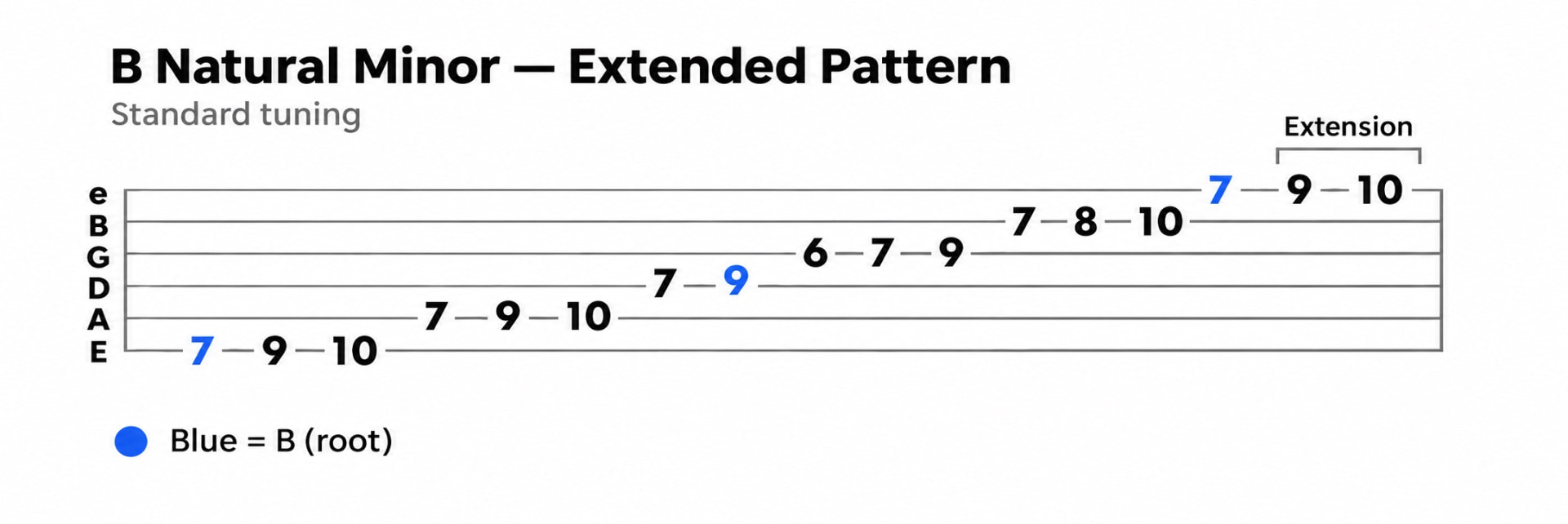
Download the full-size B minor guitar tab (JPEG)
Diagram: Robert Anthony / Sampled. Blue numbers mark the root note, B.
Which notes do the fret numbers produce?
| String | Frets | Notes |
|---|---|---|
| Low E | 7 – 9 – 10 | B – C♯ – D |
| A | 7 – 9 – 10 | E – F♯ – G |
| D | 7 – 9 | A – B |
| G | 6 – 7 – 9 | C♯ – D – E |
| B | 7 – 8 – 10 | F♯ – G – A |
| High E | 7 – 9 – 10 | B – C♯ – D |
That gives you two full octaves, from the low B to the high B, plus C♯ and D on top.
What does the extension do?
The 9th and 10th frets on the high E string carry the scale past the top B to C♯ and D. That extra reach matters in solos. Landing on the D, the minor third, makes a phrase sound unmistakably minor, and it gives you room to bend or slide at the top of a lick instead of running out of notes.
Use your ring finger on 9 and pinky on 10, or slide your index finger up from 7 if you want a smoother, vocal-style move.
How should you practice the B minor scale?
Use a metronome and start slower than you think you need. Clean notes at 60 BPM beat sloppy notes at 120.
- Ascend and descend. Play the whole pattern up and back down as quarter notes at 60–70 BPM. Raise the tempo by 5 BPM only when it's clean three times in a row.
- Root-to-root. Play from the low B (E string, 7th fret) to the middle B (D string, 9th fret) and stop. Then from the middle B to the high B. Short sections build accuracy faster.
- Groups of three. Play notes 1-2-3, 2-3-4, 3-4-5 and so on through the pattern. This breaks the "straight up and down" habit and sounds more like real melodies.
- Alternate picking. Strictly down-up through the entire pattern. Watch the string changes, where most mistakes happen.
- Drone practice. Play along with a B note or a B minor chord drone. You'll start to hear how each note feels against the root.
How do you make the B minor scale sound musical?
Scales become music when you stop playing every note in order.
- Target the roots. End your phrases on any blue B in the tab. Your ear hears that as a resolution.
- Lean on D and F♯. Together with B, those notes form the B minor chord. Landing on them always sounds "right."
- Try a classic progression. Loop Bm – G – A or Bm – Em – F♯m and improvise over it using only this pattern.
- Use the extension for climaxes. Save the high C♯ and D for the peak of a solo.
If you'd rather produce than shred, record a short Bm loop in your DAW and practice soloing over it. Our guide to tuning kick and snare drums by frequency shows how to match drums to the key of B, too.
How is B minor related to other keys?
- Relative major: D major uses the same seven notes, so this pattern works over D major songs if you treat D as home.
- Parallel major: B major shares the root but raises the 3rd, 6th and 7th (D♯, G♯, A♯).
- Harmonic minor: Raise the A to A♯ for a darker, classical or metal sound.
Want another minor key? Our lesson on how to play the C minor scale on guitar uses a similar shape one fret higher.
FAQ
Is B minor the same as B natural minor? When people say "B minor scale," they usually mean B natural minor: B, C♯, D, E, F♯, G, A. Harmonic and melodic minor are variations.
Can I move this pattern to other keys? Yes. Slide the whole shape so the low-E root lands on a new fret. Start on the 5th fret for A minor or the 8th fret for C minor.
What chords fit B minor? The main chords in B natural minor are Bm, C♯dim, D, Em, F♯m, G and A.
How long does it take to learn? Most players can memorize the pattern in a few practice sessions. Playing it smoothly and musically takes a few weeks of short daily practice.