 SAMPLED
How Do You Play the E Minor Scale on Guitar? Extended Pattern Tab and Practice Guide
Learn the E natural minor scale on guitar with a 12th-fret extended pattern, the seven notes, fingering tips, open-position shortcuts, and exercises for riffs and solos.

The E minor scale might be the most "guitar" key there is. The lowest and highest strings on a standard-tuned guitar are both E, so E minor riffs ring out with huge, open sound. Its seven notes are E, F♯, G, A, B, C and D, with just one sharp.
This lesson uses an extended pattern at the 12th fret, where the whole neck starts over an octave higher. It climbs all six strings and adds two extra notes on top. You'll learn the notes, the fingering, and how to turn the shape into riffs and solos.
What notes are in the E minor scale?
This lesson teaches E natural minor, also called E Aeolian. It's the relative minor of G major, so it uses the same notes as G major, centered on E.
| Scale degree | Note | Interval above E |
|---|---|---|
| 1 | E | Root |
| 2 | F♯ | Major second |
| ♭3 | G | Minor third |
| 4 | A | Perfect fourth |
| 5 | B | Perfect fifth |
| ♭6 | C | Minor sixth |
| ♭7 | D | Minor seventh |
The formula is 1–2–♭3–4–5–♭6–♭7, and the step pattern is whole–half–whole–whole–half–whole–whole. On one string, a whole step is two frets and a half step is one.
Where do you put your hand?
Put your index finger at the 12th fret, usually marked with a double dot. Give each finger a fret: index on 12, middle on 13, ring on 14, pinky on 15. Frets are closer together up here, so the stretches feel easier than lower on the neck.
The one reach is the 11th fret on the G string. Stretch back with your index finger, then return to 12.
Find the roots first. The 12th fret on the low E string, the 14th fret on the D string, and the 12th fret on the high E string are all E. Play those three to hear "home."
On an acoustic guitar without a cutaway, the 14th and 15th frets can be hard to reach. If that's you, use the open-position version below.
How do you read the E minor extended pattern tab?
Play each string from left to right, low to high:
- Low E: 12 – 14 – 15
- A: 12 – 14 – 15
- D: 12 – 14
- G: 11 – 12 – 14
- B: 12 – 13 – 15
- High E: 12, then the extension 14 – 15
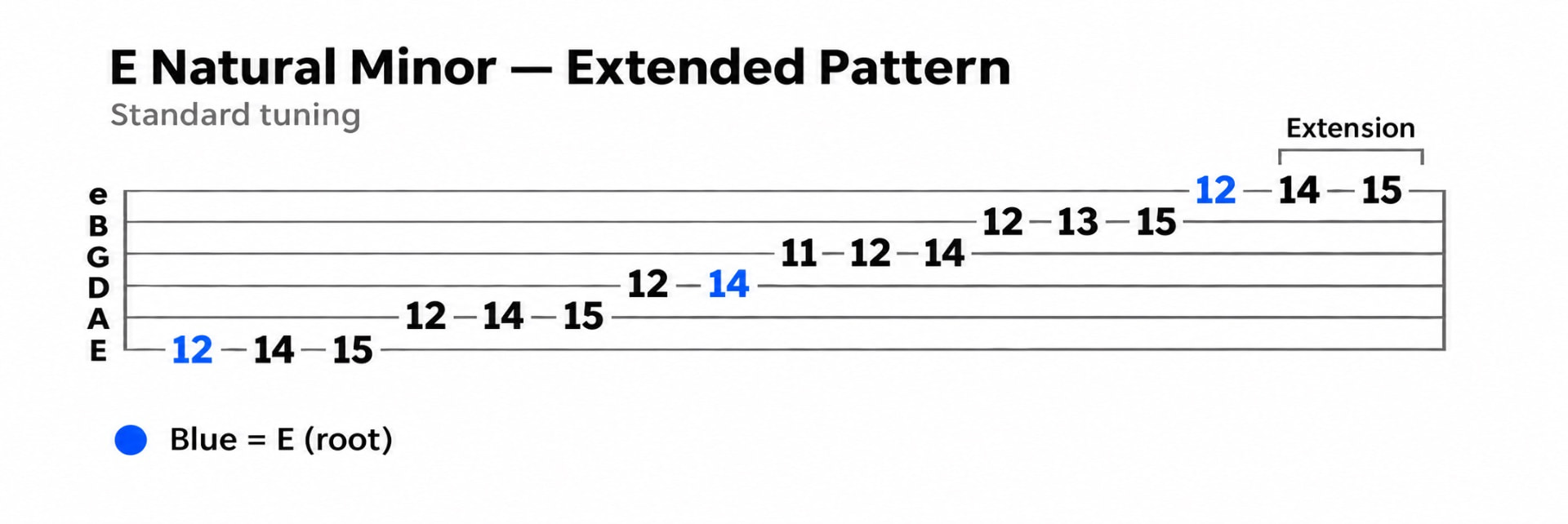
Download the full-size E minor guitar tab (JPEG)
Diagram: Robert Anthony / Sampled. Blue numbers mark the root note, E.
Which notes do the fret numbers produce?
| String | Frets | Notes |
|---|---|---|
| Low E | 12 – 14 – 15 | E – F♯ – G |
| A | 12 – 14 – 15 | A – B – C |
| D | 12 – 14 | D – E |
| G | 11 – 12 – 14 | F♯ – G – A |
| B | 12 – 13 – 15 | B – C – D |
| High E | 12 – 14 – 15 | E – F♯ – G |
That's two full octaves from E to E, plus F♯ and G on top.
Can you play E minor in open position?
Yes, and it's a great shortcut. Because the 12th fret is an octave above the open strings, subtract 12 from every number and you get the same shape at the nut. Open strings replace the 12s:
- Low E: 0 – 2 – 3
- A: 0 – 2 – 3
- D: 0 – 2
- G: 0 – 2 (the 11th fret has no open equivalent, so F♯ moves to the D string's 4th fret if you want it)
- B: 0 – 1 – 3
- High E: 0 – 2 – 3
Open strings let notes ring together, which is why so many acoustic and metal riffs live in E minor.
What does the extension do?
The 14th and 15th frets on the high E string carry the scale past the top E to F♯ and G. That high G is the minor third, the note that makes a phrase sound unmistakably minor. It's perfect for bends and climaxes at the end of a solo.
How should you practice the E minor scale?
- Up and down. Play the full pattern in quarter notes at 60–70 BPM. Go 5 BPM faster only after three clean runs.
- Root to root. Play low E to middle E (D string, 14th fret), then middle E to high E.
- Groups of three. Play notes 1-2-3, 2-3-4, 3-4-5 through the pattern for a more melodic feel.
- Alternate picking. Strict down-up strokes, paying attention to string changes.
- Drone practice. Let the open low E string ring and play the scale over it. It's a built-in drone on every guitar.
How do you make the E minor scale sound musical?
- End on the roots. Finish phrases on any blue E for resolution.
- Lean on G and B. With E, they form the E minor chord.
- Jam over a classic loop. Try Em – C – D or Em – Am – Bm and improvise with this pattern.
- Pedal-point riffs. Alternate the open low E with notes from the scale on the A and D strings, a staple of rock and metal.
How is E minor related to other keys?
- Relative major: G major uses the same notes, so this pattern works over G major songs with G as home.
- Parallel major: E major shares the root but raises the 3rd, 6th and 7th (G♯, C♯, D♯).
- Harmonic minor: Raise D to D♯ for a dramatic, classical or metal sound.
It's the same shape as our other minor-scale lessons, just moved. Try A minor at the 5th fret, B minor at the 7th, or C minor at the 8th.
FAQ
Why is E minor so popular on guitar? Both outer strings are E, so the open low E works as a ringing root, and many E minor notes can be played as open strings.
Is E minor the same as E natural minor? Usually. "E minor scale" typically means E natural minor: E, F♯, G, A, B, C, D.
What chords fit E minor? The main chords in E natural minor are Em, F♯dim, G, Am, Bm, C and D.
Can I move this pattern? Yes. Wherever the low-E root lands, that's your key: the 5th fret is A minor, the 7th is B minor, and the 8th is C minor.