 SAMPLED
How Do You Play Major Scales on Piano in All 12 Keys?
Learn all 12 major piano scales with our downloadable chart, C-major fingering, note names, chord ideas and a practical ten-minute routine.
A major scale is more than a warm-up. Its seven notes give you a map for melodies, chords and key signatures—and one repeating step pattern lets you find that map anywhere on the piano.
Start with C major, where every note is a white key. Then use our downloadable chart to explore all twelve keys. You will learn how to read the diagrams, where your fingers go in a first one-octave exercise, and how to turn the notes into something musical.
What is the major-scale pattern?
Every major scale follows the same ascending pattern:
Whole – Whole – Half – Whole – Whole – Whole – Half
A half step means moving to the immediately adjacent piano key, including black keys. A whole step is two half steps. E–F and B–C are half steps even though both keys are white.
A major scale contains seven different notes. When you finish an octave, the eighth note is the root again, higher up. The half steps fall between degrees 3–4 and 7–8; the other adjacent degrees are whole steps.
In C major, that looks like this:
C – D – E – F – G – A – B – C
Notice E–F and B–C. Those two half steps are already in the right places, so C major needs no sharps or flats. Baylor University’s Piano Basics lesson on tetrachords (opens in a new tab) explains how two whole–whole–half groups, separated by a whole step, form a major scale.
How do you play C major on piano?
Find C: it is the white key immediately to the left of a group of two black keys. Choose an octave that feels comfortable, and play C–D–E–F–G–A–B–C slowly with one hand.
For the following one-octave, hands-separate exercise, finger numbers mean 1 = thumb, 2 = index, 3 = middle, 4 = ring, 5 = little finger on either hand.
| Ascending note | C | D | E | F | G | A | B | C |
|---|---|---|---|---|---|---|---|---|
| Right hand | 1 | 2 | 3 | 1 | 2 | 3 | 4 | 5 |
| Left hand | 5 | 4 | 3 | 2 | 1 | 3 | 2 | 1 |
Right hand: play C, D and E with fingers 1, 2 and 3. Move the thumb under to F, then continue with 2, 3, 4 and 5. Coming down, reverse the sequence; the third finger crosses over the thumb from F to E.
Left hand: begin with finger 5 on the lower C. After the thumb plays G, cross finger 3 over to A, then finish B and C with 2 and 1. Reverse the movement on the way down.
Keep your hand relaxed and let your arm move with the phrase rather than locking your wrist. If a crossing makes you tense, slow down and practice only the three or four notes around it.
This fingering is for C major over one octave. It is not a universal fingering for every key, and continuous two-octave playing needs a different finger at the octave boundary. Learn each new scale’s fingering separately, especially scales that start on a black key. Baylor’s one-octave major scales lesson (opens in a new tab) is a useful companion for the finger crossings.
How do you read our major-scale piano chart?
The chart marks the root in dark blue and the other scale notes in light blue. Each small keyboard shows the same C-to-C window, not a scale beginning at its own root. The note line above each keyboard gives the ascending order from root to root.
For D major, start on D on your actual piano and play D–E–F♯–G–A–B–C♯–D, continuing into the next octave when necessary. Do not simply play the highlighted keys from the diagram’s left edge: that would begin on C♯, not D.
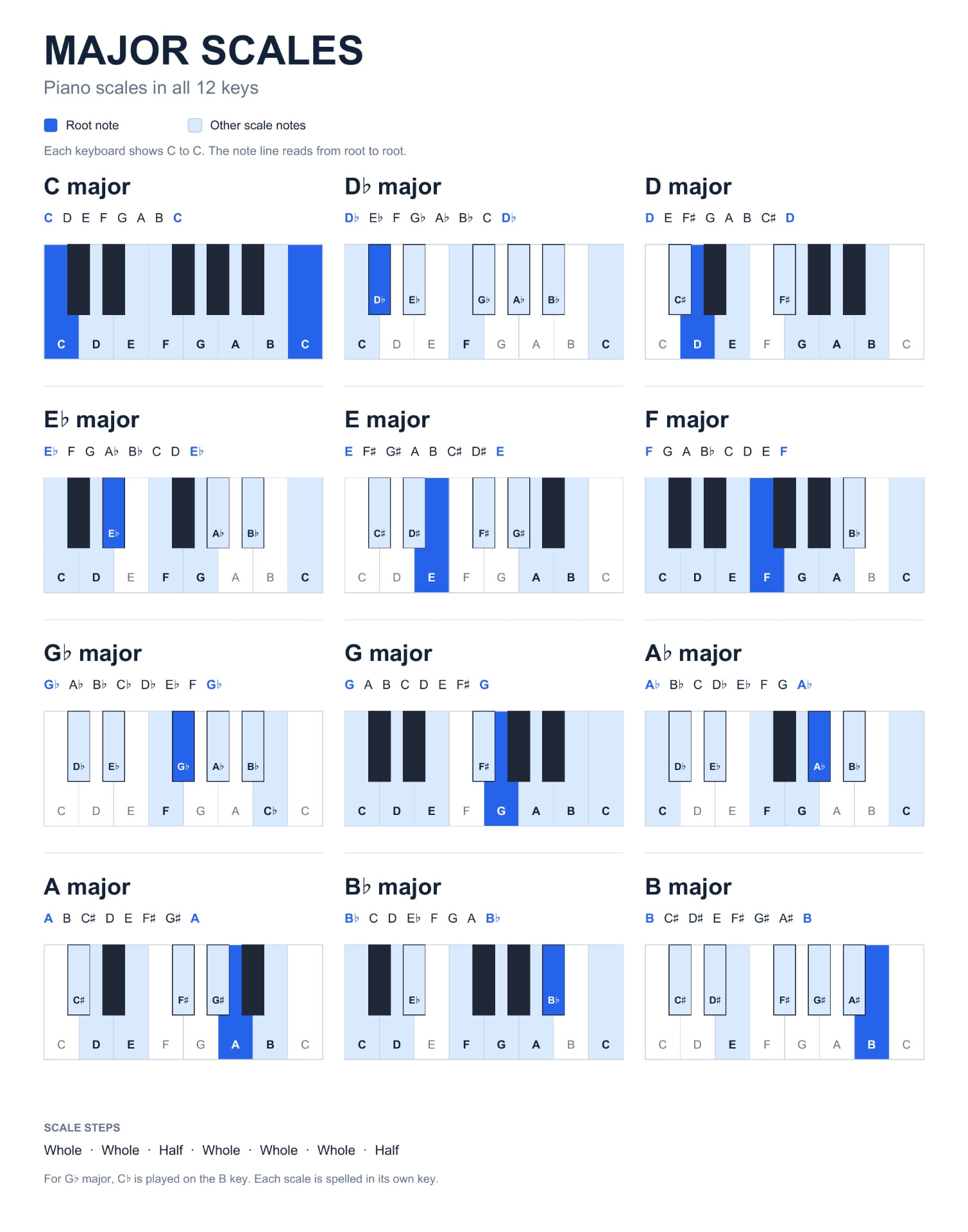
Download the full-size major scales piano chart (JPEG)
Chart: Robert Anthony / Sampled. The diagrams show scale notes, not fingering or the physical span of an ascending octave.
What are the notes in all 12 major scales?
These spellings match the chart. Each scale uses every letter name once before the root repeats. Its relative minor uses the same key signature and begins on the major scale’s sixth degree.
| Major scale | Ascending notes | Relative minor |
|---|---|---|
| C major | C – D – E – F – G – A – B – C | A minor |
| D♭ major | D♭ – E♭ – F – G♭ – A♭ – B♭ – C – D♭ | B♭ minor |
| D major | D – E – F♯ – G – A – B – C♯ – D | B minor |
| E♭ major | E♭ – F – G – A♭ – B♭ – C – D – E♭ | C minor |
| E major | E – F♯ – G♯ – A – B – C♯ – D♯ – E | C♯ minor |
| F major | F – G – A – B♭ – C – D – E – F | D minor |
| G♭ major | G♭ – A♭ – B♭ – C♭ – D♭ – E♭ – F – G♭ | E♭ minor |
| G major | G – A – B – C – D – E – F♯ – G | E minor |
| A♭ major | A♭ – B♭ – C – D♭ – E♭ – F – G – A♭ | F minor |
| A major | A – B – C♯ – D – E – F♯ – G♯ – A | F♯ minor |
| B♭ major | B♭ – C – D – E♭ – F – G – A – B♭ | G minor |
| B major | B – C♯ – D♯ – E – F♯ – G♯ – A♯ – B | G♯ minor |
Why does G♭ major contain C♭ instead of B?
On a standard equal-tempered piano, C♭ is played on the same key as B. We write C♭ in G♭ major because a correctly spelled seven-note scale uses the letters G, A, B, C, D, E and F once each. Calling both its B♭ and C♭ notes versions of B would hide that structure.
The chart chooses one spelling for each of the twelve pitch classes. Other major-key spellings also exist: F♯ major uses the same piano keys as G♭ major, but its notes are F♯–G♯–A♯–B–C♯–D♯–E♯–F♯. E♯ is the key normally called F. These are enharmonic spellings, not extra physical keys.
Which major scales should you learn first?
Try C, G and F as your first three. C uses no altered notes, G adds F♯, and F introduces B♭. This lets you hear the same scale structure while noticing how the keyboard layout changes.
Then explore D and B♭, followed by the remaining keys. You do not have to finish all twelve in one sitting. A useful milestone is being able to find the root, name the notes, play evenly in both directions, and make a short phrase before moving on.
Watch out for F major: its conventional right-hand one-octave fingering differs from C major. Do not transplant the C-major table into every new scale just because the number of notes is the same.
How do you practice major scales without just running up and down?
Use this ten-minute routine as a starting point, not a speed test:
- Two minutes: find and name the notes. Pick one key. Say the ascending sequence and locate the half steps between 3–4 and 7–8.
- Three minutes: play each hand separately. Use a slow, comfortable pulse. Aim for even timing and volume, especially around finger crossings.
- Two minutes: play a short motif. Try degrees 1–2–3–5–3–2–1. In C, that is C–D–E–G–E–D–C. Leave a little silence between repetitions.
- Two minutes: put a chord under it. Play or hold a C-major chord—C–E–G—with the left hand and use a few scale notes in the right. Start and finish on C to make the root clear.
- One minute: transpose the motif. Move the same degrees to G major: G–A–B–D–B–A–G. You have transferred a musical idea, not just a hand shape.
Only combine hands after each hand feels comfortable on its own. A metronome can help expose uneven notes, but choose a pace that lets you stay loose. Faster practice is not better if the crossings become rushed.
How do major scales help you build chords?
Build a triad by taking a scale note, skipping one, taking the next, skipping one again, and taking the next. In C major, starting on C gives C–E–G. Starting on D gives D–F–A.
The triads built from a major scale follow this quality pattern:
Major – Minor – Minor – Major – Major – Minor – Diminished
For C major, those are C, Dm, Em, F, G, Am and B diminished. A first chord loop to explore is C–F–G–C, the I–IV–V–I chords. Play a simple scale melody over the loop and listen to how a note feels against each chord. Belonging to the scale does not make every note equally settled over every chord.
What is the difference between major and natural minor?
Compare C major with A natural minor. They share the same white keys, but C and A act as different tonal centers. Starting and ending a phrase on a different note is a useful demonstration; harmony and phrasing help establish that new center in actual music.
Now compare scales on the same root: C major is C–D–E–F–G–A–B, while C natural minor is C–D–E♭–F–G–A♭–B♭. Natural minor lowers the third, sixth and seventh degrees relative to major. The Open University’s explanation of relative keys (opens in a new tab) provides more background.
Our natural minor piano lesson with a downloadable 12-key chart lets you compare those patterns directly. For another instrument, explore our A minor, B minor, C minor and E minor guitar lessons.
Frequently asked questions
Is C major the easiest piano scale?
It is a clear starting point because it uses only white keys and makes the whole-step/half-step pattern easy to see. That does not mean it is automatically the most comfortable scale for every hand; even playing and relaxed crossings still take practice.
Does every major scale have the same fingering?
No. They share the interval pattern, but black-key positions and starting notes affect fingering. The C-major table above is specifically a one-octave exercise.
Are there twelve or fifteen major keys?
There are twelve distinct starting pitches on an equal-tempered piano. The conventional key-signature system has fifteen major-key spellings, from seven flats through seven sharps; enharmonic pairs share piano keys. This chart presents twelve scales using one spelling per starting pitch.
Do major scales change when you play them descending?
No. Reverse the same notes. C major descends C–B–A–G–F–E–D–C; it does not acquire different sharps or flats on the way down.
Should you learn the notes or the finger numbers first?
Learn both together in small sections. Note names explain what you are playing; appropriate fingering helps you play it smoothly. The chart is a note reference, so it should sit alongside—not replace—hands-on fingering practice.